

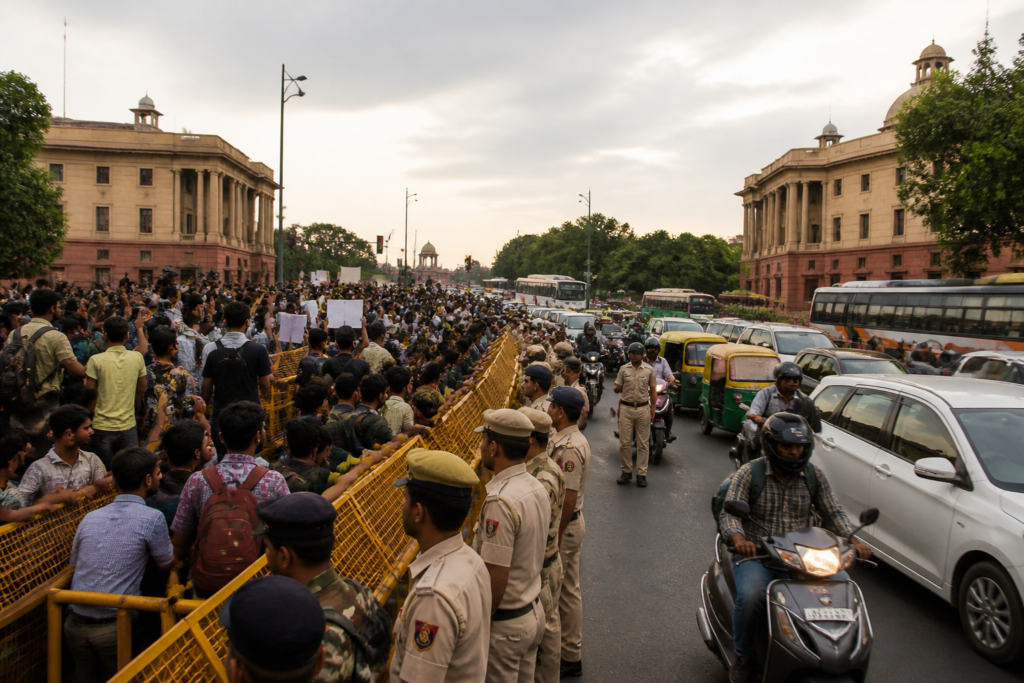
Delhi anti-SIR protests entered their fifth consecutive day on Wednesday as students and political workers marched at multiple locations in central Delhi, prompting large-scale police deployment, detentions and traffic restrictions. Demonstrators were protesting the special intensive revision of electoral rolls, demanding the resignation of Chief Election Commissioner Gyanesh Kumar and opposing the removal of Jantar Mantar’s designated protest-site status.
At Firoz Shah Road, members of the Students’ Federation of India and the Democratic Youth Federation of India began a march before police and security forces moved to control the gathering. Protesters climbed over barricades and raised slogans against Mr. Kumar. Placards displayed messages including “We are Indians, not terrorists” and “Protest, not silence, is the lifeblood of democracy”.
Police began detaining protesters who sat on the road. Several demonstrators were pushed or bundled into detention vehicles by personnel from the Delhi Police, the Rapid Action Force and the Central Reserve Police Force. The number of people detained was not immediately available.
“We were detained; we were beaten up earlier also. By beating us, they cannot shut us up. Our protests will go on. Until Gyanesh Kumar resigns, we will remain on the roads. We will not back down,” a protester said.
A separate march by Indian Youth Congress workers began near Patel Chowk Metro Station, about 800 metres from the other protest site. Carrying party flags and placards, the marchers moved towards Jantar Mantar after initially sitting outside the metro station amid a heavy security presence. The procession was stopped near the Parliament Street police station, where protesters were detained and placed in buses. Some climbed on top of the vehicles and continued raising slogans as police cleared the area.
Police warned against unauthorised processions, protests and gatherings, citing Section 163 of the Bharatiya Nagarik Suraksha Sanhita. Barricades and security deployments were placed at both locations, turning the protest sites into tense standoffs between demonstrators seeking to remain on the roads and police personnel attempting to disperse them.
The restrictions affected movement through parts of the New Delhi district. Road closures, barricading and diversions introduced for security arrangements caused congestion during the afternoon, leaving commuters to navigate slow-moving traffic and altered routes. The disruption highlights the operational impact that prolonged demonstrations in the capital’s central administrative district can have on public movement and access to major roads and metro approaches.
The protests began on October 10, when the Cockroach Janta Party called for a demonstration against the SIR exercise and the Chief Election Commissioner. On Tuesday, student and youth organisations including the Disha Students’ Organisation, the National Students’ Union of India, the All India Students’ Federation, the Bhim Army and the Krantikari Yuva Sangathan held marches and flash protests at different locations.
The latest demonstrations also followed the judicial custody of CJP leaders Saurav Das and Ashutosh Ranka. They were sent to jail after entering the now-denotified Jantar Mantar protest site on Tuesday, according to the report.
Amid allegations of assault and manhandling involving journalists, police instructed media representatives covering the protests to maintain a “safe distance” from protesters and police personnel and not enter the crowd. Further demonstrations and police restrictions are expected to determine traffic conditions and access around central Delhi’s protest and government districts.


