

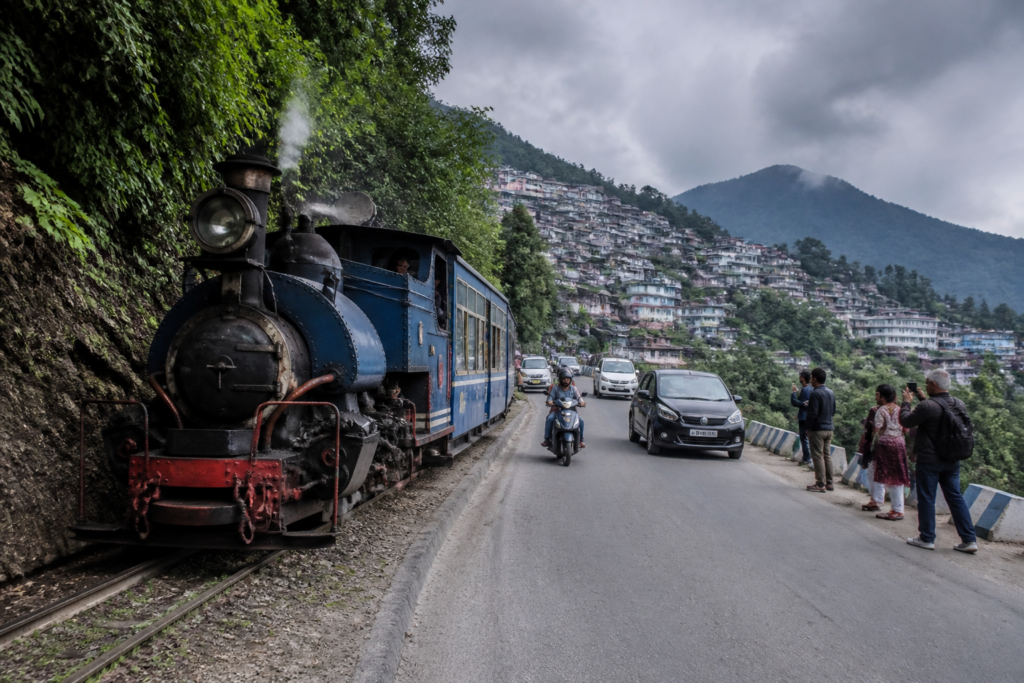
The Darjeeling Himalayan Railway’s decision to increase surveillance and act against illegal parking and obstruction along its route follows a collision involving a car, the heritage toy train and a scooter on October 11. The incident, captured in a viral social-media video, has brought renewed attention to the safety risks created where the hill railway line and vehicle routes run extremely close to each other.
According to a report by Sangbad Pratidin – Bengal, a tourist leaned out of a car window to record the moving steam-powered train. The car was driven close to the train while the video was being made, and contact occurred between the car and the locomotive. The car then hit a scooter, throwing a couple riding it onto the road. Police later seized the car and initiated legal action against its driver.
The incident is significant not only because of the unsafe behaviour captured in the footage, but also because it shows how a heritage railway corridor can become a shared and poorly disciplined space for trains, private vehicles, two-wheelers, pedestrians and tourists seeking photographs. The available report describes parts of the hill route where the road and railway line run alongside each other, leaving little separation between moving trains and road traffic.
Rishabh Choudhury, director of the Darjeeling Himalayan Railway, said the toy train is Darjeeling’s pride and heritage. He appealed to tourists and drivers to maintain distance when trains are operating and warned that leaning out of vehicle windows to record videos or make reels could result in serious danger. The warning followed earlier appeals that, according to the report, had not prevented similar behaviour.
The railway authority has now decided to work with the local administration and police against violations that obstruct train movement or involve illegal parking. It also plans to increase traffic discipline and surveillance in areas adjoining the railway route. The reported response places responsibility across several institutions rather than treating the incident only as a case of individual recklessness.
That distinction matters in corridors where the boundaries between transport systems are not clearly protected. A road user may be able to stop or park close to the track, while a train operating on a fixed alignment cannot move away from an obstruction. When tourists deliberately bring vehicles close to a moving locomotive for a video, the risk is therefore not limited to the occupants of that vehicle. It can extend to people using the road, railway staff, passengers and anyone forced to react to a sudden collision or obstruction.
The October 11 footage also shows the difficulty of relying on warnings alone. The railway authority had previously urged tourists and drivers to maintain a safe distance, but the reported incident indicates that the warning did not prevent a driver from bringing a car close to the train. The enforcement decision is consequently a shift from general advice towards joint monitoring and legal action.
The source report says the driver later alleged that the train had been operating on the wrong side. Police, after examining footage recorded from inside the car, reportedly concluded that the driver had moved close to the train while attempting to film and had also tried to park dangerously on the road. That sequence underlines the importance of recorded evidence in determining responsibility when road and rail movements intersect.
The case also raises a question about how heritage transport is managed in heavily visited landscapes. The railway is presented as an important part of Darjeeling’s identity, but its continued operation depends on safe coexistence with modern road traffic and tourism activity. A heritage designation does not remove the operational risks associated with a live railway corridor. It can, however, increase the need for careful management because the railway itself is part of the visitor experience.
The reported demand for buffer zones along the hill route reflects this conflict. Local residents and tourists have sought stronger traffic surveillance and greater separation where roads and tracks run close together. The supplied report does not establish whether a formal buffer-zone plan has been approved, how much land would be required, or which agency would finance and implement such a measure. It does establish that the demand has emerged after repeated incidents involving people attempting to record videos or reels near the moving train.
This is also an administrative coordination problem. The railway authority controls train operations, while local administration and police have powers relating to traffic, parking and public safety. A train operator can issue safety appeals and report obstructions, but preventing vehicles from stopping in dangerous locations requires enforcement on the road. The decision to act jointly acknowledges that neither side can manage the entire risk in isolation.
The available evidence points to three immediate pressure points. The first is behaviour: tourists and drivers are using an active transport corridor as a backdrop for social-media content. The second is space: in some stretches, the road and heritage railway line are described as running alongside each other with minimal separation. The third is enforcement: repeated warnings have not been sufficient, leading the railway and authorities to consider stronger surveillance and action against parking and obstruction.
The incident therefore should not be understood only as a warning about making reels. It is a test of whether a live railway can safely share a narrow, high-pressure corridor with tourist traffic. The focus on social-media filming identifies the immediate trigger, but the underlying management challenge is broader: keeping vehicles, pedestrians and trains apart in locations where physical space is constrained and visitor activity is intense.
The report does not provide figures for the number of earlier accidents, the length of the affected stretches, the number of enforcement personnel or the frequency of illegal parking. It also does not specify the precise legal provisions used against the driver or set out a timetable for the proposed surveillance expansion. Those gaps limit the extent to which the incident can be measured against a wider safety trend.
What is clear is that the railway authority has linked the collision to a renewed enforcement programme. The next stage will depend on how the joint action with police and local administration is carried out on the ground: whether dangerous stopping points are monitored, whether obstructions are removed promptly and whether road users are prevented from approaching moving trains for photographs or videos.
For Darjeeling, the immediate issue is public safety around a functioning heritage railway. The longer institutional question is whether a corridor shared by trains and road traffic can remain safe without stronger separation, consistent traffic control and coordinated enforcement. The railway’s announced measures provide the first response; their effectiveness will be judged by whether similar obstructions and close-contact incidents are prevented.


