

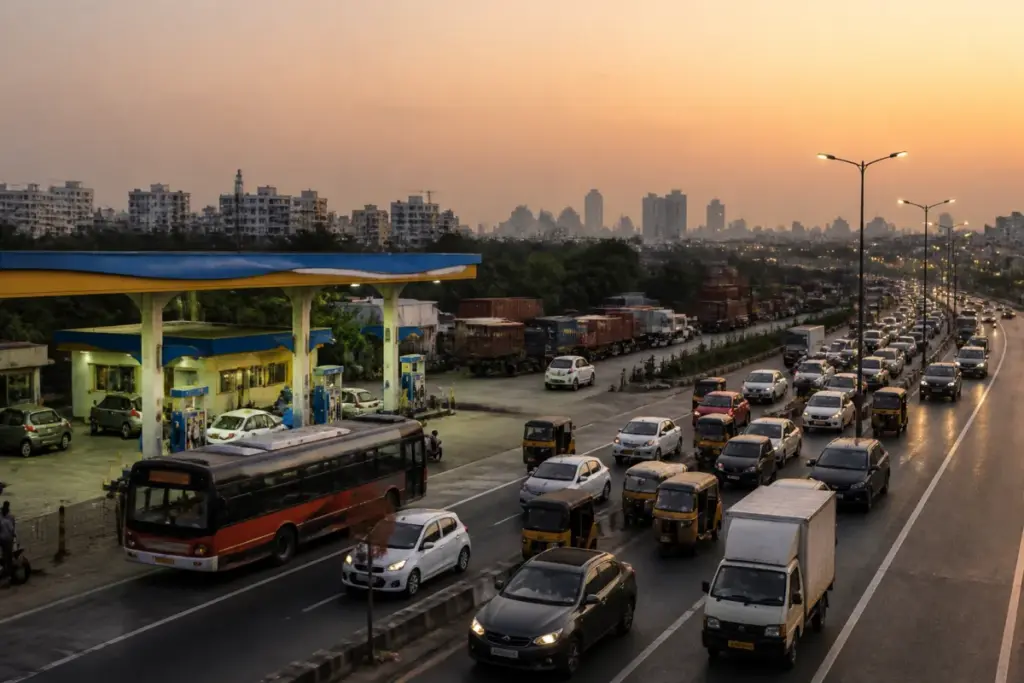
Crude oil rising to around $110 a barrel has reopened a familiar vulnerability for India: an external energy shock can quickly become a domestic urban cost problem. The immediate concern is not limited to petrol and diesel prices. Higher crude costs can move through freight, public and private transport, manufacturing, construction inputs and household budgets, making energy markets an important part of how Indian cities function.
According to a report by Aaj Tak Business, Brent crude reached $110 a barrel on 16 October, its highest level since May, before closing at $109.86. US West Texas Intermediate rose 3.5% to $101.41 a barrel. During the week, WTI gained more than 10%, while Brent increased by about 5%. The report linked the movement to geopolitical tensions in the Middle East and eastern Europe, including risks around important maritime routes and energy infrastructure.
The significance of the price movement lies in its potential transmission into the real economy. Crude oil is traded globally, but its effects are experienced locally. In cities, fuel is embedded in daily mobility and in the movement of food, construction materials, consumer goods and industrial supplies. A rise in the international benchmark therefore creates pressure well beyond filling stations.
The first channel is transport. Petrol and diesel costs influence the operating expenses of cars, buses, goods vehicles, taxis and other road-based services. The Aaj Tak Business report said experts expect higher crude prices to affect retail fuel costs, transport expenses and manufacturing costs. If the rise is sustained, logistics operators may face higher costs for moving goods between ports, warehouses, markets and neighbourhoods.
That matters because the urban economy depends on continuous movement. A city is not only a concentration of buildings and roads; it is also a daily system of deliveries, commuting, service calls and waste collection. Higher fuel expenses can place pressure on businesses that operate on narrow margins, particularly transport-dependent firms. The cost may then be passed on through product prices, service charges or delivery fees.
The second channel is manufacturing. The report said manufacturers could increase product prices if transport costs rise. The precise impact would vary across sectors, depending on the amount of fuel used directly, the distance goods travel and the ability of companies to absorb additional expenses. But the direction of pressure is clear: when energy and transport become more expensive, businesses face a difficult choice between reducing margins and charging more.
For urban households, this can create a layered impact. A family may face higher expenditure on personal travel, while also paying more for goods that have travelled through several stages of production and distribution. The effect can be particularly visible in households that depend on private vehicles or informal and app-based transport. The supplied report does not provide a forecast for Indian petrol or diesel prices, nor does it establish how quickly any global crude increase would reach consumers. That pass-through remains dependent on domestic pricing decisions and market conditions.
The third channel is infrastructure and construction. Roads, buildings, metro systems, water networks and other urban projects require materials to be transported and machinery to be operated. The report does not quantify the effect on construction costs or identify specific Indian projects at risk. However, its reference to higher manufacturing and transport expenses points to a wider cost environment in which infrastructure contractors and suppliers may face pressure if fuel prices remain elevated.
This is important because urban infrastructure is delivered through long chains of procurement. A project may involve quarries, factories, warehouses, contractors and construction sites spread across different locations. Fuel is not necessarily the largest cost in every project, but it supports the movement of materials and equipment across the chain. A sustained energy shock can therefore become one more pressure on project budgets and operating decisions.
The reported rise was associated with simultaneous risks in the Strait of Hormuz and Bab al-Mandeb, two important energy and shipping corridors. The report said that disruptions or threats in these routes raised concerns about commercial shipping and petroleum transport. It also referred to tensions involving Iran, attacks by the Houthis on Saudi Arabia and continuing conflict in eastern Europe, including the risk of attacks on Russian refineries by Ukraine.
These geopolitical developments matter to urban economies because energy markets respond not only to actual supply losses but also to fears about future disruption. When traders assess that oil production, refining or shipping may be affected, prices can move before a prolonged physical shortage is established. For cities, this creates uncertainty for businesses and public agencies that must plan transport and operating costs in advance.
The report’s central warning is therefore about volatility as much as the absolute price. Brent crossing three digits signals a sharp change from the lower price environment that businesses and households may have been budgeting for. A short-lived spike and a sustained period above $100 would have different consequences, but the supplied material does not establish how long the current rise will continue. That distinction is critical before making any firm prediction about inflation or urban costs.
India’s exposure is linked to its dependence on imported crude, according to the report. This means international prices can influence domestic energy costs even when the trigger is outside the country. The transmission is not automatic or uniform: taxes, currency movements, domestic pricing practices, inventory levels and policy decisions can affect the final price paid by consumers and businesses. None of these factors is quantified in the supplied report, so the article cannot establish the likely size of the impact on Indian inflation.
Still, the institutional question is clear. A crude oil shock is first experienced through global markets, but its management involves domestic authorities, fuel retailers, transport operators, manufacturers and urban consumers. Decisions on fuel pricing influence mobility costs. Decisions by businesses influence the price of goods and services. Public transport agencies and municipal bodies must manage their own operating pressures. The result is a distributed urban impact rather than a single policy problem.
The situation also highlights the difference between energy dependence and urban resilience. Cities with extensive road-based movement are more exposed to fuel-price changes because daily economic activity depends heavily on vehicles. The supplied report does not compare Indian cities or provide data on the fuel intensity of different transport systems. It therefore cannot show which cities or urban sectors would be most affected. But its account points to the importance of monitoring transport costs alongside headline crude prices.
The same applies to households. A crude oil increase does not affect every resident equally. Commuters with long daily journeys, small businesses dependent on deliveries and workers whose earnings are tied to vehicle operations may feel the pressure sooner than households with lower transport exposure. The report does not provide household-level evidence, income data or city-specific price estimates. These gaps limit the precision of any assessment of distributional impact.
What the available evidence confirms is narrower but significant. Brent crude reached $110 on 16 October, WTI crossed $101, and both benchmarks recorded strong weekly gains. The movement was reported against a backdrop of geopolitical tension affecting major energy and shipping corridors. Experts cited by Aaj Tak Business warned that a prolonged rise could increase fuel, transport and manufacturing costs and add to inflationary pressure in India.
What remains uncertain is whether the price increase will persist, how much of it will pass through to Indian fuel prices, and which urban sectors will bear the largest burden. Those questions require further price data, official responses and sector-level evidence. The next developments to monitor are the duration of the crude rally, movements in domestic petrol and diesel prices, transport-cost changes and any response from Indian authorities or major fuel and manufacturing companies.


