

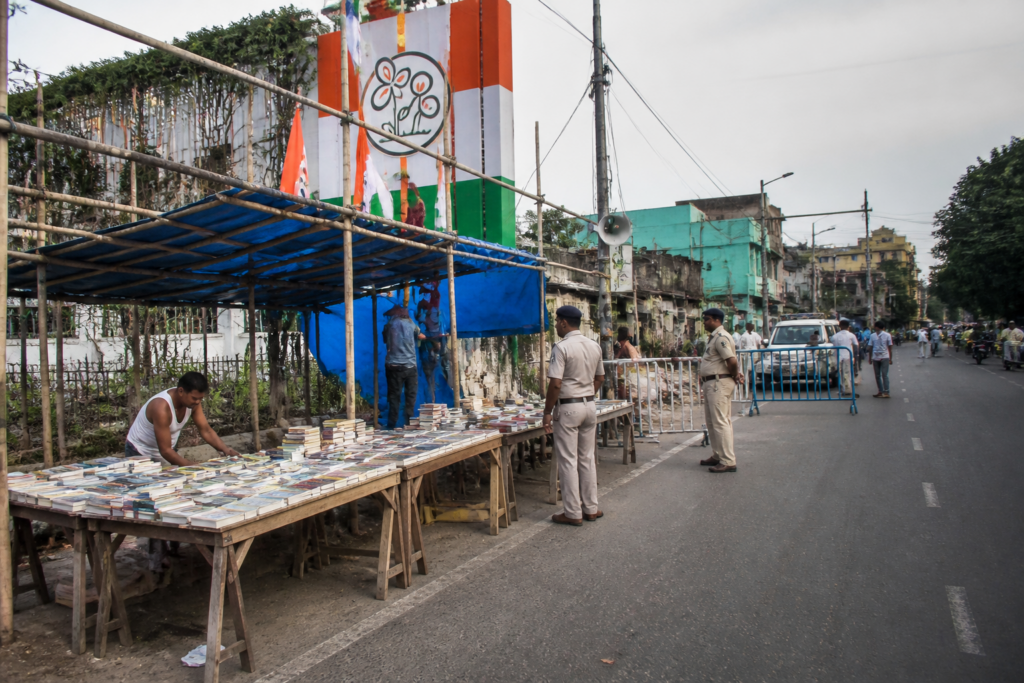
The Calcutta High Court has allowed the Communist Party of India (Marxist) to set up a book stall in Bongaon during Durga Puja, while directing the state and police to ensure equal enforcement of rules governing temporary structures and maintain peace around the site.
Justice Sougat Bhattacharyya permitted the CPIM to establish the stall within 100 metres of its party office. The court also directed the police to ensure that there is no disturbance while the stall is being built or during its operation. Adequate police personnel must be deployed to maintain law and order, according to the report.
The district Superintendent of Police has been asked to submit a report to the High Court on November 23. The direction follows a dispute over whether the proposed stall required permission from the highway authority and whether the administration had applied the same standard to other temporary structures in the area.
During the hearing, West Bengal Advocate General Surjit Nath Mitra argued that construction on a highway was not permissible without approval from the highway authority. He sought dismissal of the request to allow the book stall. The state also maintained that the police could not provide security or assistance for construction activity.
The court questioned why the CPIM should be required to obtain separate permission when other parties had erected stalls without obtaining permission. Justice Bhattacharyya said different rules could not be applied to different parties and that the law had to operate equally. The judge also questioned whether selective intervention by authorities could create instability in the area.
The court directed that existing temporary structures be removed within 24 hours, according to the report, and asked the state to frame a specific policy within one year. Justice Bhattacharyya said the state must adopt a neutral position in such matters. The court also told the highway authority to remove the constructions within the specified period.
Additional Advocate General Bilwadal Bhattacharyya said the CPIM had not sought permission from the Public Works department. He further submitted that the owner of the building housing the CPIM office had permitted the Hindu Jagran Manch to construct a stall.
The court’s order places the immediate dispute within a wider administrative question: how local authorities regulate temporary structures during public festivals when roads, highways, party offices and community activities overlap. The order, as reported, does not remove the requirement to comply with applicable permissions. It allows the CPIM stall while requiring police supervision, a defined location and a subsequent report from the district police chief.
The next formal step is the submission of the Superintendent of Police’s report to the High Court on November 23. The state has also been given one year to formulate a specific policy for such temporary constructions.


