

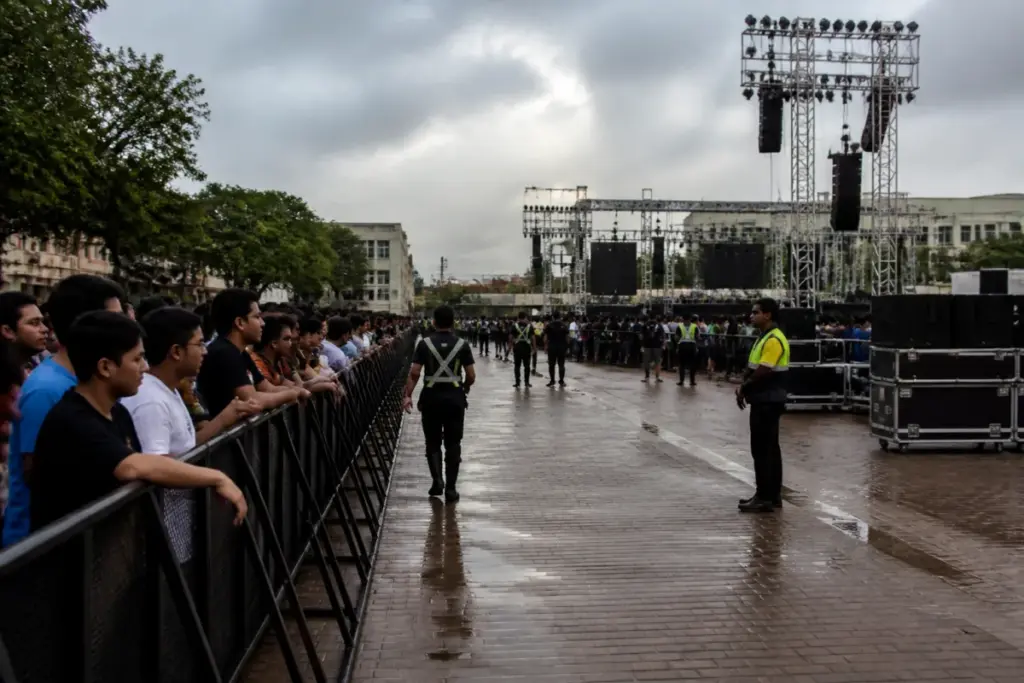
The death of a student and injuries to several others after a lighting structure collapsed during Dandiya celebrations at MVSR Engineering College in Nadargul have exposed a wider weakness in college event safety: large gatherings are being organised in spaces that may not be designed, inspected or managed for the risks created by temporary infrastructure and dense crowds.
The incident has also revived concerns raised after a sound equipment structure collapsed during a pre-release event for actor Yash’s film ‘Toxic’ at Malla Reddy University in Maisammaguda on August 22. Several people were injured in that incident. Taken together, the two accidents have shifted attention from individual failures to the way educational institutions plan, approve and supervise large public events.
Student unions have argued that colleges should treat safety as a core institutional responsibility rather than allow campuses to function as venues for commercial-scale entertainment. Students Federation of India secretary Nagaraju said educational institutions should avoid bringing celebrities to campuses for large events and alleged that colleges were conducting events as a business. He demanded a government inquiry and a committee to prevent similar incidents.
The evidence in the reported incidents points to three connected risks. The first is the structural safety of temporary installations. Lighting towers, sound equipment, stages and other event infrastructure are often assembled for a limited period, but their failure can have consequences similar to those of permanent structures when large crowds are present. The second is crowd management. Even a structure that remains stable can become dangerous if people are compressed into confined areas or if movement routes are poorly planned. The third is emergency response, including access for medical teams, clear evacuation routes and accountability when arrangements fail.
These risks are not confined to college festivals. Large gatherings in Hyderabad have also raised concerns over crowd movement, vehicle management and emergency care. On September 5, 19-year-old BTech student S. Badrinath died after collapsing amid a large crowd during a Ganesh idol Aagaman procession in Ramnagar. Police said there was no stampede and suspected asphyxiation. A traffic reserve sub-inspector attempted CPR before the student was taken to Gandhi Hospital, where he was declared dead. Musheerabad police registered a case as a suspicious death and began an investigation.
On September 25, a 24-year-old delivery worker, Shiva, died after slipping under the wheels of a lorry carrying a Ganesh idol near Khairatabad crossroads. Police said he had attempted to board the vehicle while walking alongside it. The circumstances differed from the college incidents, but the cases underline the range of hazards that can emerge when people, vehicles, temporary installations and large crowds occupy the same public environment.
The common thread is not that every gathering has the same cause of danger. It is that safety depends on several systems working together before an event begins. A temporary lighting tower requires stable installation and inspection. A large campus event requires crowd-flow planning and controlled access. A procession requires separation between pedestrians and moving vehicles. Medical arrangements must be capable of responding quickly when a person collapses or suffers an injury.
Student unions have called for college managements and authorities to take responsibility for crowd management, ensure emergency medical arrangements and inspect temporary structures before events. They have also demanded formal safety procedures and accountability for lapses. These demands identify a governance gap: responsibility for an event may be distributed among college administrators, event organisers, contractors, police, traffic officials and medical responders, while the public experience of failure is concentrated on students, visitors and workers at the venue.
The reported incidents do not establish whether the lighting structure at MVSR Engineering College failed because of faulty design, poor installation, inadequate inspection, overloading or another cause. They also do not establish whether the structure at Malla Reddy University was approved or inspected under a specific process. Those questions are central to any inquiry because prevention depends on identifying the precise point at which a safety system broke down.
That uncertainty is important for policy. A call for more safety is not sufficient unless it is converted into a process that can be checked. Before a large event, institutions and authorities would need to know who has examined temporary structures, who has assessed the expected crowd, who has approved the layout and who is responsible for emergency access. After an incident, an inquiry would need to establish whether those steps were completed and whether records existed to demonstrate compliance.
The college setting makes the issue particularly significant. Campuses are usually treated as controlled institutional spaces, but large cultural programmes and celebrity events can transform them into temporary public venues. The scale of attendance, the presence of visitors unfamiliar with the campus and the installation of stages, lighting and sound systems can create conditions that differ sharply from normal college operations. Institutional familiarity with everyday campus management does not automatically amount to expertise in event safety.
The report also raises a question about the commercialisation of campus space. Student unions allege that colleges are treating events as business activities and commercial attractions. That allegation requires investigation rather than assumption, but it identifies a structural tension. When an institution seeks the visibility or revenue associated with a large event, the operational demands of the programme can expand faster than its safety systems. The more a campus resembles a concert venue, film promotion site or public festival ground, the more clearly it must define the standards that apply to that use.
The incidents described in Hyderabad show why safety cannot be reduced to crowd control alone. A crowd can be orderly and still be exposed to an unsafe tower. A temporary structure can be properly installed and still become dangerous if people are directed into an unsuitable area. A medical team can be present but ineffective if it cannot reach a casualty quickly. Safety therefore depends on the interaction between infrastructure, movement, supervision and response time.
The available report does not provide figures on crowd sizes, the specifications of the collapsed structures, inspection records, venue capacities or the number of medical personnel deployed. Without those details, it is not possible to compare the incidents quantitatively or determine whether a particular type of event presents the highest risk. It is, however, possible to identify a recurring administrative requirement: event permissions and institutional approvals must be matched by verifiable safety arrangements.
The next stage should be determined by the investigations into the incidents and by the response of college managements and authorities. A government inquiry, as demanded by student unions, could clarify responsibility and examine whether existing procedures are adequate. The reported calls for structure inspections, emergency medical arrangements, crowd-management plans and accountability provide a framework for that examination.
What the evidence confirms is that Hyderabad’s large gatherings are placing multiple forms of temporary urban infrastructure under pressure. What remains unclear is whether the institutions organising these events have a consistent system for assessing that pressure before people arrive. That question, more than the branding or scale of any individual programme, will determine whether campuses can safely host events that function like public venues.


