The Chorebagan stampede, in which 19 people were killed during Durga Puja celebrations, has drawn attention to a less visible part of public-event safety: the institutional knowledge required to manage crowds in dense, narrow neighbourhoods. Reporting by The Telegraph India indicates that the local Puja committee was reconstituted twice within a month, with experienced members resigning to make way for new entrants, while survivors and residents alleged failures involving exits, lighting, announcements and coordination.
The incident is therefore not only a question of what happened inside a pandal on a rainy evening. It also raises a governance question about who understands a locality’s physical constraints, who is responsible for crowd-flow decisions and how that responsibility is shared between organisers, police and local representatives. The available account does not establish a final cause of the stampede, but it sets out several conditions that can turn a temporary congestion into a fatal crush.
According to The Telegraph India, seven people, including four members of the new Puja committee, were arrested after the incident. The report said that none of the BJP leaders associated with the committee had been arrested at the time of publication. The committee included Bijay Ojha, the BJP MLA from Jorasanko; Debdeep Adhikari, identified as the nephew of West Bengal chief minister Suvendu Adhikari; and Tamaghna Ghosh, the BJP’s north Calcutta district president.
The political changes within the committee are relevant because the report links them to a loss of operational experience. Eight members of the previous committee, including former general secretary Jayanta Banerjee, had resigned to make way for new members. Banerjee told the newspaper that BJP leaders, including Locket Chatterjee and Kaustuv Bagchi, attended the first khuti puja organised by the old committee, after which the new committee held a second khuti puja within the same month.
Ojha, who was described as the local MLA and Puja committee chairman, denied that the BJP had tried to take complete control of the committee. He said he had been made chairman as the local representative and that his constituency had 105 Durga Pujas. On the stampede, he described the incident as heart-wrenching before ending the conversation, according to the report.
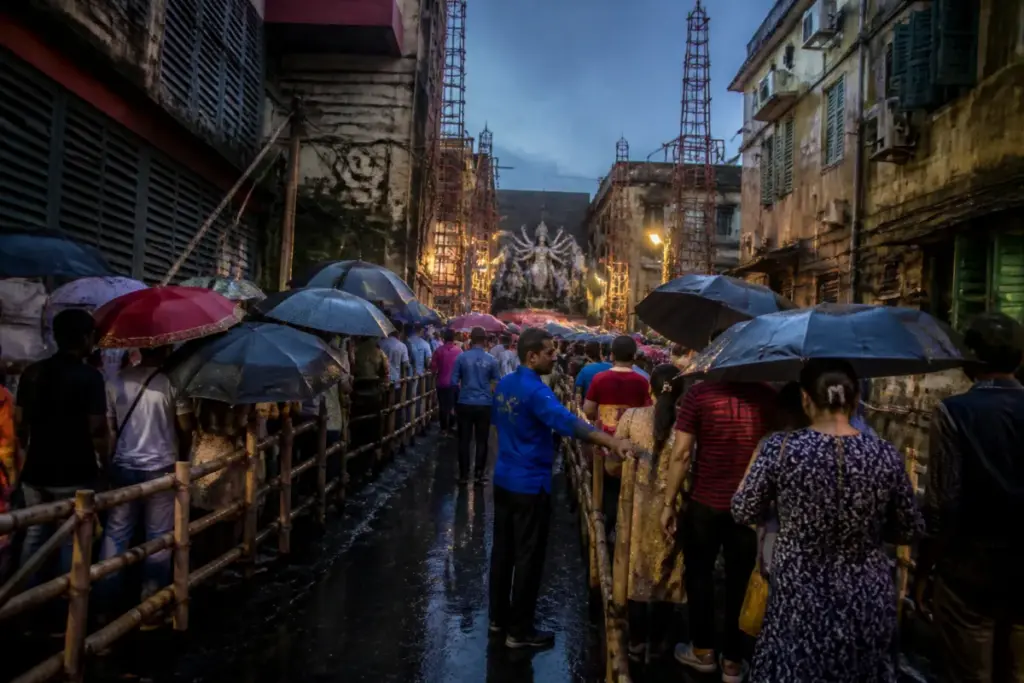
The physical setting described in the account helps explain why local knowledge mattered. Former committee members said the road leading to the Chorebagan Sarbajanin Durgotsav Samity pandal was narrow and winding, particularly near the main entrance, where it resembled a “chicken’s neck”. One former member said years of experience had led organisers to place volunteers with ropes at several points along Amar Basu Sarani to stagger the flow of people.
That arrangement also included a buffer zone separating visitors entering the pandal from those waiting in the queue. The former member said the buffer zone was not in place during the incident. A senior resident told the newspaper that some new committee members did not know the locality and that there was no coordination between police personnel and Puja committee members.
These details point to crowd management as a spatial problem rather than merely a manpower problem. A narrow approach road, a constrained entrance and a winding exit corridor can create opposing flows even when the number of security personnel appears adequate. A queue that is stable in dry weather may behave differently when people are seeking shelter from rain. If people entering, waiting and leaving occupy the same limited space, pressure can build quickly once an unexpected announcement or physical obstruction changes movement patterns.
The report said that eyewitnesses described a drizzle turning into a shower on Saturday evening. People waiting to enter allegedly began pushing forward to avoid getting wet. The situation was further complicated by an announcement about the possible collapse of part of the pandal, which created panic and a surge towards the exit. Those near the exit were reportedly waiting for the rain to stop before leaving, producing congestion in the narrow, winding corridor.
An eyewitness told the newspaper that people inside began screaming as some fell and were unable to withstand the pressure from behind. Others complained of breathlessness, asked for water or called out for relatives. These accounts describe the human consequences of a crowd losing the ability to move at its own pace, but they do not by themselves establish which specific decisions caused the deaths. That determination would depend on the investigation and any official findings not included in the supplied report.
The testimony from other Puja organisers offers a wider operational context. Several large Puja organisers told The Telegraph India that crowd management is a skill acquired over years and requires active involvement by committee members. One senior organiser said that experienced members should be able to assess their strengths and weaknesses, intervene when rain changes visitor behaviour, break queues when necessary, move people to covered areas and coordinate with those managing exits.
The same organiser said that a committee cannot rely only on hired guards and police personnel, and that members must remain present to manage the crowd. This distinction matters institutionally. Police can regulate traffic, provide security and respond to emergencies, but organisers often control the detailed design of queues, entrances, barricades, volunteer deployment and public announcements. When these responsibilities are not clearly coordinated, the crowd encounters a fragmented safety system.
The Chorebagan account also shows why a committee’s formal composition can have consequences beyond internal politics. A change in membership may alter who knows the lanes, who has managed previous peak crowds, who can identify bottlenecks and who can act quickly when conditions change. The report does not establish that committee changes directly caused the stampede. It does, however, record repeated concerns from former members and residents that local familiarity and practical experience had weakened.
There is also an accountability gap visible in the information available so far. Arrests have been reported, but the supplied account does not specify the full investigative findings, the precise charges against each person, the approved crowd-capacity plan, the deployment arrangements or the formal division of responsibility between the Puja committee and police. It also does not provide an official reconstruction of the sequence involving the rain, the announcement, the entry queue and the exit corridor.
That missing information is important because public-event safety cannot be assessed only through the final casualty count. It requires documents and decisions: site plans, route maps, entry and exit calculations, emergency access arrangements, lighting provisions, public-address protocols, weather contingencies and records of coordination meetings. None of these materials is included in the supplied report, so the wider institutional responsibility remains to be established.
The immediate urban lesson is that temporary religious installations function as high-density public infrastructure during peak hours. They reshape roads, pedestrian routes and neighbourhood access for short periods, often in places that were not designed for large, simultaneous inflows and outflows. Their safety depends on the interaction of built form, event management and public administration. A committee change, a missing buffer zone or a poorly understood exit can therefore become an infrastructure risk even though the event itself is temporary.
For Kolkata’s Puja season, the Chorebagan tragedy places renewed attention on the connection between local experience and formal safety planning. The available evidence confirms that the site had narrow and difficult movement corridors, that committee membership had changed shortly before the event and that witnesses and organisers described failures in crowd control and coordination. It does not yet establish the complete chain of responsibility. The next significant developments are the findings of the investigation, the basis of the arrests and any official review of the pandal’s crowd-management arrangements.