

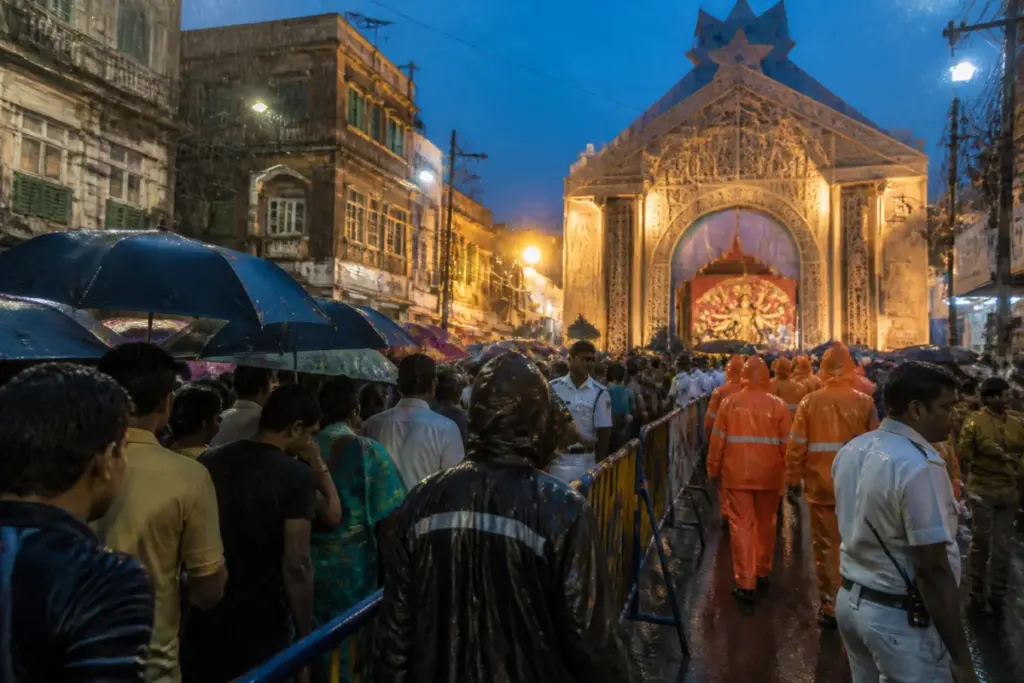
The reported Chorbagan stampede in north Kolkata has raised urgent questions about crowd management, temporary pandal design and emergency response after a Bengali news report said 19 people died and more than 35 were injured during heavy rain on Saptami evening. The figures and the precise sequence of events remain subject to official confirmation, as the report said Kolkata Police had not issued a formal statement at the time of publication.
According to Sangbad Pratidin, the incident took place at the Chorbagan Sarbojanin puja venue, located inside a narrow lane in north Kolkata. The report said the pandal had attracted unusually large crowds after receiving publicity through news coverage and video bloggers. By around 6.30 pm, the queue reportedly extended along Central Avenue towards Mahatma Gandhi Road Metro station.
The account said heavy rain began at approximately 7 pm, prompting a large number of visitors to try to enter the pandal at the same time. A section of the structure reportedly collapsed during the resulting pushing and crowd surge at around 7.15 pm. The report further said people began rushing down from an elevated passage through a staircase, with the reported stampede taking place at around 7.20 pm.
The source attributed the reported deaths primarily to suffocation under crowd pressure, while also saying that more than 35 people were trampled or injured. Bodies and injured people were reported to have begun arriving at Medical College Kolkata at around 7.40 pm. The report said Chief Minister Shuvendu Adhikari, state industry minister Tapas Roy, the director general of police and the Kolkata police commissioner reached the hospital at around 9 pm. These details require confirmation from official authorities and hospital records.
The report identified several possible factors behind the incident, but did not establish them as verified findings. Eyewitnesses and local sources reportedly pointed to the narrow access route, limited space inside the pandal, prolonged crowding and a sudden attempt by visitors to move indoors to escape the rain. The report also cited claims that confusing announcements were made from the pandal, potentially increasing uncertainty among visitors.
Crowd-control arrangements are another focus of the reported allegations. Local residents said the scale of the crowd had been predictable, yet questioned whether enough police personnel had been deployed. They also raised concerns about the experience of volunteers managing the queues and the reported shortage of ambulances after the incident. The report said police sources, however, maintained that the administration had attempted to control the crowd from the beginning but that the volume of visitors, combined with the rain, overwhelmed the situation.
The account also referred to concerns over VIP queue management, saying that crowd control arrangements may have been affected by the attention given to such access. This remains an allegation in the supplied report and has not been independently established. No official inquiry findings, casualty bulletin, structural assessment or documented emergency-response timeline was included in the source material.
The incident highlights the risks created when temporary public structures, narrow urban access routes, weather disruption and large festival crowds converge in a dense city neighbourhood. Establishing responsibility will require an official death and injury count, medical records, police and municipal statements, examination of the pandal structure, and a reconstruction of entry, exit and evacuation arrangements.
The immediate next steps are official confirmation of the casualty figures, a formal account of the incident by the police and civic authorities, and any inquiry into crowd management, structural safety, emergency access and the deployment of personnel and ambulances. Until those records are released, the details in this report should be treated as preliminary and attributed to the supplied source.


