

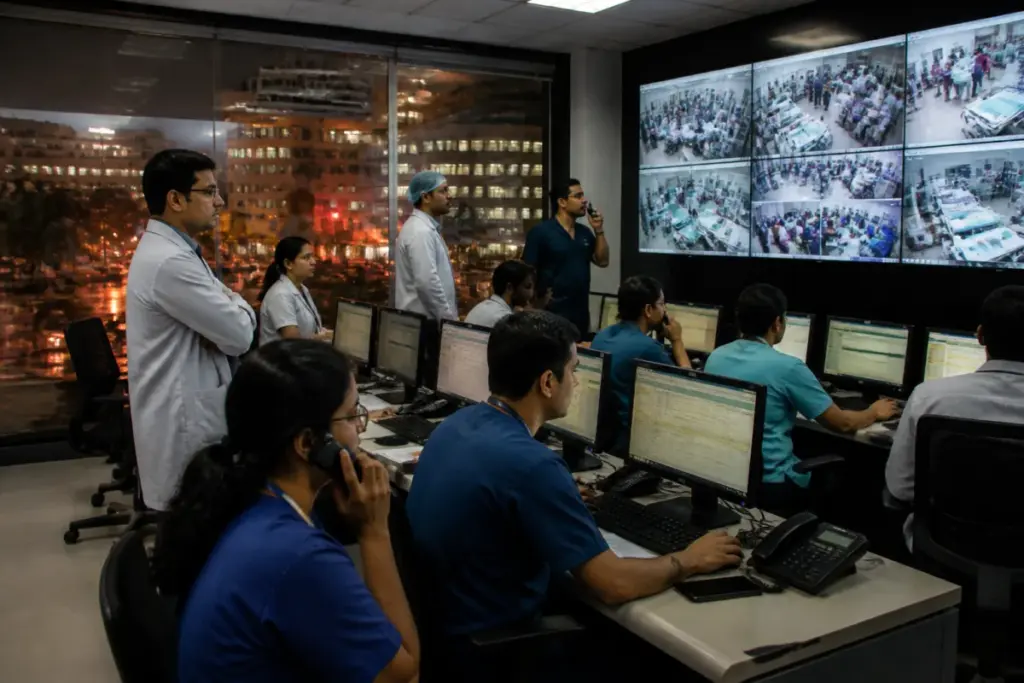
West Bengal Chief Minister Suvendu Adhikari has defended the decision to send people injured in the Chorbagan stampede to private hospitals, saying the move was taken to prevent further deaths during the Durga Puja period. He made the remarks while reviewing emergency preparedness at the state Health Department’s control room on Navami night.
The chief minister said the decision to refer injured people to private facilities was taken at the site because the immediate priority was to save lives. “We decided to send the injured to private hospitals at the spot so that the number of deaths would not increase,” he said, according to Sangbad Pratidin – Kolkata. He added that no further deaths were reported after the injured were sent to private hospitals.
Adhikari also said that some patients died while undergoing treatment, but rejected the suggestion that the deaths occurred because of the referral decision. “After sending them to private hospitals, not a single person died. Many died during treatment. That did not happen,” he said, as reported by the publication.
The remarks came during an unannounced visit to the Health Department’s control room, where the chief minister monitored conditions at hospitals across Kolkata and other parts of West Bengal through a large display screen. Health Minister Sharadwata Mukhopadhyay accompanied him during the review.
The control-room visit took place as large crowds gathered on roads in Kolkata and its suburbs for the final days of Durga Puja. With Vijaya Dashami approaching, the state was also reviewing arrangements at immersion sites, where additional security measures had been put in place, the report said. The health review was intended to assess how prepared the department was to respond if accidents occurred amid the festival crowds.
The chief minister acknowledged that government hospitals have infrastructure shortcomings and said improvements comparable to private hospitals would take time. “There are some shortcomings. It will take two years to improve the infrastructure like private hospitals. It has only been six months,” he said, according to the report.
His comments place emergency referrals within a wider question about the capacity of public hospitals to manage sudden surges in casualties during major public gatherings. The decision to use private facilities can expand treatment capacity during a crisis, but it also makes coordination between public authorities and private hospitals central to the response. The report does not provide details of the number of injured people referred, the private hospitals involved, or the arrangements governing their treatment.
Adhikari also said the government would examine whether doctors and junior doctors who had commented on the referrals were on duty when the incident occurred. He said leaving assigned duties to undertake other activities would be against service rules and inappropriate from a humanitarian standpoint.
The chief minister’s visit ended with the state continuing its festival-period monitoring of hospitals, roads and immersion sites. The government is expected to examine the conduct of medical staff involved in the response and continue work on improving infrastructure at public hospitals over the next two years.


