

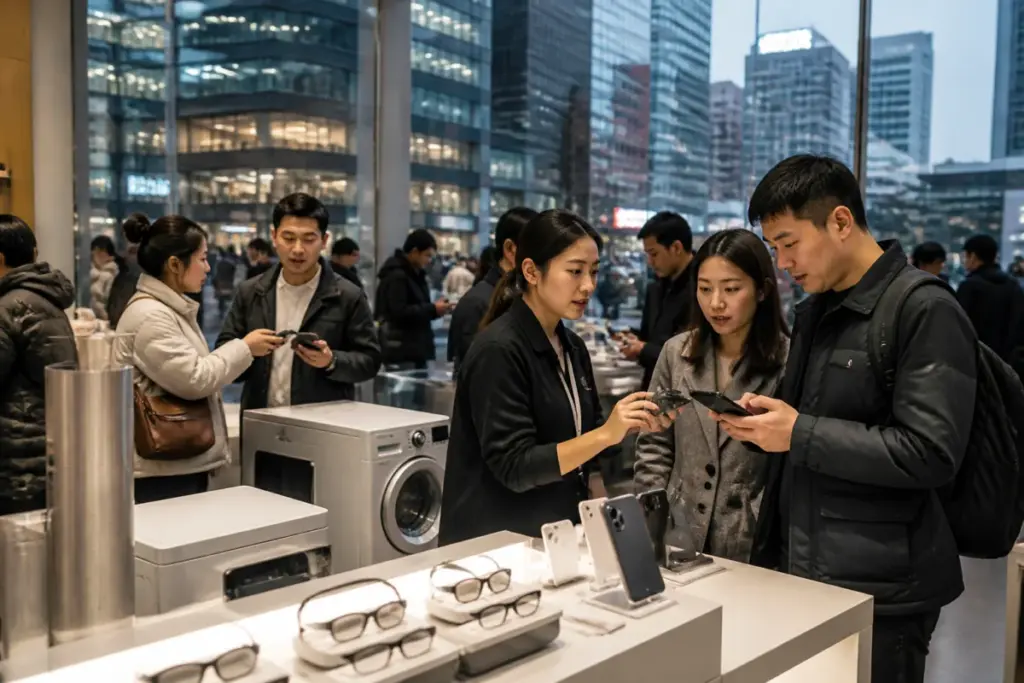
China’s consumer subsidy programme has generated large sales but has not yet solved the deeper weakness in household demand. The 250 billion yuan initiative, equivalent to about $37 billion, is designed to encourage purchases of smartphones, smart glasses, energy-efficient appliances and electric vehicles. But the economic evidence suggests that discounts can move consumption between products or bring purchases forward without restoring confidence across the wider economy.
That distinction matters because Beijing is not simply trying to sell more gadgets. It is using consumer incentives to connect household spending with an industrial strategy centred on artificial intelligence devices, green technologies and advanced manufacturing. The programme is intended to create demand for products that Chinese companies want to produce at scale. The immediate result is stronger sales in selected categories. The unresolved question is whether targeted demand can compensate for weak property investment, subdued household confidence and slow growth in services.
According to the figures cited in the supplied report, the trade-in programme supported sales worth 1.55 trillion yuan by August. The scheme provides financial incentives to consumers who replace old products with eligible new ones. Smartphones, tablets, smartwatches and smart glasses priced at 6,000 yuan or less qualify for a 15 per cent subsidy, capped at 500 yuan per item. A 3,000-yuan pair of eligible smart glasses, for example, could receive a discount of 450 yuan.
The programme also covers six categories of household appliances, but eligibility is restricted to products meeting the highest energy- or water-efficiency standards. This condition gives the subsidy a second purpose. It is not only a consumption measure; it is also a mechanism for directing purchasing power towards particular technologies and product standards.
The sales data show how concentrated the effect has been. Sales of communications equipment at major retailers rose 27.3 per cent year on year in August, while sales of smart glasses on major online shopping platforms increased 120 per cent during the first eight months of the year, according to China’s Commerce Ministry. The government said subsidies had supported purchases of 108 million digital and smart products.
These figures indicate that households are responding where the financial incentive is clear and the product is eligible. They do not, by themselves, establish that overall household consumption has entered a durable recovery. A consumer who buys a subsidised smartphone earlier than planned has increased the month’s retail sales, but may not have increased total spending over the year. Similarly, spending redirected towards discounted electronics may replace spending on travel, restaurants or other services.
This is the central limitation of product-based stimulus. It can influence what people buy and when they buy it, but it has less power to address why households may be cautious in the first place. The supplied report links that caution to continuing weakness in China’s property market. Property investment fell 20.2 per cent in the first three quarters of the year, while fixed-asset investment, including infrastructure, factories and property, declined 7.2 per cent compared with the same period in 2025.
Property is especially important because a large share of household wealth is tied to the sector. When property values and construction activity remain under pressure, households may feel less secure even when selected consumer goods become cheaper. A discount on an appliance can reduce the cost of a purchase, but it does not restore confidence in housing assets or reverse a prolonged real estate downturn.
The difference between retail activity and broader investment is therefore significant. Retail sales grew 0.4 per cent in August and improved to 1.1 per cent in September. Those numbers show some improvement, but the pace remains modest compared with the scale of the intervention. At the same time, the contraction in property and fixed-asset investment points to a wider adjustment in the urban economy, where construction, land markets, household balance sheets and local demand are closely connected.
China’s headline economic growth remains stronger than its domestic demand indicators. The economy grew 4.5 per cent year on year in the July-September quarter, compared with 4.3 per cent in the previous quarter. Growth for the first nine months of 2026 was 4.6 per cent, according to the National Bureau of Statistics figures cited in the report.
The composition of that growth is the more important story. Exports of chips, electronic components and other high-technology products have supported the economy, while domestic consumption and investment have remained weak spots. Professor Abhinav Tripathi, described by NDTV as a senior economic expert, called this a “two-speed economy” in which export-oriented manufacturing continues to perform strongly while domestic demand and investment struggle to gain momentum.
The subsidy programme reflects this two-speed structure. It attempts to use household spending to reinforce the manufacturing sectors that are already central to China’s industrial ambitions. Beijing’s stated approach, quoted in the report from Vice Commerce Minister Sheng Qiuping, is to use “new demand to guide new supply, and new supply to create new demand”. In policy terms, the government is trying to build a market for products that manufacturers are expected to develop and scale.
Artificial intelligence devices are a clear example. Chinese companies including Huawei and Xiaomi are expanding into AI-enabled products, while component suppliers that make optical systems, sensors and speakers could benefit if smart-glasses demand continues to grow. Goertek, a Shenzhen-listed electronics supplier, told institutional investors in September that AI smart glasses could be among the product categories with the greatest growth potential.
The policy does not formally exclude foreign brands. Eligible Apple iPhones can receive the same consumer subsidy as competing domestic products, and Tesla can benefit from incentives for qualifying electric vehicles. However, the structure still supports China’s wider manufacturing ecosystem because increased demand for eligible products can benefit domestic assemblers, component producers and technology suppliers.
The vehicle market also illustrates why subsidies do not automatically remove competitive pressure. Consumers who scrap older vehicles and buy qualifying electric vehicles can receive up to 12 per cent of the new vehicle’s price, capped at 20,000 yuan. Tesla has separately offered limited-period price reductions of 5,000 yuan on the Model 3 and 7,000 yuan on the Model Y in China. Subsidies may increase affordability, but they operate within a market where manufacturers continue to compete aggressively on price.
For cities, the property and investment figures are as important as the technology sales. Urban economies depend on the interaction between construction, household wealth, employment, retail demand and public and private investment. A prolonged property downturn can weaken more than developers’ balance sheets. It can reduce construction activity, affect suppliers and contractors, constrain local economic activity and make households more cautious about major purchases.
The decline in fixed-asset investment also matters because the category includes infrastructure, factories and property. The supplied figures do not separate the performance of each component, so they cannot establish how much of the decline came from urban infrastructure or specific construction segments. They do, however, show that the weakness extends beyond household shopping and is part of a broader investment slowdown.
China’s reliance on exports adds another layer of vulnerability. Exports rose 36.3 per cent year on year in September, and the trade surplus reached $938.1 billion in the first nine months of 2026, up from $875.1 billion in the corresponding period last year. High-tech products and green technologies, including batteries, have strengthened overseas sales. But the report also notes growing scrutiny from trading partners, tariffs and trade disputes that could disrupt access to overseas markets.
That makes domestic demand a strategic requirement rather than a short-term statistical target. Strong exports can support growth while external markets remain open, but they cannot fully substitute for resilient household consumption if trade conditions become more difficult. The consumer programme is therefore being asked to perform several jobs at once: support retail activity, create markets for emerging technologies, assist manufacturers, improve energy efficiency and reduce the economy’s dependence on external demand.
The International Monetary Fund’s revised forecasts underline the difficulty. The IMF lowered its 2026 growth forecast for China from 4.6 per cent to 4.5 per cent and its 2027 projection from 4.1 per cent to 4 per cent. It attributed the revisions to sluggish consumption and weakening investment amid continuing property-sector problems, partly offset by strong exports.
Beijing has responded with targeted measures that include support for first-time homebuyers and selected interest-rate cuts, alongside the consumer trade-in programme. The combination shows that policymakers recognise the problem is not limited to retail prices. Housing demand, borrowing conditions, investment confidence and industrial capacity are connected parts of the same urban economic system.
The evidence currently supports a limited conclusion. China’s subsidies are effective at stimulating selected purchases and strengthening demand for strategically important technologies. They have helped increase sales of communications equipment, smart products and eligible vehicles. But the available figures do not show that the programme has yet produced a broad-based recovery in household consumption, property investment or fixed-asset spending.
The next test is whether the programme can generate new spending rather than merely rearrange existing spending. If retail growth remains modest while property and investment indicators continue to weaken, the limits of product-specific subsidies will become clearer. If demand expands across goods and services while confidence improves, the policy will have achieved more than a temporary boost to selected sales. For now, China’s consumer push remains an industrial policy with visible retail gains, operating inside a much larger struggle to restore confidence in the urban economy.


