

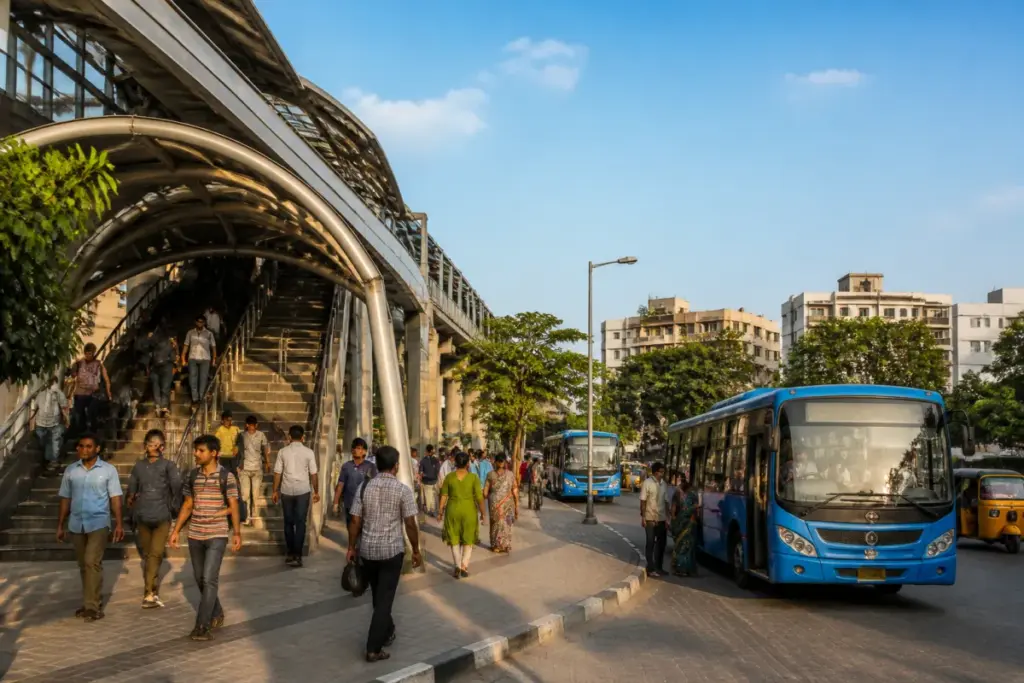
Chennai Metro feeder services are set for a data-led redesign, with the Chennai Unified Metropolitan Transport Authority (Cumta) inviting tenders for a two-month study to map how passengers travel before reaching and after leaving the city’s 41 operational Phase I stations.
The exercise will use anonymised mobile phone location data to identify gaps in last-mile connectivity and prepare origin-destination (OD) matrices for the catchment areas around every Phase I station. Cumta plans to use the findings to design feeder bus routes based on actual travel patterns rather than existing assumptions about where metro users live and travel.
The study will cover an area extending up to 5km by road around each station. These catchment areas will be divided into small traffic analysis zones of about 0.5 square kilometre each, allowing the authority to examine movements at a more local level.
The consultant appointed for the exercise will use anonymised GPS traces from smartphone applications or mobile networks covering at least three months. Cumta has specified that the data sample should represent about 10-15% of the target population, according to a Cumta official quoted by The Times of India.
The data will be processed to identify the origins and destinations of trips, peak and off-peak movements, and trip lengths. The study will also compare overall travel demand around the stations with actual ridership on Chennai Metro Rail Limited’s network.
“We want to understand the share of trips being captured by CMRL and the travel demand that exists around stations but may not be translating into metro trips,” the Cumta official said.
The exercise comes as Cumta, along with the Metropolitan Transport Corporation, has identified 12 metro stations for a pilot last-mile connectivity programme. The plan involves introducing 150 buses measuring 5 metres and 70 buses measuring 7 metres by the middle of next year. These services are expected to operate within a 5km radius of the selected stations, with fares likely to be around ₹20-25.
I Jeyakumar, member secretary of Cumta, said route planning was necessary both to serve existing metro commuters and to encourage more people to choose public transport. “But we need to plan their routes. Apart from serving existing commuters, we need new ones to opt for public transport. So planning is needed to take metro to doorsteps,” he said.
Chennai Metro’s Phase I network covers 54km through the Blue and Green lines and carries more than 3.5 lakh passengers a day. The proposed feeder study is intended to show where potential trips are being lost between neighbourhoods and stations, and whether better road-based connections can expand the metro’s catchment.
Cumta also plans to provide a web-based platform for one year after the study, featuring heat maps and desire-line diagrams showing travel movements across the study area. The tendered study and the subsequent platform are expected to provide the data required to plan the pilot feeder routes.


