

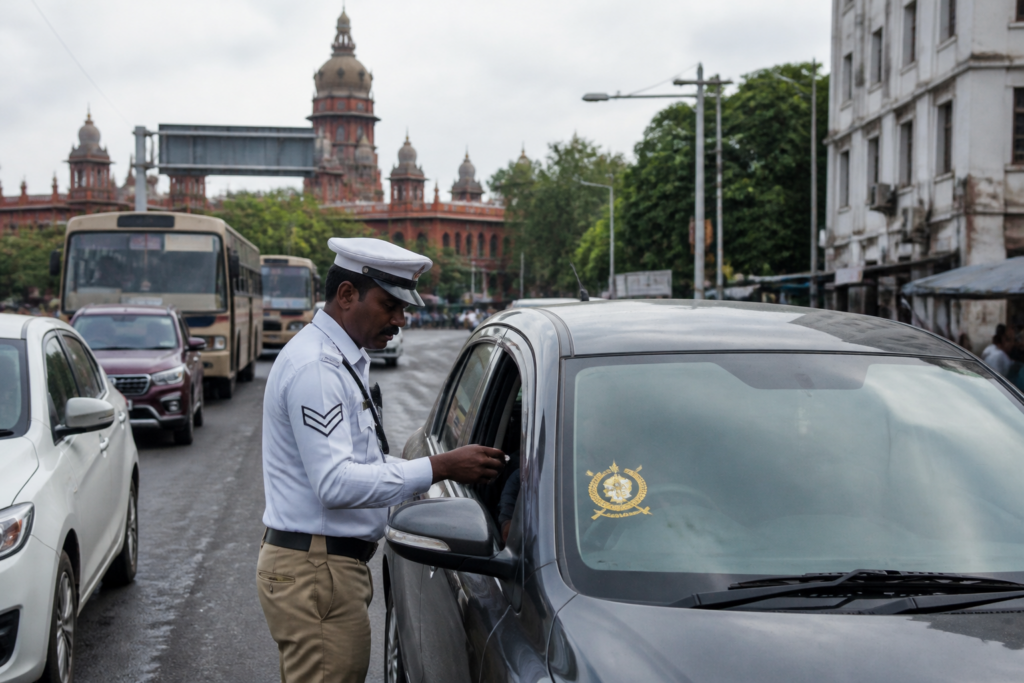
The Chennai High Court’s direction to the Tamil Nadu Transport Commissioner to report on unauthorised stickers and slogans on vehicles has turned a familiar road-side practice into a question of administrative accountability. The court has asked what action was taken during the past six months against the use of unapproved identifiers associated with journalists, doctors, advocates and the police, as well as the misuse of government and national emblems.
The order came during the hearing of a case relating to bus services before Justice N. Senthilkumar. The judge added the Transport Commissioner as a respondent and directed the official to file a report on enforcement against stickers and statements displayed on government and private vehicles. The court also sought information on whether an earlier direction to remove misused national emblems within one month and register cases against violators had been implemented.
The immediate issue is not simply the appearance of stickers on vehicles. It is the use of institutional identity in a public space where such markings can influence how a vehicle is perceived and treated. A sticker indicating an occupation or association may be intended to claim recognition, access or exemption, while an emblem can create the appearance of official authority. The court’s intervention places the responsibility for distinguishing authorised identification from unauthorised display on the agencies responsible for transport regulation and enforcement.
The source report identifies several categories of stickers that the court considers unauthorised, including those associated with journalists, doctors, advocates and the police. It also refers to government and national symbols displayed on vehicles. The order, as reported, does not establish that every sticker in these categories is illegal in identical circumstances. Instead, it asks the Transport Commissioner to explain what action has been taken against the practice and to report on compliance with the earlier direction concerning national emblems.
That distinction is important for administration. Regulation becomes difficult when enforcement is based on informal recognition rather than a clearly documented authorisation process. The court has not merely sought information about individual vehicles. It has asked for a record of action over a defined six-month period, thereby shifting attention from isolated violations to the functioning of the enforcement system. The report will have to show whether the relevant agencies identified violations, removed prohibited displays and initiated cases where required.
The order also names groups whose former or retired public positions, according to the report, do not authorise them to use government emblems on vehicles, letterheads or buildings. Former Members of Parliament and legislators, retired officials and former office-holders are specifically mentioned. The court’s observation establishes a broader principle in the matter: previous public status does not automatically create continuing permission to use official symbols.
For urban residents, the issue is visible at street level. Vehicles operate in a shared public environment governed by common rules. When some vehicles display symbols or occupational labels that appear to confer official standing, the distinction between ordinary users and institutional representatives can become unclear. The supplied report does not provide data on how often such displays affect enforcement decisions or public behaviour. It does, however, show that the court regards the practice as sufficiently persistent to require a formal report from the transport administration.
The institutional chain involved in the matter is also significant. The Transport Commissioner has been asked to report on action relating to vehicle stickers and slogans. The earlier direction concerning misused national emblems was addressed to the government and the Director General of Police, with the requirement that prohibited symbols be removed within one month and cases registered against violators. This places responsibility across transport administration, the police and the state government rather than within a single enforcement office.
Such divided responsibility can create a familiar governance problem: a rule may exist, but accountability for identifying violations, ordering removal, registering cases and reporting compliance may be distributed across institutions. The High Court’s decision to add the Transport Commissioner as a respondent brings the transport department directly into that chain. The forthcoming report is therefore likely to be important not only for the number of actions taken, but also for clarifying which agency performed which function.
The matter also illustrates how regulation of the built environment extends beyond large infrastructure projects and municipal services. Roads are governed spaces, and the vehicles using them carry visual signals that interact with policing, public administration and citizens’ understanding of authority. A government emblem on a vehicle, or a sticker suggesting a recognised professional role, operates within that public setting. The court’s scrutiny treats the display of such symbols as an issue of public regulation rather than a private design choice.
At present, the supplied report does not include the full court order, the number of vehicles inspected, the number of cases registered, the names of agencies that carried out enforcement or the government’s response to the earlier direction. It also does not state whether the Transport Commissioner has already begun compiling the requested information. These gaps matter because the court’s concern is ultimately about implementation. Without an official report, it is not possible to determine whether enforcement has been systematic, occasional or absent.
The court’s request for a six-month account creates a basic measurement framework. Authorities will need to establish what categories were treated as unauthorised, how violations were detected, how many displays were removed and how many cases were registered. The earlier one-month removal direction provides a separate compliance test for the misuse of national emblems. The two strands of reporting may help distinguish routine enforcement against stickers from action involving symbols that carry formal governmental or national significance.
The case also raises a question about how rules are communicated. The source report refers to unauthorised stickers and slogans but does not reproduce a consolidated list of permitted and prohibited displays. If enforcement is to be consistent, vehicle owners and officers need clarity about the applicable standards. The supplied material does not establish whether such guidance already exists or whether the court has sought changes to it. That remains an issue for the official report and subsequent proceedings.
What the court has established, on the available account, is a demand for institutional evidence. The Transport Commissioner must explain the action taken during the previous six months, while the authorities must also report whether the earlier direction on removing misused national emblems and registering cases was implemented. The significance of the order lies in this move from general concern to documented compliance.
The larger urban question is whether public rules are applied consistently in the everyday spaces where authority is displayed. The court’s intervention does not resolve that question yet. It sets a reporting obligation that can reveal the scale of the practice, the division of responsibilities and the extent to which earlier instructions were acted upon. The next substantive development will be the Transport Commissioner’s report and the court’s consideration of whether the government, police and transport authorities complied with the directions already issued.


