

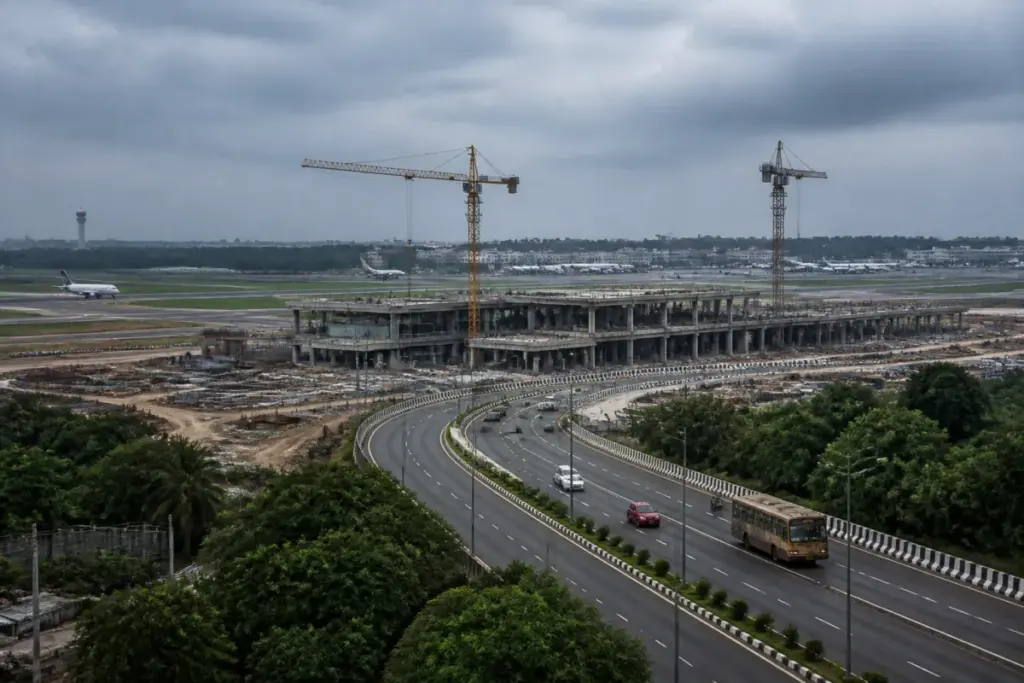
Chennai airport’s proposed Terminal 5 is being positioned as the immediate answer to the city’s aviation-capacity problem after Tamil Nadu dropped plans for a second airport at Parandur. But the expansion is creating a larger urban planning challenge: how to connect a new terminal located between existing runways to the rest of the airport, the city’s road network and the industrial belt to the west without creating new congestion or flood risks.
The state is considering three possible links to Terminal 5, or T5: a metro line, an underground monorail or a road connection. The terminal is planned on the western side of Chennai airport, between the runways, and will have a road link to the Tambaram–Maduravoyal bypass. Officials are now studying an additional connection to GST Road and the existing terminals so that passengers can move between them without taking a long detour.
The change follows the decision announced in August to scrap the Parandur airport project. According to the report, that decision revived an earlier Airports Authority of India proposal for a satellite terminal at the existing Chennai airport. The state has said it will support the airport’s expansion and build the required connections, shifting the immediate focus from creating a new aviation site to increasing the capacity of the existing one.
The scale of the proposed terminal explains why transport links have become central to the project. Chennai airport director M Raja Kishore said T5 would be designed to handle 20 million passengers a year. He said better links to the existing terminals could push the airport’s saturation point to 2050, giving the state more time to build a second airport.
The airport’s physical capacity would also change materially under the plan. According to Kishore, the number of parking bays would rise from 84 to 124, while aerobridges would increase from 17 to 42. The design remains at an early stage. Work on T5 is expected to begin in earnest after the completion of the T3 integrated terminal.
These numbers also show why T5 cannot be treated as a stand-alone building project. An airport terminal is only as accessible as the road, rail and internal circulation network that serves it. If passengers arriving at T5 have to travel through a circuitous route to reach the existing terminals or the city, the additional passenger-handling capacity could shift pressure from the terminal building to the surrounding transport system.
The institutional arrangement is still being assembled. Tamil Nadu Industrial Development Corporation, or TIDCO, has been assigned responsibility for preparing the detailed project report. Officials from TIDCO, the National Highways Authority of India and the Water Resources Department met to determine who should prepare the report. Chennai Metro Rail Ltd was also considered, but TIDCO received the assignment. The agencies are now working out the terms of reference, and officials said bids for a consultant were expected to be invited by November.
That process matters because the connectivity options fall under different administrative responsibilities. A metro extension would involve Chennai Metro Rail Ltd and the state’s wider transport planning framework. A highway or expressway would require coordination with NHAI and the state road network. Any structure affecting the Adyar river or other water bodies would require the Water Resources Department to assess hydraulic and flood implications. TIDCO’s role places the project within a development-agency framework, but the final solution will depend on coordination between agencies with different mandates.
The metro option itself is already being reconsidered. Chennai Metro’s plan to extend a line from the airport to the Parandur site through Tiruneermalai and Sriperumbudur is expected to be reworked so that it ends at T5 instead. This is an important change in the geography of the proposed line. A route originally linked to a planned second airport would instead serve an expansion terminal within the existing airport complex.
The report does not establish the revised alignment, its cost, construction schedule or proposed stations. It also does not say whether the metro option will be selected. Those details are expected to form part of the detailed project report, along with an assessment of an underground monorail and a road along the airport perimeter.
The road proposal has a wider metropolitan logic. NHAI has proposed a four- or six-lane expressway from T5 to the Tambaram–Maduravoyal bypass. The proposal includes a cloverleaf interchange at Tharapakkam and a link to the Outer Ring Road. Officials said the route could accelerate cargo movement from the Sriperumbudur industrial belt, connecting airport expansion with the movement of goods as well as passengers.
This makes the T5 plan more than an airport-access project. The proposed road would sit at the intersection of aviation, freight and regional highway planning. Its usefulness would depend not only on how quickly passengers can reach the terminal but also on whether cargo traffic can move without adding pressure to existing urban roads. The source material, however, does not provide traffic forecasts, projected cargo volumes or an assessment of how the proposed expressway would interact with the wider road network.
The connection to GST Road would address another operational problem. Passengers using T5 would need a direct route to the existing terminals, while passengers arriving at T5 would need a faster connection to the city. Without such a link, internal airport transfers and city-bound journeys could be forced onto the Tambaram–Maduravoyal bypass, creating a detour even before traffic conditions are considered.
The project also brings an environmental and flood-management question into the centre of airport planning. The Water Resources Department is studying whether pillars built in the Adyar river would obstruct the river’s flow and increase the risk of flooding in nearby areas. Urban planner Pavithra Sriram said environmental considerations should be included because constructing pillars on water bodies could have a negative impact.
That concern is significant because the connectivity options are being considered before the final design of T5 has been completed. The choice of an elevated structure, an underground system, a perimeter road or a river-crossing component would shape both construction impacts and long-term operation. The report does not establish the findings of the Water Resources Department’s study, so the environmental feasibility of any particular option remains unresolved.
The sequence of decisions reveals the institutional cost of changing airport strategy. Parandur was expected to provide a separate aviation site, while the revised approach increases the role of Chennai airport and requires a new set of internal and external connections. The proposed metro extension must be reworked, the road system must be assessed for passenger and cargo traffic, and water-management agencies must examine potential impacts. Each decision is linked to the others, even though different agencies will prepare or evaluate different components.
The immediate capacity figures are clear: T5 is planned for 20 million passengers a year, with parking bays rising from 84 to 124 and aerobridges from 17 to 42. The longer-term claim that connectivity improvements could extend the airport’s saturation point to 2050 comes from the airport director and remains tied to the quality and delivery of the proposed links. The supplied report does not provide an independent capacity model or details of how the 2050 estimate was calculated.
For Chennai, the central urban question is therefore not simply whether T5 can be built. It is whether a terminal added inside an established airport can be integrated with the metropolitan transport system without transferring capacity pressure to roads, creating difficult inter-terminal journeys or affecting flood-sensitive landscapes. The answer will depend on the detailed project report, the revised metro alignment, the highway design and the Water Resources Department’s assessment.
The next stage is the preparation of the detailed project report and the appointment of a consultant. Until those studies are completed, the metro, underground monorail and expressway remain options rather than confirmed components of the airport expansion. The completion of the T3 integrated terminal is also identified as the milestone after which work on T5 is expected to begin in earnest.


