

Chennai airport faced widespread flight disruption after heavy overnight rain, thunder and lightning affected arrivals and departures, with more than 20 services delayed and one IndiGo flight diverted to Hyderabad.
The IndiGo service from Kolkata, carrying 184 passengers, was unable to land in Chennai and was diverted to Hyderabad. More than 10 domestic flights arriving from Delhi, Mumbai, Bengaluru, Hyderabad, Madurai, Tiruchy and Kolkata also remained in the air for extended periods, circling until weather conditions eased.
As the rain subsided, the holding flights began landing at Chennai airport one after another. Departures, however, continued to face delays, with 12 services leaving between one and two hours behind schedule.
The delayed departures included domestic flights to Madurai, Kochi, Mumbai, Bengaluru, Pune and Delhi. International services bound for Singapore, Kuala Lumpur, Sri Lanka, Frankfurt and Abu Dhabi were also affected.
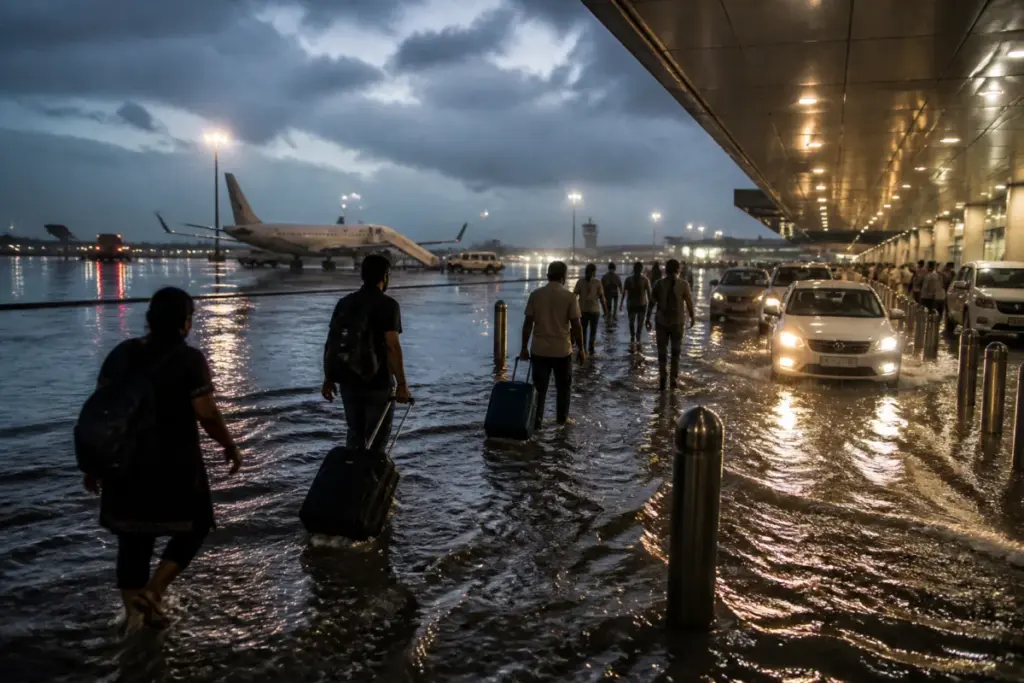
The disruption extended beyond aircraft operations to passenger movement within and around the airport. Rainwater accumulated in parking bays, creating difficulties for passengers arriving on flights assigned to open bays without aerobridge facilities. They had to disembark and use passenger-transfer vehicles while navigating waterlogged areas.
Several passengers struggled to walk through the accumulated water to reach the waiting vehicles. The lack of aerobridge access meant that the impact of the rain was felt not only through flight delays but also during the transfer of passengers between aircraft and the terminal.
Conditions were also difficult outside the terminal. Large volumes of rainwater flowed through the portico area, making it difficult for cars to stop and collect arriving passengers. People leaving the terminal had to negotiate waterlogged stretches to reach their vehicles, while cars faced difficulty pulling in close to the pickup area.
The incident highlights how intense rainfall can affect an airport’s entire passenger chain, from aircraft landing and departure schedules to apron transfers, parking bays and terminal access. In this case, the airport’s operational disruption was accompanied by ground-level difficulties for passengers moving through exposed aircraft parking areas and the terminal frontage.
The report did not specify the total rainfall recorded, the duration of the waterlogging, the number of passengers affected beyond the diverted IndiGo service, or the time required for normal airport operations to resume. It also did not provide details of any airport authority advisory or further operational measures.
Flights that had been holding in the air were able to land after the rain eased, while the affected departures left with delays of up to two hours, according to the report.


