

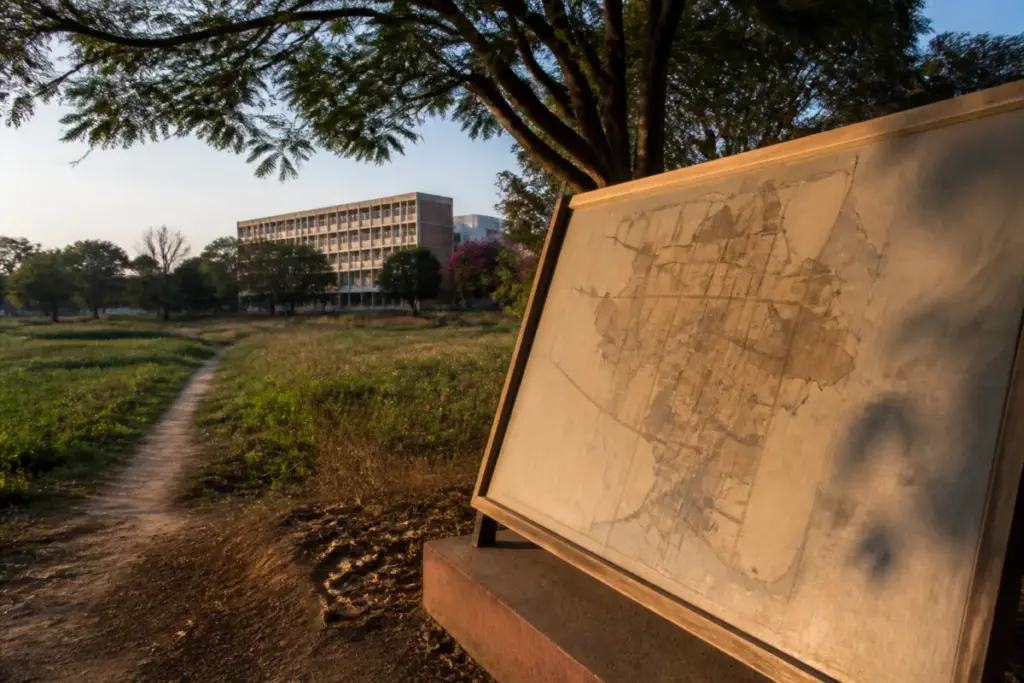
A representation submitted by Panjab University student group SAAKHI has opened a larger question about how Chandigarh records the villages and communities displaced during the making of its urban institutions. The group has asked the university to acknowledge original Puadhi villages, install a memorial plaque or monument on campus, and prepare a research-based map linking those villages to different sectors of the city.
The immediate demand is modest in administrative terms: a website statement, a physical memorial and a publicly accessible map. Its significance, however, lies in what these requests seek to make visible. Chandigarh is commonly understood through its planned sectors, institutional buildings and modernist urban form. SAAKHI’s representation asks that this official geography also include the settlements and cultural identity that existed before the campus and the city were established.
According to the report in the Times of India, the student organisation submitted its representation to the Panjab University vice-chancellor on Saturday. It identified villages including Kanjimajra and Dhanas as places whose land was acquired for the university campus. The group described the original settlements as part of the Puadh region and argued that their historical, linguistic and cultural identity should be formally recognised by the university administration.
The proposal therefore concerns more than heritage signage. It connects land acquisition, institutional expansion, regional identity and the production of urban knowledge. A campus is not created on an empty map. Roads, academic buildings, hostels and public institutions occupy land that may previously have supported villages, farms, social networks and local cultural practices. When those earlier geographies disappear from the visible city, the urban landscape can appear complete while the history of its formation remains partial.
The representation is especially relevant because Panjab University is both a major educational institution and a substantial component of Chandigarh’s built environment. The university’s campus is not simply a collection of buildings. It is an organised urban space with its own roads, open areas, institutional departments and daily population. A decision to document the villages associated with its land would place campus development within the wider history of Chandigarh’s expansion rather than treating the institution as separate from the city around it.
SAAKHI has proposed a three-part response. First, it wants Panjab University to publish an official acknowledgement on its website in Punjabi, Hindi and English. The proposed statement would name the original inhabitants and relevant villages. Second, it has called for a dedicated memorial plaque or monument on campus documenting the history of the displaced villages. Third, it has proposed a research-based map identifying the original Puadhi villages associated with different sectors of Chandigarh.
The three requests perform different institutional functions. A website statement would make recognition accessible to students, researchers and the public. A plaque or monument would give the history a permanent physical presence within the campus. A map would connect historical information to the city’s present-day spatial structure. Together, they would move the issue from an individual memory or local account into the university’s formal public record.
The proposed map is also the most technically significant part of the representation. SAAKHI has suggested that it be prepared in collaboration with Panjab University’s departments of history, geography and Punjabi. That combination matters because the question involves several kinds of evidence at once: historical records, spatial relationships and language or cultural identity. A map produced only as a commemorative graphic could remain symbolic. A research-based map would instead seek to establish how the original villages relate to the university campus and Chandigarh’s sectors, using the evidence available to the participating departments.
The source report does not provide the complete list of villages, the total land acquired, the dates of acquisition, the number of families affected or the precise boundaries of the areas identified by SAAKHI. Those details are important because any official map or memorial would need to distinguish between documented land acquisition, broader regional association and later community memory. The supplied material establishes the group’s demand and names Kanjimajra and Dhanas, but it does not establish the full historical or administrative record behind the proposed map.
That limitation points to the central institutional challenge. Recognition can be meaningful only when the record is carefully established. A plaque that names villages without explaining the basis of the information could simplify a complex history. A map that links villages to present-day sectors would need clear sources, definitions and methodology. The university’s history, geography and Punjabi departments could provide the institutional setting for that work, but the report does not say whether the administration has agreed to constitute such a research exercise.
SAAKHI’s appeal to international precedents adds another layer to the proposal. The group cited Columbia University, the University of British Columbia, the University of Toronto and the University of Sydney as examples of institutions that acknowledge histories connected to their campuses. The comparison, as reported, is not a claim that the histories or legal circumstances are identical. It is an argument that universities can use official statements and campus markers to recognise communities and places that preceded institutional development.
For Panjab University, the question is therefore not only whether a monument should be installed. It is whether the university treats the history of its land as part of its academic and public responsibilities. Universities routinely produce research about society, territory and culture. A proposal to document the villages associated with the campus asks the institution to apply those capabilities to its own physical setting.
The language of the proposed acknowledgement is also significant. SAAKHI has asked for the statement in Punjabi, Hindi and English, while highlighting the distinct dialect and heritage of the Puadh region. This places linguistic identity alongside land and built form. In a planned city, sector numbers and institutional names can become the dominant way of describing place. Recording the Puadhi identity associated with earlier villages would add another layer to that spatial vocabulary.
The issue also reflects a recurring difficulty in urban development: the difference between physical relocation and historical disappearance. When land is acquired and urban infrastructure is built, the original settlement may no longer be visible in its earlier form. Yet the absence of buildings does not automatically remove the settlement from the history of the city. The representation asks the university to recognise that distinction by preserving evidence and naming the places connected to the campus.
At present, the administration’s response is awaited. The student group has requested a meeting with university officials to discuss implementation and has submitted historical documents and references in support of its demands. The next institutional step will determine whether the proposal remains a student representation or becomes a formal exercise involving the university’s departments and public records.
The evidence currently confirms a clearly defined request, two named villages, three proposed forms of recognition and a proposed collaboration across three academic departments. It does not yet establish the university’s position, the historical scope of the displaced settlements or a timetable for any website statement, plaque or map. Those are the facts that will need to be clarified if Panjab University moves from acknowledging the demand to documenting Chandigarh’s pre-campus and pre-sector geography.


