

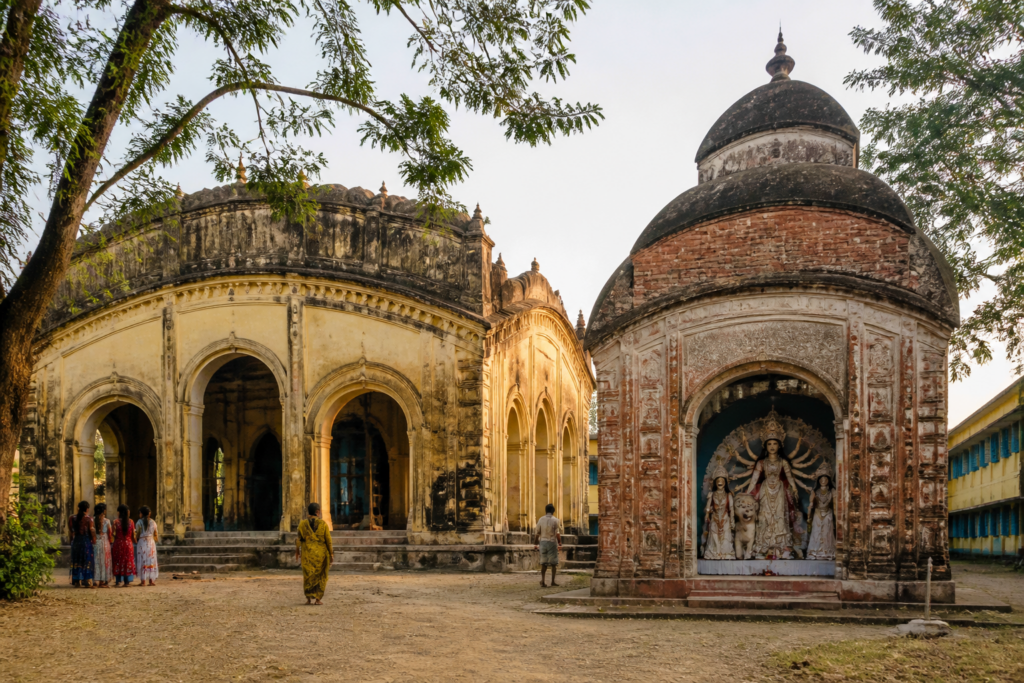
The 186-year-old Boinchee Durga Puja in Hooghly’s Pandua is more than a surviving religious tradition. It is also a record of how private zamindari property was gradually converted into a public institution, while the former estate’s architecture and community rituals continued to shape local memory.
The puja is held at the Boinchee B.L. Mukherjee Free School, a site that was once a zamindar’s residence. The school complex is associated with Ishwar Chandra Vidyasagar, whose involvement helped redirect the property towards education and public welfare. The transformation did not erase the earlier identity of the site. Instead, the annual festival continued within a complex where the history of landholding, philanthropy, schooling and village life remains visible together.
That layered history gives the puja significance beyond its ritual calendar. According to Goutam Bit, principal of Kannan College, the puja was started by Thakurdas Mukhopadhyay, the father of Bihari Lal. The family established its zamindari in Bainchigram, and its influence expanded during Bihari Lal’s time. Since Bihari Lal had no children, the future of his property became a social and institutional question rather than a private inheritance issue alone.
Regional historian Partha Chattopadhyay said Bihari Lal formally recorded his will on 9 August 1870 regarding the future use of the property. Official records relating to the area, he said, note Vidyasagar’s association with the preparation of the document. After Bihari Lal’s death, Vidyasagar took an active role in giving effect to the intention behind the arrangement.
The resulting change was gradual. In December 1877, the Biharilal High Free School was established, and a charitable hospital was also created as part of the wider public welfare effort. The zamindarbari consequently acquired a new public identity. Education and service began to take precedence over its role as a private residence, although the Durga Puja remained in place.
This is the central urban and built-environment question raised by the site: what happens to historic properties when their original economic and political purpose disappears? The Boinchee complex suggests one possible answer. A former seat of zamindari authority can become a school and a centre of welfare without losing every part of its cultural memory. But that continuity depends on more than retaining a festival. It also depends on maintaining the physical structures that allow the history to remain legible.
The old zamindarbari still contains architectural elements associated with its earlier identity. The large, arched Natmandir, a pillared hall in front of the main shrine, remains linked to the Durga Puja and Jagaddhatri Puja. Near the entrance is a Rashmandir, or festival pavilion, where traces of terracotta decoration can still be seen.
Both structures, however, have become increasingly fragile. Efforts have been made to raise funds for renovation, but the money collected has not been sufficient for restoration. This is a familiar preservation problem: a building may retain strong cultural value while lacking a stable institutional mechanism for structural conservation. The continued use of a site does not automatically guarantee the survival of its architecture.
The challenge is particularly visible because the buildings remain part of a living festival rather than a closed heritage property. The Natmandir and Rashmandir are not simply architectural remnants. They are associated with ceremonies, gatherings and the movement of residents through the site. Their value comes from the relationship between structure and use. At the same time, continued use can increase pressure on buildings that already require repair.
The festival itself retains several distinctive features. The idol is made in the ekchala tradition, with Durga and her four children—Lakshmi, Saraswati, Ganesha and Kartikeya—sculpted together beneath a single overarching frame. Its face has distinct Bengali features, including long eyes and a traditional appearance. Mahishasura is depicted with green skin, a visual detail that has become one of the puja’s recognisable attractions.
Some customs have changed. Animal sacrifice, once part of the puja, has been discontinued and replaced by offerings of pumpkins and bananas. The immersion procession has also changed as the social conditions supporting it have weakened.
Earlier, villagers carried the deities on their shoulders through four neighbourhoods before immersion in the school pond. Local resident and retired teacher Asit Chatterjee said the procession represented collective participation and connected the festival with the wider social life of the village. That tradition disappeared because fewer people were available to carry the idols. The deities are now transported by tractor through the same four neighbourhoods before immersion.
The change is significant because it shows that cultural continuity does not mean that every practice remains unchanged. The route survives, but the method of transport has altered. The ritual remains connected to the neighbourhoods, while the labour system that once supported it has weakened. In this sense, the festival records demographic and social change without providing evidence that the community has abandoned the tradition itself.
The shift from human carriers to a tractor also illustrates how infrastructure and ritual are connected. A procession requires people, routes, time and an organising institution. When one of those elements changes, the visible form of the festival changes as well. Yet the continued movement through four neighbourhoods indicates that the spatial relationship between the puja and the surrounding community remains important.
The Board of Trustees once played a significant role in organising the festival. Government assistance was also available, although the amount was limited. Over time, that assistance proved insufficient to meet the puja’s expenses. The funding problem has a direct bearing on preservation because the same local institutional and public resources are linked to both the annual festival and the upkeep of the historic structures.
This creates a governance problem that is not resolved by cultural popularity alone. A site can be widely valued, regularly used and historically important, yet still lack enough money for restoration. The account of Boinchee shows how ritual institutions, educational bodies, trustees, residents and government support can overlap without necessarily producing a dedicated conservation framework.
The site’s history also complicates the common separation between heritage and public infrastructure. The former zamindarbari became a school and was connected to a charitable hospital. Its significance therefore lies not only in its age or architectural appearance, but also in the public functions that replaced private estate power. The building’s history is inseparable from the expansion of education and welfare in the area.
Partha Chattopadhyay described the continuity as embodying several layers of local history: the legacy of the zamindar family, the conversion of private property into an educational and welfare institution, Vidyasagar’s social outlook and the cultural memory of generations of villagers. The evidence supplied in the account supports that interpretation through the documented sequence of the will, the school’s establishment, the hospital’s creation and the continued puja.
What remains uncertain is the precise condition of the Natmandir and Rashmandir, the scale of restoration required and the institutional arrangement that could fund and manage it. The available account establishes that both structures are fragile and that existing fundraising has been inadequate, but it does not provide a structural assessment, restoration estimate or confirmed conservation plan.
That gap matters because the Boinchee Durga Puja’s future is tied to both intangible and physical continuity. The festival can preserve memory through its rituals, the idol’s form and its procession route. But the architectural spaces in which those traditions are enacted require separate attention. If the buildings deteriorate, part of the relationship between education, welfare, worship and local history may become harder to sustain.
The Boinchee example therefore shows heritage not as a fixed object from the past, but as an evolving institutional arrangement. Zamindari authority gave way to public education and welfare; ritual practices adapted to changing social conditions; and the historic buildings continued to serve as cultural anchors despite increasing fragility. The immediate evidence confirms a durable connection between the puja, the school and the village. It also points to an unresolved question: whether the community and public institutions can find sufficient support to preserve the physical setting that carries that history forward.


