

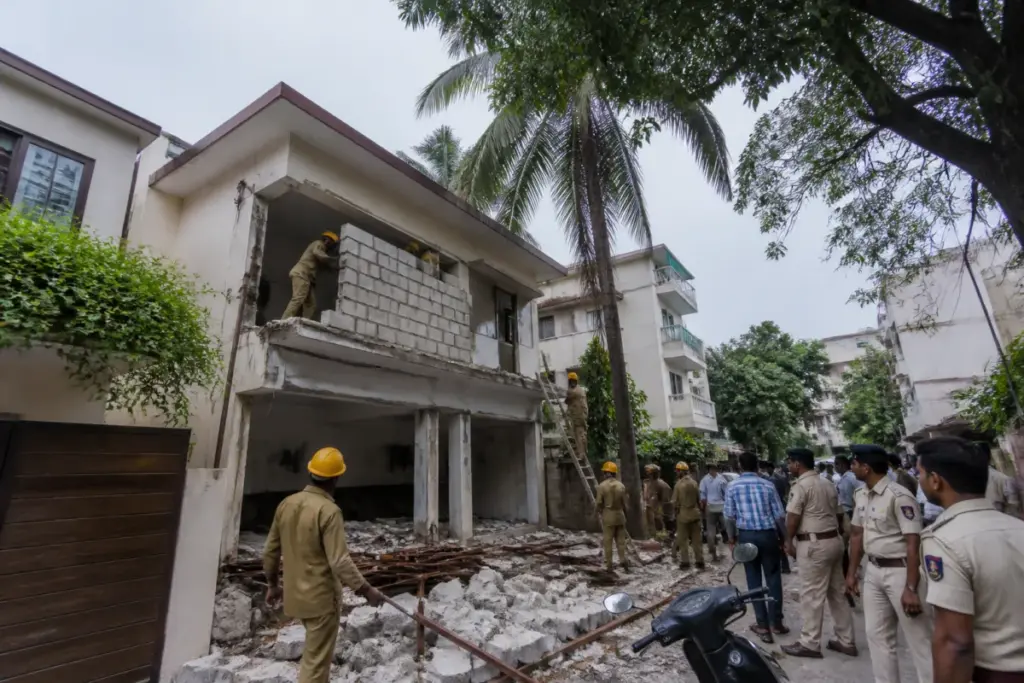
The BMC demolition in Juhu was not simply a celebrity-linked property dispute. It was the visible outcome of a basic municipal enforcement question: whether ongoing additions and alterations had received permission from the competent authority before construction began. In this case, the civic body said the owners did not produce those documents, while the actor’s office said the property was rented out and that the necessary changes required by the BMC had been carried out.
The action took place on October 12 at a bungalow in Kapol Cooperative Housing Society on N S Road No. 11, JVPD, Vile Parle (West). The property is owned by actor Ajay Devgn and his mother, Veena Devgn. According to the BMC, the work involved unauthorised additions and alterations using Siporex blocks at CTS No. 841, Plot No. 10. The civic body demolished portions of the ongoing work after rejecting the owners’ response to an earlier stop-work notice.
The episode matters because Mumbai’s construction-control system depends on permissions being secured before physical work proceeds. The BMC’s action, as described in its speaking order, followed a sequence: a stop-work notice, a demand for documents, an assessment of the owners’ reply and then removal of the work when the authority concluded that the required approvals had not been established. That sequence offers a window into the administrative mechanics behind what can otherwise appear to be a sudden demolition.
The K/West ward office issued the stop-work notice under Section 354A of the Mumbai Municipal Corporation Act on September 10. The notice directed the owner or occupier to stop construction immediately and submit relevant permissions within 24 hours. It also warned that the unauthorised structure and construction materials could be removed at the owner’s risk and cost if the directions were not followed.
The notice did not only concern the completed physical work. It also addressed the construction process while it was under way. The BMC said that because the construction was ongoing, the owner was required to possess permission from the competent authority. In its speaking order dated October 6, the ward office recorded that the reply submitted on September 15 did not include documents proving that the construction was authorised or a copy of permission granted by the competent authority.
That distinction is central to understanding the case. The question before the municipal authority was not presented as whether the property belonged to a prominent public figure, nor whether the proposed use was commercially attractive. The immediate issue was whether the work could be supported by the required approval documents. The BMC treated the absence of those documents as sufficient to reject the reply and classify the work as unauthorised.
The case also shows how enforcement responsibilities can extend beyond the municipal office. The notice directed police to keep watch at the site and, if required, remove persons carrying out the work. This indicates that the BMC anticipated the possibility that construction could continue despite the stop-work direction. The municipal process therefore involved both a planning and building-control decision and an on-site enforcement mechanism.
The owners’ response, as reported by the Times of India, presents a different part of the administrative picture. A statement from Ajay Devgn’s office said that the property was not the actor’s residence but a separate property that had been rented out. It added that the owners had applied to the BMC for the requisite permissions for one of their properties and were complying with applicable BMC rules, regulations and guidelines. The statement further said that the necessary changes, alterations and modifications required by the BMC had been carried out.
The supplied account does not establish whether the application mentioned in the statement was subsequently approved, nor does it provide the final status of any permission after the demolition. It records the BMC’s finding as of the speaking order and the actor’s office statement about compliance. That leaves an important administrative gap: applying for permission and possessing permission are not necessarily the same stage in a construction-control process. The BMC’s stated objection was that the necessary documents had not been furnished when demanded.
The proposed use of the property adds another layer to the dispute. Sources cited in the report said the bungalow was to be rented to a salon. Residents of the cooperative housing society had reportedly objected, fearing that the proposed business could open private society premises to members of the public visiting the salon. The source material does not state whether the salon had begun operating, whether the society had formally approved the use, or whether the BMC’s demolition order was based on the proposed commercial activity. What it does show is that a property alteration dispute can involve both municipal permissions and the internal governance of a housing society.
These two approval systems address different questions. The municipal authority determines whether construction or alterations comply with applicable civic rules and whether the work has the required permission. A cooperative housing society may separately regulate how a property is used within its premises and whether a proposed activity affects common access, security or the terms governing the society. In the Juhu case, the reported objections indicate that residents viewed public access to a private society as a material concern, even as the BMC focused on the legality of the ongoing construction.
The case therefore illustrates how redevelopment, renovation and change of use can become entangled. A property owner may seek to modify a structure, a tenant may plan a commercial activity, residents may object to increased visitor movement, and the municipal authority may examine whether the physical work has been approved. These are not interchangeable questions. The BMC action addressed the construction-permission issue; the available account does not show that it finally resolved the society’s concerns about the salon.
The use of a speaking order is also significant. The BMC’s October 6 order set out why the owner’s reply was not accepted: the response did not contain documents establishing authorisation or a copy of permission from the competent authority. Such an order creates a written administrative basis for enforcement rather than leaving the action dependent only on a site inspection or verbal instruction. In the reported case, the demolition followed that recorded reasoning and the earlier notice.
At the same time, the material available does not provide the full file history. It does not identify the exact alterations beyond the reference to Siporex blocks, disclose the dimensions of the demolished portions, state the cost of removal, or reproduce the complete speaking order. It also does not record a separate response from the housing society or explain whether any appeal, review or subsequent application was filed after the action. Those omissions limit what can be concluded about the final legal and operational status of the property.
The broader urban question is how Mumbai manages incremental construction in already developed neighbourhoods. The reported work was not described as a new large-scale project. It involved additions and alterations to an existing bungalow. Yet even small changes can trigger questions about structural permissions, land and building records, use of premises, access and neighbourhood impacts. The case shows why municipal control is not limited to major towers or large redevelopment schemes; it also operates at the level of individual plots and private housing societies.
It also highlights the importance of timing. The BMC said the construction was ongoing when the notice was issued. Intervention at that stage allowed the authority to direct that the work stop and to warn that materials and unauthorised structures could be removed. Once work is completed or occupied, enforcement can become more complicated because the physical alteration, tenancy arrangements and use of the premises may already be established. In this case, the BMC’s account places the action within an active construction phase rather than after a long period of completed occupation.
The Juhu property case does not, on the evidence supplied, establish a wider pattern of enforcement across Mumbai or show that celebrity ownership changed the municipal process. It does, however, make the approval chain unusually visible. The BMC identified the work, issued a notice, required documents, rejected the response and removed portions of the construction. The owner’s office said permissions had been sought and that required changes had been made. The difference between those positions turns on the documentary record and the status of the permissions, which the available report does not fully disclose.
What the episode confirms is narrower but important: municipal construction permissions are not a post-facto formality, and a property owner or occupier can face removal action when ongoing work is treated as unauthorised and the required documents are not produced. The next points to monitor are the status of the permission application mentioned by the actor’s office, any further BMC action, and whether the proposed salon use proceeds after the reported objections from society residents.


