

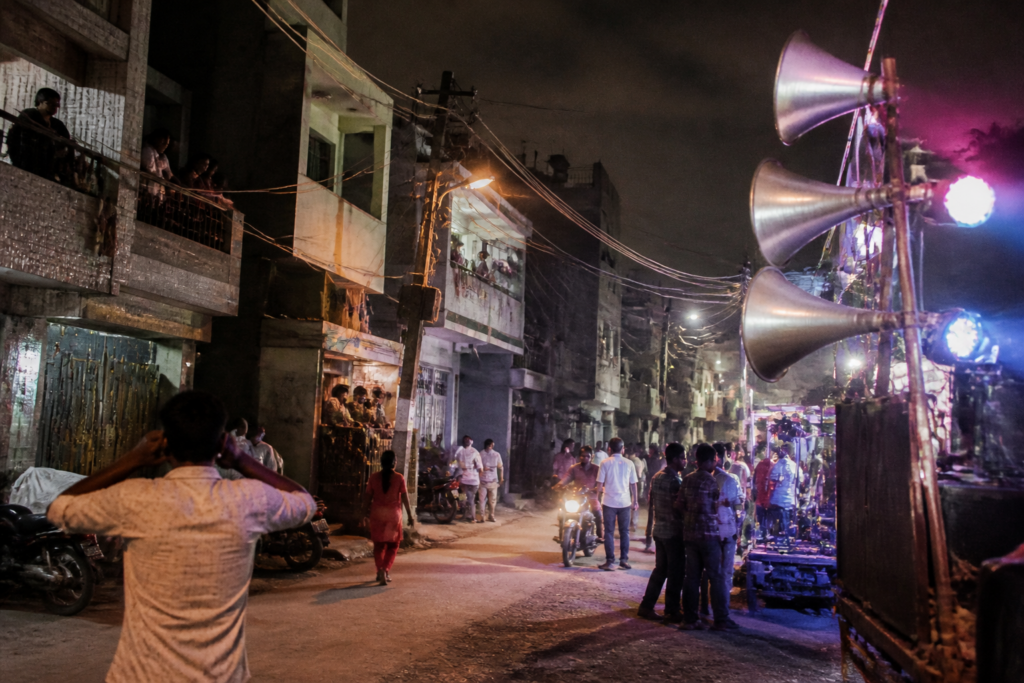
Bhopal’s growing exposure to DJ systems and amplified loudspeakers is being described by doctors as more than a neighbourhood nuisance. The concern is not limited to hearing damage: medical specialists cited in a recent report warn that repeated or poorly timed noise can disturb sleep, increase stress, aggravate mental-health conditions and place additional strain on the cardiovascular system. The issue reveals a wider urban problem—how cities recognise, regulate and respond to a form of pollution that is experienced privately but created collectively in public spaces.
A 2025 study on environmental noise pollution in Bhopal, published in the Journal of the Metrology Society of India, assessed noise levels in different parts of the city. The study did not specifically examine amplified DJ music, but it found that noise levels at the surveyed sites exceeded permissible limits. That distinction is important. The available evidence does not establish the precise contribution of DJs or loudspeakers to the city’s overall noise levels. It does, however, indicate that Bhopal already has a broader environmental noise problem into which amplified music fits.
This makes the debate larger than the question of whether a particular celebration, procession or event is too loud. Noise is produced through multiple urban activities, often at different times and in different neighbourhoods. Amplified sound can become especially disruptive when it continues at odd hours, reaches homes, schools or hospitals, or is repeated over long periods. The public-health consequences described by doctors therefore depend not only on volume, but also on timing, duration, frequency and the number of people exposed.
District civil surgeon Dr Sanjay Jain said excessive noise poses a risk of hearing loss and that noise played at odd hours disrupts sleep and adversely affects overall health. His observation connects the issue to one of the most basic functions of a city: allowing residents to rest. Sleep disruption is not an isolated inconvenience when it is repeated. It can affect a household’s daily routine, students’ ability to concentrate and the capacity of workers to recover between shifts. The report does not provide citywide data on how many residents experience such disruption, but it identifies the pathway through which noise becomes a health concern.
The effects are not distributed evenly across the population. Dr Samiksha Sahu, assistant professor in the psychiatry department at Gandhi Medical College, said loudspeakers affect people across age groups, with children, people with autism and elderly residents particularly vulnerable to distress and disruption. She also linked prolonged exposure to increased irritability and anxiety and said it could aggravate existing conditions, including depression.
For people with post-traumatic stress disorder, Dr Sahu said loud music and firecrackers can trigger flashbacks and heightened startle responses. Noise-triggered migraines and difficulty concentrating were additional concerns, particularly for students preparing for examinations. These observations shift the discussion away from a generic idea of public inconvenience. The same sound environment can be tolerated by one resident and experienced as acute distress by another, depending on age, health, sensory sensitivity and personal circumstances.
Children with autism may experience heightened distress, while elderly people may be more vulnerable to noise-related disruption and emotional strain, according to Dr Sahu. The report does not quantify these effects in Bhopal or establish how frequently such incidents occur. It does show why a single citywide approach to noise management may fail to capture the lived experience of different groups. A rule that treats every location and every hour as equivalent would not reflect how exposure is actually experienced inside homes and institutions.
The cardiovascular concern follows another route. Cardiologist Dr GC Gautam said prolonged noise exposure could activate the body’s stress response, releasing hormones that raise heart rate and blood pressure. Repeated exposure, he said, can keep the body under stress and increase strain on the heart and blood vessels, potentially raising the risk of cardiovascular problems over time.
The wording is significant because it describes a cumulative risk rather than claiming that one loud event directly causes a heart condition. The available report does not provide local hospital data linking DJ noise to cardiovascular cases, nor does it establish a specific exposure threshold at which such harm occurs. What it provides is a medical explanation of why repeated exposure deserves attention as a public-health issue rather than being treated solely as a law-and-order matter.
Hearing health presents a more direct concern. ENT specialist Dr SP Dubey said high-volume amplified music can cause tinnitus, a persistent ringing or buzzing in the ears, as well as temporary or permanent hearing damage. He added that risk depends on the sound level reaching the ears and the duration and frequency of exposure. That qualification places measurement at the centre of the problem. Without reliable information on sound levels and exposure duration, authorities and residents cannot easily distinguish between a short disturbance and a pattern capable of causing lasting harm.
The 2025 Bhopal study supplies one part of that measurement picture by showing that surveyed locations exceeded permissible noise limits. But because the study did not specifically examine DJ systems, it cannot by itself establish how amplified events contribute to the result. Nor does the supplied material identify the locations surveyed, the recorded levels, the relevant time periods or the enforcement action that followed. Those gaps limit what can be concluded about the scale and distribution of the problem, while leaving the central concern intact: measured exceedances already exist in the city’s noise environment.
This is where noise becomes a governance question. Excessive sound is generated in public or semi-public settings, but its effects travel into private homes and affect people who may have no control over the source. Residents can close windows or leave a locality temporarily, but those responses are not equally available to everyone. Children, elderly residents, people with disabilities, patients and students may remain exposed even when they are not participants in the event producing the noise.
The report’s reference to a recognition gap is therefore important. Authorities may recognise excessive noise as a disturbance requiring an immediate complaint response without consistently treating it as an environmental and health issue. That framing can narrow the administrative response to isolated incidents. A public-health approach would require attention to patterns: where noise is repeatedly reported, when it occurs, which communities are exposed and whether measured levels exceed permissible limits.
The supplied report also notes that the Supreme Court has recognised excessive noise as a threat to the right to life under Article 21, while Article 48A directs the State to protect the environment. These constitutional references place noise within a wider legal and administrative framework, although the material provided does not identify the specific judgments, orders or local enforcement mechanisms that apply in Bhopal. The gap between recognition in principle and action on the ground remains central to the issue.
A city’s noise policy is ultimately tested at street level. It is tested in whether residents can sleep, whether students can study, whether medical and care needs are respected and whether people with heightened sensitivity can use their homes without repeated distress. It is also tested in whether authorities possess the equipment, records and institutional coordination needed to respond to complaints with evidence rather than impressions.
The available evidence confirms three things. Bhopal has recorded noise levels above permissible limits at surveyed sites; doctors identify hearing, sleep, mental-health and cardiovascular risks associated with excessive or prolonged exposure; and amplified DJ music is part of a wider noise environment rather than a fully isolated phenomenon. What remains unestablished in the supplied material is the precise scale of DJ-related exposure, the locations and times of the worst violations, and the effectiveness of enforcement. Those are the facts that would determine whether Bhopal’s noise problem is being managed as occasional nuisance or as a continuing urban public-health failure.


