

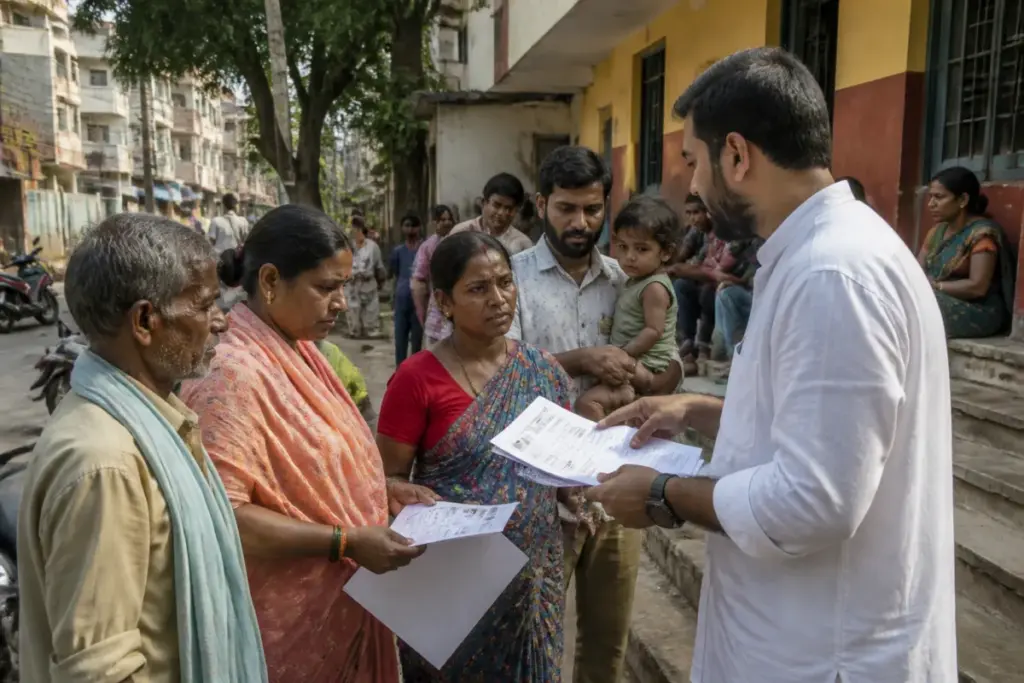
Bengaluru’s voter roll revision has exposed a serious gap between administrative data and residents’ ability to protect their electoral registration. In several polling stations, large numbers of electors were marked absent, shifted, dead or duplicate, while residents told The Hindu that they had not received enumeration forms, deletion notices or clear instructions on how to restore their names.
The issue is not limited to the question of whether individual entries were correctly classified. It also shows how a formal revision exercise can become difficult to navigate for citizens whose working hours, mobility and limited access to official information prevent them from responding in time. In New Timber Yard Layout, many residents work as labourers, carpenters or daily-wage workers and are away from home during the hours when Booth Level Officers may visit.
The scale of deletions reported at some polling stations makes the administrative process particularly important. At polling station Part No. 242, the Summary Revision 2025 data recorded 1,419 electors. Of these, 776 were marked for deletion: 389 as shifted, 275 as absent, and 112 as dead or duplicate. Residents said some people listed as absent had been living in the area, while some marked shifted said they had not changed residence.
A similar pattern was reported at Part No. 243 in New Timber Yard Layout. The 2025 revision data recorded 1,399 electors, of whom 722 were marked for deletion, mostly under the absent or shifted categories. Enumeration data accessed by The Hindu also showed consecutive blocks of serial numbers marked absent or shifted, including serial numbers 334 to 343, 472 to 485, and 716 to 735.
Consecutive entries being classified in the same way does not by itself establish that the deletions were incorrect. It does, however, raise an administrative question about how verification was conducted and how residents were given an opportunity to respond. The distinction matters because electoral rolls are not merely databases. They determine whether an eligible citizen can exercise a constitutional right at a particular polling station.
Residents’ accounts point to a second weakness: the information system surrounding the revision. Sonu, a carpenter from New Timber Yard Layout, told The Hindu that residents only recently learnt that they had to apply for inclusion because their names had been deleted. He said Booth Level Officers had told them there was no last date to apply, leaving residents unaware that an additional list and a final roll were part of the process and that Form-6 could be used for inclusion.
Lakshmi, who said she had lived in the locality for years but was marked absent, told the newspaper that she had not received a notice explaining why her name was being deleted or what she needed to do next. Other residents said they had assumed that submitting details during a door-to-door exercise would be sufficient and did not understand that a separate application might be necessary if their names were left out.
This is where the Bengaluru case becomes a question of governance rather than only electoral procedure. A process may provide a formal remedy, but that remedy is weak if the affected population does not know that it exists, cannot identify whether its name has been removed, or has to lose a day’s wages to complete an application. The administrative burden is then transferred from the institution conducting the revision to the citizen whose record is at risk.
The reported experiences also expose the importance of last-mile communication. Residents said some Booth Level Officers visited from time to time, but many did not receive enumeration forms. Others said they submitted forms but still found their names deleted. Some people who knew that the Special Intensive Revision was under way said they were told that their forms would be issued in another State, but reported that they did not receive forms there either after the exercise was completed.
The problem is compounded when information is distributed through channels that do not match the city’s labour and housing conditions. Daily-wage workers may not be present at home during office visits. Tenants and migrant households may have links to more than one location. Residents may know their voter identity card exists but not understand that the electoral roll, rather than possession of the card, determines whether they can vote at a polling station. The supplied report does not establish how widespread each of these conditions is, but it shows how they can interact with a large-scale revision.
Another polling station illustrates the potential scale of the problem. At Shanti Children School, Room No. 1, in the Sarvagnanagar Assembly constituency, the Summary Revision 2025 data recorded 1,134 electors, of whom 1,053 were marked under the Absent, Shifted, Dead, Duplicate and Others category. Residents in that locality similarly reported that they were unaware their names had been deleted, that draft electoral rolls had been published, or that Form-6 could be used to seek inclusion.
These figures should be read carefully. The report notes that the enumeration data accessed by The Hindu were from August. Before the draft rolls were published, the ASDDO list had been made public and many names were subsequently restored. The newspaper contacted Booth Level Officers to ask whether deletions at the reported polling stations had changed, but updated figures were not provided. The current status of every entry described in the report is therefore not established in the supplied material.
That limitation does not remove the public-interest issue. It changes the question from how many names were finally removed to whether the correction process was visible, accessible and understandable to the people affected. A revision system can produce a more accurate roll only if citizens can detect errors and participate in correcting them. Without that feedback loop, the final list may reflect not only verification outcomes but also unequal capacity to respond.
The institutional framework described in the report places Booth Level Officers at the centre of that feedback loop. They are expected to interact with residents, distribute or collect forms and support the preparation of electoral data at the polling-station level. But the accounts from Bengaluru indicate that the effectiveness of this local interface depends on whether residents are reached, whether notices are understood and whether the next procedural step is explained clearly.
The report also mentions a special campaign in areas reporting high numbers of electors classified as absent, shifted, duplicate or dead. Such a campaign suggests that the administration has recognised that certain localities require additional attention. Its significance will depend on whether it reaches residents who were missed during the original exercise and whether the process communicates not just that a name is absent, but also the precise action needed for restoration.
The potential consequences extend beyond voting. Residents feared that deletion from electoral rolls could affect access to other benefits, including ration benefits and free bus travel for women. The supplied report does not establish that electoral-roll deletion automatically removes eligibility for those schemes. Their concern nevertheless reflects a wider perception that government databases are interconnected and that a change in one record may create difficulties elsewhere. That perception makes clear communication especially important.
Bengaluru’s experience therefore raises a structural question about the design of urban administration: can a city verify millions of records without creating an information and access deficit among the people being verified? The answer depends on more than the accuracy of a database or the number of forms processed. It depends on whether administrative systems recognise how residents live and work, especially in neighbourhoods dominated by informal employment, rented housing and high daily mobility.
The evidence currently confirms three things. Large clusters of Bengaluru electors were marked under deletion-related categories in the data examined by The Hindu; residents in affected areas reported inadequate notice or guidance; and some names were later restored before the draft rolls were published. What remains unclear from the supplied material is the updated number of deletions at each polling station and how many residents ultimately regained inclusion.
The next stage of the exercise will therefore be judged not only by the publication of a final roll but by the transparency of corrections and the reach of the special campaign. For Bengaluru residents, the central issue is straightforward: whether an administrative classification can be challenged in time by the people whose names it affects.


