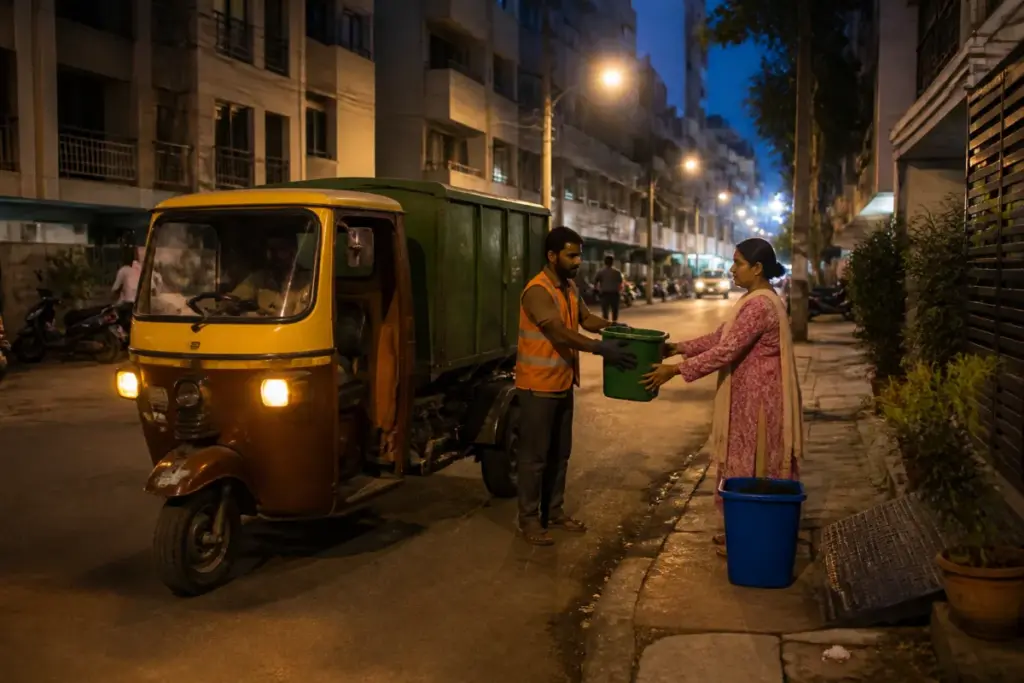
Bengaluru South City Corporation has begun evening waste collection in five wards, deploying 20 to 25 autos between 5 p.m. and midnight to address roadside garbage blackspots and help residents who cannot hand over waste during morning hours.
Commissioner K.N. Ramesh said the pilot covers four wards in the Bommanahalli Assembly constituency and Hongasandra ward. He inspected the evening collection system and said the additional service was intended to make it easier for households to hand over wet and dry waste after work and other daytime commitments.
The five wards already have 160 waste collection vehicles operating in the morning. The evening pilot adds a separate deployment of smaller collection autos. In Hongasandra, six vehicles—three for wet waste and three for dry waste—are operating during the evening, while 31 autos continue to collect waste in the morning, Mr. Ramesh said.
The pilot responds to a persistent sanitation problem in parts of south Bengaluru, where residents’ welfare associations have repeatedly reported the emergence of garbage blackspots. Areas including Adugodi, S.G. Palya and Siddapura Road have recently seen complaints about roadside waste accumulation.
Residents have linked some of the new blackspots to the enforcement of waste-segregation rules. Bengaluru Solid Waste Management Limited has directed collection vehicles not to accept unsegregated waste. According to the report, some households that had previously handed over mixed waste began leaving it on roadsides when collection vehicles refused to take it.
The timing of collection has also been a longstanding concern. Residents have used social media and raised the issue with civic authorities, arguing that morning-only collection does not work for households whose members leave for work before collection vehicles arrive. Evening or twice-a-day collection has consequently become a recurring demand in several parts of the city.
The decision marks a shift from the earlier position expressed by Bengaluru Development Minister Krishna Byre Gowda. He had rejected requests for evening collection, saying that accommodating residents’ convenience could require civic authorities to collect waste throughout the day. He had also said it would not be feasible to ask sanitation workers to collect waste twice daily or appoint additional workers for that purpose.
The present arrangement uses a limited number of autos rather than introducing twice-daily collection across the city. Its immediate operational focus is on the five selected wards and on collecting both wet and dry waste during the evening window. The corporation has not indicated in the supplied report how long the pilot will run or whether it will be extended to other wards.
The pilot places the practical challenge of waste segregation alongside the question of collection access. While the city’s rules require households to hand over segregated waste, the effectiveness of that system also depends on residents having a workable opportunity to pass waste to authorised vehicles. For now, the corporation’s next step is to operate the evening service in the selected wards while the pilot continues.