

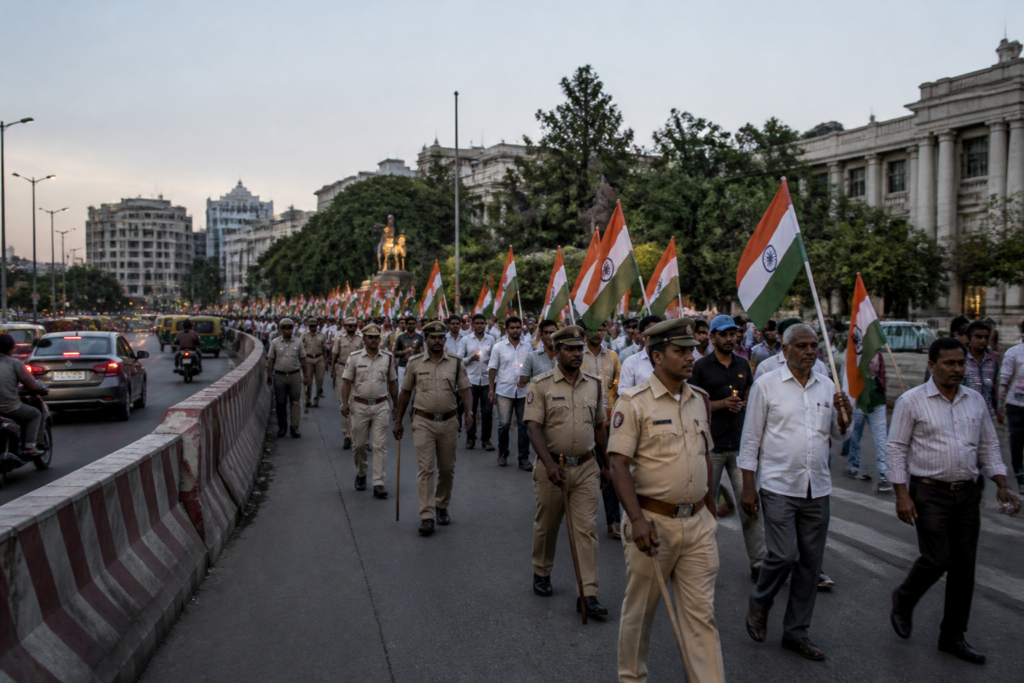
Bengaluru protest restrictions came into focus again on Friday when a Tiranga march organised by the Cockroach Janata Party, along with Jagrita Karnataka and My Vote, My Right, was allowed to travel from Town Hall to the Quit India Memorial near Bannappa Park. The police did not permit the organisers to hold the protest march they had originally sought, but approved a peaceful march under tightly defined conditions. The episode shows how the city is trying to manage a difficult administrative question: how can public movement and traffic be protected without turning the regulation of demonstrations into a broader restriction on public assembly?
The march was part of a nationwide mobilisation by the CJP over alleged irregularities in the Special Intensive Revision of electoral rolls and its demand for the resignation of Chief Election Commissioner Gyanesh Kumar. Participants carried the national flag and a banner displaying the Preamble to the Constitution, while raising slogans including ‘Hum Honge Kamyab’ and ‘Inquilab Zindabad’. It began at Town Hall and ended at the Quit India Memorial near Bannappa Park, close to Mysuru Bank Circle on Kempegowda Road.
The immediate administrative framework was set out in a communication dated October 16 from the office of the Assistant Commissioner of Police, Halasuru Gate Sub-Division. The permission covered the march between 5 pm and 6.30 pm, while stating that Town Hall, the route and the memorial were not designated venues for protests under a Karnataka High Court order. The organisers were therefore directed not to hold a protest or symbolic demonstration at any of those locations.
The distinction between a march and a protest was central to the arrangement. The police prohibited protest-related posters, placards and banners, as well as slogans that could disturb public order or target a political party, organisation or individual. The organisers were also required to ensure that pedestrian and vehicular movement was not obstructed and that the event concluded within the permitted time. In practice, the permission allowed a processional use of public space while limiting the political expression that had prompted the original request.
This is not an isolated administrative decision. The Karnataka High Court’s August 1, 2022, order restricted protests, dharnas and rallies in Bengaluru to designated venues, including Freedom Park. Officials have cited the possibility of traffic congestion and disruption to public movement when demonstrations take place on roads or at locations outside those venues. The order has consequently become a recurring reference point whenever organisers seek to use central roads, civic landmarks or government-office approaches for public demonstrations.
The rule creates a designated geography for dissent. Freedom Park functions as the principal approved site, while other high-visibility locations and routes are subject to police permission and conditions. That arrangement gives authorities a clear mechanism to separate protest activity from busy transport corridors. It also means that the location of a demonstration becomes an important part of its public meaning: a protest near a government office or civic landmark can communicate a direct demand, whereas a gathering at a designated site is easier to contain and manage.
The recent sequence of events has made that tension more visible. On Monday, protesters attempting to march towards the Chief Electoral Officer’s office near K R Circle were preventively detained after refusing to move to Freedom Park. Photojournalists covering the police action alleged that they were manhandled. The supplied report does not establish the outcome of those allegations, but it records that the episode drew scrutiny. On Tuesday, Home Minister Priyank Kharge and Chief Minister D K Shivakumar reiterated that peaceful protest was fundamental to democracy and said the police action would be reviewed.
Friday’s march was handled differently. Deputy Commissioner of Police (Central) Akshaya M Hakay told The Indian Express that the police were not denying anyone their freedom and pointed to peaceful marches, including drug-awareness campaigns, festivals and religious processions, that had been held from Town Hall with adequate security arrangements. He said the organisers had sought permission for a peaceful Tiranga march after their request for a protest march was denied.
The police position, as reported, is therefore not that public gatherings are prohibited across the city. It is that different forms of gathering can be regulated differently, based on their purpose, route, slogans, banners and likely effect on public movement. The organisers’ position was also clearly stated. Subhashree, a CJP coordinator, said the march would remain peaceful and that participants would carry the national flag without violence.
For Bengaluru, the significance lies in the way a traffic-management rule is being applied to a political act. The police conditions deal with pedestrian and vehicular movement, time limits, route control and public-order concerns. These are ordinary requirements for managing a large gathering in a dense urban area. But the same conditions also determine what participants may display, say and symbolically do. Administrative control over the route consequently becomes control over the form in which the protest can be seen and heard.
The city’s designated-venue model reflects a familiar governance preference: concentrate demonstrations in spaces that can be secured, monitored and separated from major traffic flows. This can make policing more predictable and reduce the risk of disruption on roads. It can also reduce the ability of demonstrators to reach the institution or public site they want to address. The supplied material does not provide data comparing congestion, police deployment or public disruption at Freedom Park with other locations, so the relative effectiveness of the model cannot be measured from this episode alone.
Nor does the report establish whether the restrictions have resolved the underlying dispute over where peaceful political expression should take place. The sequence instead shows an unresolved administrative boundary. The police have relied on the High Court order to deny a protest march, while political leaders have acknowledged peaceful protest as fundamental to democracy and promised a review of police action. The Friday permission demonstrates that a narrower, conditional route can be found, but it does not clarify how future requests will be classified.
That classification will matter. A march carrying the national flag may be permitted if it is defined as peaceful and non-protest activity, while the same route may be refused when organisers seek to display protest placards, raise targeted slogans or symbolically demonstrate at a civic location. The difference is not merely semantic. It affects the visibility, destination and political purpose of a public gathering. Yet the supplied report does not state the detailed criteria used by the police to distinguish one category from the other beyond the conditions listed in the permission letter.
The case also underlines the importance of transparent municipal and police coordination in a city where central roads serve several functions at once. Town Hall, Mysuru Bank Circle, Kempegowda Road and the area near K R Circle are not only civic or symbolic spaces; they are also part of the movement network. Decisions about demonstrations therefore involve policing, traffic management, court directions and the administration of public space. The impact is experienced by both participants seeking to assemble and commuters seeking uninterrupted movement.
What the evidence confirms is a tightly managed march permitted after a protest request was rejected, against the backdrop of a court-directed designated-venue system and recent scrutiny of police action. What remains unclear is how consistently the boundary between a permitted march and a prohibited protest is applied, how the authorities assess disruption, and what the promised review of Monday’s action will conclude. Those next steps will determine whether Bengaluru’s current approach becomes a stable framework for public gatherings or remains a recurring source of contest over access to the city’s most visible public spaces.


