

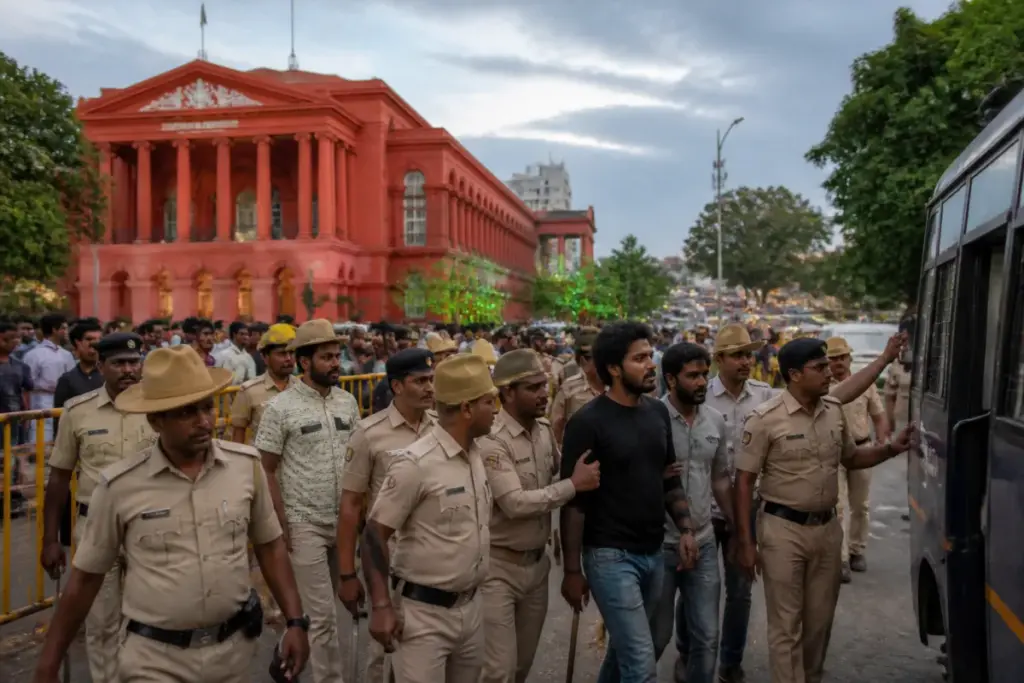
Bengaluru police detained hundreds of young protesters, including members of the All India Students’ Association (AISA) and activists from the Cockroach Janta Party, after they gathered outside Town Hall on Saturday evening to protest the ongoing special intensive revision (SIR) exercise despite being denied permission.
The protesters had sought approval from the jurisdictional police at Ulsoor Gate station to hold the demonstration outside Town Hall. Police rejected the application, citing High Court orders that restrict protests and agitations in Bengaluru to Freedom Park. The police suggested that the organisers shift the demonstration to Freedom Park instead.
Despite the refusal, AISA announced on social media that its members would assemble outside Town Hall. The gathering subsequently took place at the central Bengaluru location, where police detained the protesters for allegedly proceeding with the demonstration without permission.
The incident highlights the operational role of designated protest spaces in Bengaluru. According to the report, the police relied on existing High Court directions while processing the application and did not permit the proposed demonstration at Town Hall. The restrictions mean that organisers seeking to stage public protests in the city must use Freedom Park rather than other locations, including the area outside Town Hall.
The protest was directed against the ongoing SIR exercise. The report does not provide details of the protesters’ specific objections, the number of people detained, the duration of the detentions or whether any cases were registered. It also does not state whether the organisers later agreed to move the demonstration to Freedom Park.
Town Hall is a prominent public building and civic gathering point in central Bengaluru. Restrictions on demonstrations at such locations place the responsibility for managing public assembly primarily on the police and the designated protest venue. In this case, the authorities’ decision was based on the High Court orders cited in the police response to AISA’s permission request.
The episode also shows how protest planning now intersects with digital mobilisation. Although permission had been denied, AISA used social media to announce that the gathering would proceed at Town Hall. Police action followed when the protesters assembled at the location identified in the announcement.
Further details on the legal provisions applied during the detentions, the police action against individual protesters and any subsequent decision by the organisers were not available in the report. The immediate next step will depend on the police process following the detentions and on whether the organisers seek permission to hold the protest at Freedom Park.


