

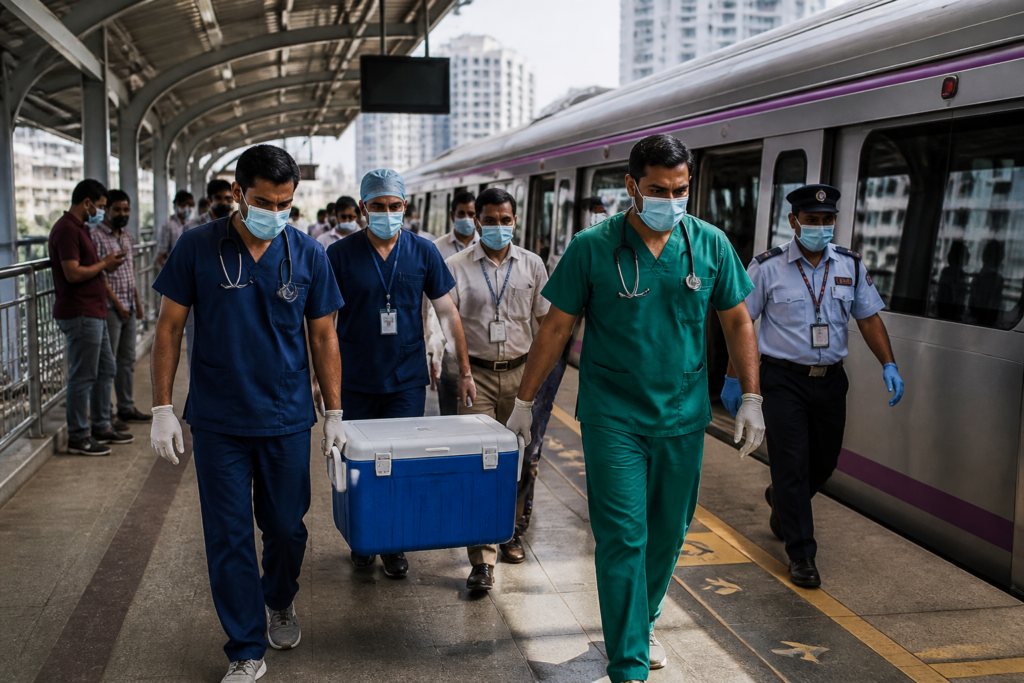
Bengaluru Metro transported a donated heart from Sparsh Hospital in Goraguntepalya to Apollo Hospital near Mantri Square on Wednesday, completing the rail journey in 18 minutes and helping avoid possible delays from road traffic.
Doctors decided to use the Green Line after assessing that transporting the organ by road could take longer because of congestion. The medical team discussed the plan with Bengaluru Metro Rail Corporation Limited (BMRCL) officials before bringing the heart to Goraguntepalya Metro station at 2.20 pm.
BMRCL staff and members of the hospital’s medical team carried the heart into a Metro train at 2.22 pm. The train then travelled to Mantri Square station, where the heart was transferred to an emergency vehicle for the final journey to Apollo Hospital.
The operation placed the Metro system within a tightly coordinated medical transfer involving hospitals, doctors, station staff and emergency transport. The rail journey was limited to the section between the two Metro stations, with road vehicles used for the first and last legs of the transfer.
BMRCL officials said that, including Wednesday’s transport, six donated organs have so far been moved through the Bengaluru Metro network. These include one liver, three hearts and one pair of lungs. The figures indicate that the system has been used for more than one type of time-sensitive organ transfer.
For organ donation logistics, the movement between hospitals is not limited to the distance on a map. The transport chain must also account for traffic conditions, station access, transfer points and the time required to move the organ safely between medical teams and vehicles. In Wednesday’s case, the Green Line provided a rapid middle section between Goraguntepalya and Mantri Square.
The latest transfer also illustrates how an existing urban transport network can support emergency medical operations without requiring a dedicated road corridor for the entire journey. The heart was transported by Metro only after coordination between the doctors and BMRCL, and it was handed over to an emergency vehicle after reaching Mantri Square station.
BMRCL’s disclosure that six organs have been transported through the Metro provides a record of the system’s expanding role in time-critical civic operations. Wednesday’s movement began at 2.20 pm, entered the train at 2.22 pm and reached Mantri Square 18 minutes later, according to the report.


