

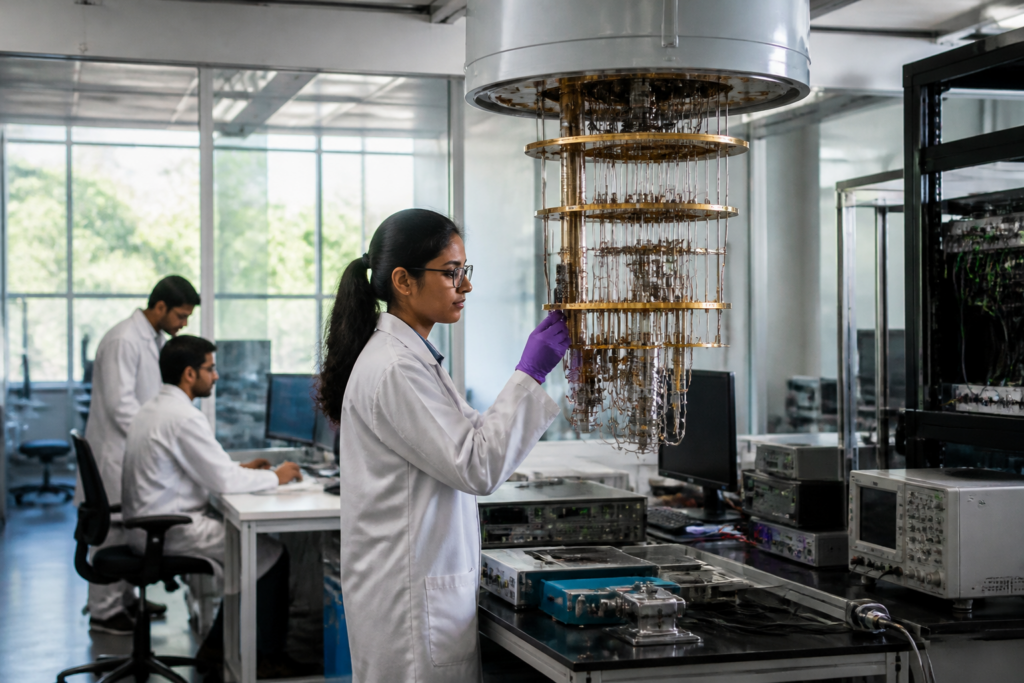
Bengaluru has added two new quantum technology facilities aimed at expanding research, specialised training and indigenous hardware development, with the Indian Institute of Science (IISc) partnering with Samsung Semiconductor India Research (SSIR) and Manipal Institute of Technology launching its own quantum hub.
The Quantum Research Lab at IISc was inaugurated on October 15 with corporate social responsibility support from SSIR. The facility will support work on qubit characterisation, cryogenic electronics, quantum-device reliability, single-photon sources and detectors, and the integration of advanced semiconductor materials with quantum systems.
According to IISc, the laboratory has already catalysed research on two-dimensional-material-based quantum devices and emerging device concepts under cryogenic conditions within the institute’s Department of Electronic Systems Engineering. The collaboration brings semiconductor research and quantum technology infrastructure together at a time when access to specialised equipment remains a major requirement for advanced experimentation.
IISc said the facility is intended to serve researchers and students beyond the institute. Through structured training and research exposure, participants from institutions across India will be able to engage with quantum technologies and experimental infrastructure that may otherwise remain inaccessible because of high capital and operational costs.
The institute said the broader objective is to help build a national talent pool capable of contributing to India’s developing quantum technology ecosystem. The IISc–SSIR collaboration will also support selected learning modules on quantum materials and devices, cryogenic electronics and qubit technologies under the India Semiconductor Workforce Development Program.
The workforce programme addresses skills in areas including device physics, process development, modelling, simulation, characterisation and reliability. Rajesh Krishnan, Managing Director of Samsung Semiconductor India Research, said the partnership would combine advanced infrastructure, education and access to support research linked to semiconductors and quantum technologies.
IISc Director Professor Govindan Rangarajan said the partnership would strengthen both frontier quantum research and semiconductor workforce development. He described the initiatives as part of IISc’s wider role in advancing national capabilities in quantum computing and next-generation semiconductor technologies.
Separately, Manipal Academy of Higher Education has established Manipal House of Quantum, Quantum-Hub@MAHE, at the Manipal Institute of Technology campus in Bengaluru. The facility is intended to support quantum hardware experimentation, engineering education and indigenous technology development in alignment with India’s National Quantum Mission.
MAHE said the facility provides students, researchers and industry collaborators with access to quantum hardware, cryogenic systems and quantum control technologies. Its planned activities include experimentation, application development, deep-tech start-up incubation, component innovation, testing and translational research.
The facility has commenced operations with a 25-qubit open-architecture dilution refrigeration system for training and experimentation. According to the institute, its roadmap moves from sub-50-qubit training systems to 150-qubit proof-of-concept platforms and eventually to industrial-grade quantum product systems with more than 1,000 qubits.
The two Bengaluru facilities represent separate institutional initiatives, but both place specialised infrastructure and practical training at the centre of quantum technology development. Their next operational milestones will be the expansion of research access, delivery of training programmes and progression of the planned hardware development roadmap.


