

The Bastar rehabilitation programme has entered a wider phase in which the response to Maoist violence is being linked not only to prosthetic support but also to housing, employment, banking, welfare access and public-service delivery. The shift matters because the consequences of conflict in a remote region are not limited to security. They also shape mobility, access to institutions, household stability and the ability of residents to participate in ordinary civic life.
Union home minister Amit Shah’s interaction with people from Bastar who were disabled in Maoist violence was part of the second phase of a rehabilitation programme for persons with disabilities. According to figures cited in the report, more than 3,600 beneficiaries were covered during camps held in Jagdalpur from October 5 to 7, including more than 1,570 people from Bastar. The assistance included artificial limbs, wheelchairs, tricycles, crutches, hearing aids and smart walking sticks.
The immediate intervention is therefore practical and physical: restoring mobility or helping people manage disabilities through assistive devices. But the programme also reveals the broader administrative challenge of rehabilitation. A prosthetic limb can improve movement, yet a person’s ability to live independently still depends on access to roads, public buildings, welfare offices, health services, education, livelihoods and household income. The government’s stated expansion of the programme acknowledges that disability caused by conflict cannot be addressed through a single camp or one-time distribution exercise.
The report says Shah described people disabled by improvised explosive devices and other incidents linked to Maoist violence as victims of a grave human rights violation. He also said rehabilitation must continue after the decline of Maoist violence. That distinction is significant. A reduction in active violence does not automatically remove the institutional and economic effects created by years of insecurity. Physical impairments, displacement, disrupted livelihoods and missing documents can continue to affect families long after the immediate conflict environment changes.
The figures cited by Shah indicate the scale of the wider state response. As many as 8,526 Maoists have surrendered, while 7,328 bank accounts have been opened for people who did not previously have one. The government has sanctioned 4,014 houses and provided jobs to 455 people, according to the report. These numbers cover different parts of the rehabilitation effort, but together they point to a process that extends beyond security operations into formal systems of identification, finance, housing and employment.
Bank accounts are a basic administrative gateway. They allow welfare payments and other forms of state support to be transferred through formal channels, but opening an account does not by itself establish economic security. The figures show that financial inclusion has been treated as one component of rehabilitation, alongside housing and employment. The report does not provide details on the value of benefits, the employment sectors involved, the location of sanctioned houses or the long-term status of the beneficiaries. Those gaps matter because the headline count of interventions cannot alone show whether households have achieved durable independence.
Housing has a similar institutional importance. The sanctioning of 4,014 houses suggests that rehabilitation is being linked to a permanent or semi-permanent settlement framework rather than only to immediate relief. Yet a housing sanction is an administrative milestone, not necessarily a completed, occupied and serviced home. The supplied report does not establish how many houses have been completed, whether they have electricity and water connections, or how close they are to schools, healthcare facilities, markets and transport. Those details will determine whether housing support becomes part of a functioning civic network.
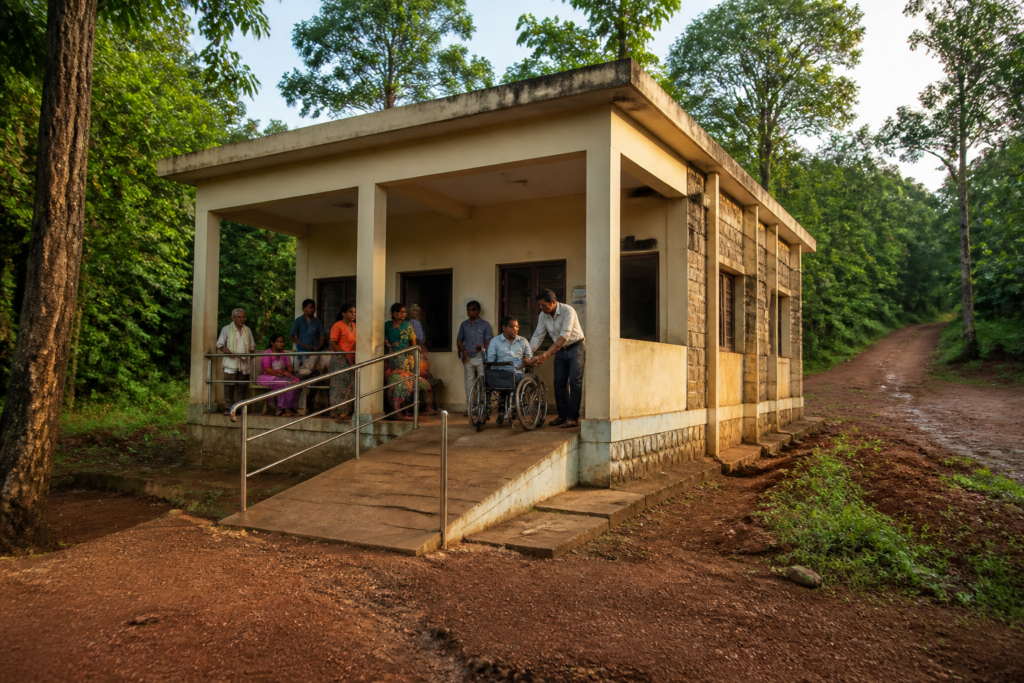
The conversion of more than 200 of the over 500 security camps established during the anti-Maoist campaign into Shaheed Veer Gundadhur public service centres is the most important institutional development in the report. It represents a change in the intended use of physical infrastructure. Locations created primarily for security deployment are now expected to help deliver government and welfare services in remote parts of Bastar.
This proposed conversion also raises a central planning question: whether public services can be brought closer to residents by repurposing an existing network rather than building an entirely new one. In remote regions, distance is not simply a transport problem. It can determine whether residents are able to obtain documents, access welfare schemes, reach officials or seek assistance without losing a day or more of work. A service centre located closer to villages could reduce that administrative distance, although the report does not specify the staffing, operating hours, services or budgets planned for the new centres.
The physical transformation of a security camp into a public facility is also a change in the relationship between the state and the settlement around it. During conflict, the presence of an institution may be understood primarily through security. In the proposed next phase, the same location is expected to support welfare delivery and normal civic administration. That transition will depend on whether the centres become reliable points of public contact rather than only renamed facilities.
The report places this institutional shift alongside initiatives such as the Bastar Olympics, Bastar Pandum and Niyad Nellanar. Shah presented these measures as part of a broader effort to restore normal civic life. The supplied material does not provide operational details or outcome data for these initiatives, but their inclusion indicates that the government’s stated framework combines physical rehabilitation with social and economic reintegration.
That combination is important because conflict-related disability is not only a medical issue. A person who has lost a limb in an IED blast may require an assistive device, but may also need income support, accessible transport, a suitable home, documentation, family assistance and a way to return to work or community life. The programme’s expansion towards housing, jobs, bank accounts and skill training reflects this wider administrative reality. At the same time, the report does not establish how these services are coordinated across departments or how beneficiaries are tracked after initial support.
The numbers also show why a camp-based approach cannot be the entire system. More than 3,600 people were covered in the reported Jagdalpur camps, but the government’s own figures describe a much larger population affected by surrender, displacement, disability and economic vulnerability. The report says the next phase will focus on people left disabled, displaced or economically vulnerable. This broadens the definition of the beneficiary beyond those receiving mobility aids and places pressure on the state to maintain records of different needs over time.
For Bastar, this is fundamentally a question of last-mile governance. The region’s rehabilitation challenge is not solved when assistance reaches a camp. It is solved only when residents can continue to access services after returning home, when houses are connected to basic infrastructure, when employment support produces sustained income and when people with disabilities can move through public spaces and institutions. The available figures establish the scale of announced interventions but do not yet measure the quality or continuity of that access.
The shift from security camps to public service centres could become a visible marker of the region’s transition, but the evidence supplied supports only the announcement of the proposed conversion, not its completion. Similarly, the cited numbers on bank accounts, houses and jobs demonstrate administrative activity, while leaving open questions about delivery, use and outcomes. These distinctions are essential in evaluating post-conflict rehabilitation: inputs show what the state has initiated, while outcomes show whether residents’ daily lives have changed.
The Bastar rehabilitation programme therefore sits at the intersection of disability support, housing, infrastructure and governance. Its stated ambition is larger than restoring mobility after injury. It is to rebuild the institutional conditions for independence and dignity in a region where violence has affected both bodies and access to the state. The next evidence to watch is the functioning of the proposed public service centres, the completion and servicing of sanctioned houses, and the continuity of support for beneficiaries after the rehabilitation camps end.


