

Balrampur rehabilitation is being built through more than compensation or a single government benefit. In Chhattisgarh’s Balrampur-Ramanujganj district, families affected by Maoist violence are being connected to self-help groups, small loans, housing, literacy programmes and government employment. The approach offers a useful view of rehabilitation as an institutional process: restoring a household’s capacity to earn, live securely and participate in everyday administration.
The district administration has covered 94 families under its wider rehabilitation exercise. These families fall into four categories: surrendered Maoists, civilians injured in violence, dependants of people killed in violence, and families whose property was damaged. The classification matters because the effects of conflict are not uniform. A family that has lost a wage earner requires a different form of support from one whose house or property has been damaged. A surrendered person may need economic reintegration, while an injured civilian may require assistance linked to both income and care.
The available figures show that the administration has attempted to convert this classification into targeted support. Of 34 families identified as eligible for linkage with self-help groups, 25 have joined so far. They include nine families of surrendered Maoists, all three eligible families of injured civilians and 13 other Maoist-affected families. The groups operate under Bihan, the national rural livelihood mission programme through which women’s collectives can access savings, credit, training and income-generating activities.
This is significant because self-help groups are not simply small-business platforms. They are also local institutions through which households interact with the state. A savings book, a loan record and participation in a group can provide a family with a documented economic identity. For households emerging from violence and administrative neglect, that connection may be as important as the initial financial assistance.
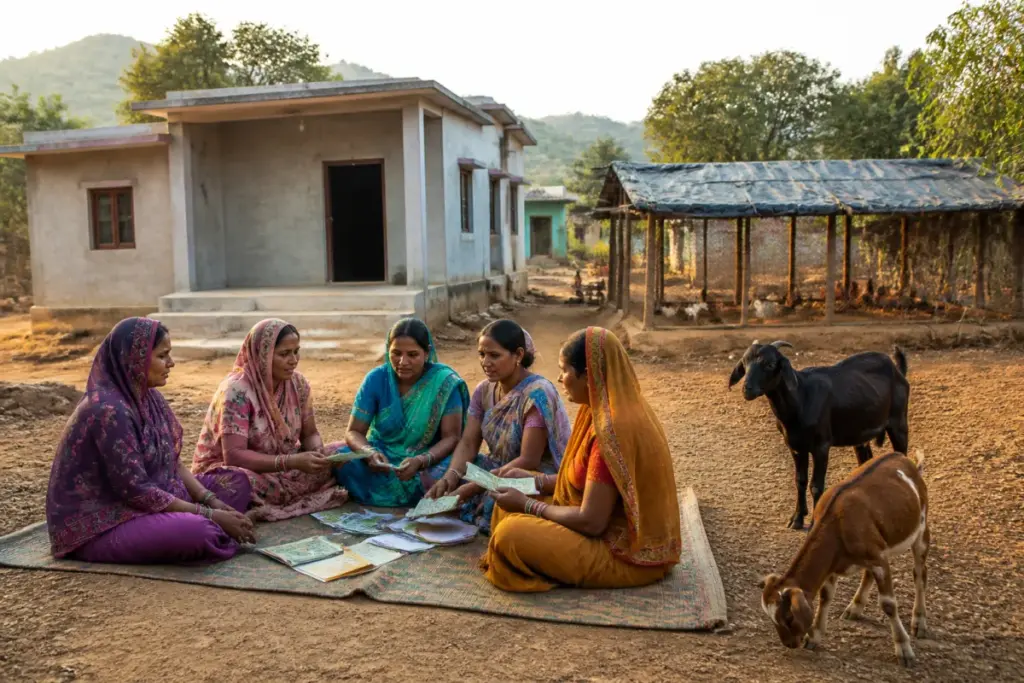
The experience of Savita Singh of Barwahi village illustrates the progression. Singh’s father-in-law was killed in Maoist violence, leaving the family without its main support. After receiving a permanent house under the Pradhan Mantri Awas Yojana, she joined the Nisha women’s self-help group and began goat rearing with a loan of Rs 2,000. A second loan of Rs 10,000 helped expand the activity.
According to the district administration, goat rearing now generates between Rs 1 lakh and Rs 1.5 lakh a year for the family. Poultry and dairy have added to household income. The reported change is not only a rise in earnings. It shows how housing and livelihood support can reinforce each other. A permanent home provides stability, while access to modest working capital allows a household to build an activity suited to its local conditions.
The sequence is important. A house without an income source can remain a completed asset without becoming a durable foundation for recovery. Conversely, a livelihood intervention is more difficult to sustain when a family lacks secure shelter. In Singh’s case, the administration’s account presents housing, group membership and credit as linked stages rather than isolated benefits.
More than a dozen women from the affected families are also being trained with the objective of helping them qualify as “Lakhpati Didis”. The term refers to women being supported to achieve annual household incomes of at least Rs 1 lakh. The report does not provide the number of women who have already reached that level, so the training should be understood as an ongoing intervention rather than a completed outcome.
Housing remains another major component of the district’s plan. Twenty-seven houses have been sanctioned under a special PMAY project for surrendered and Maoist-affected families. Eighteen houses have been completed and nine are still under construction. The completion rate reported by the administration is therefore two-thirds of the sanctioned total, while the remaining homes represent unfinished rehabilitation commitments.
That distinction is important in evaluating public programmes. Sanctioning a house establishes administrative approval, but completion determines when a household receives the intended benefit. Until construction is finished and the home becomes usable, the family remains dependent on existing accommodation. The nine houses still under construction are therefore not merely a pending infrastructure figure; they mark the distance between a government decision and a lived outcome.
The rehabilitation plan also includes measures that extend beyond housing and income. Five members of affected families in Nawadih, also known as Kothli village, who were previously unable to read or write became literate under the literacy mission in 2025. Dependants from 29 families of people killed in Maoist violence have been given government jobs. Relief assistance has also been extended in most eligible cases involving death, injury and property loss, according to the district administration.
These measures show that the administration is treating rehabilitation as a portfolio of needs. Housing addresses physical security. Self-help groups and loans address income. Literacy addresses participation and access. Government jobs provide a more stable form of support for some dependants. Relief assistance responds to immediate loss. None of these interventions, taken alone, can restore a household’s social and economic position after violence.
Collector Chandan Sanjay Tripathi said the focus was on linking each family with the support it actually needed, including housing, livelihood, education, nutrition or welfare schemes, instead of treating rehabilitation as a one-time benefit. That approach places coordination at the centre of implementation. The challenge is not only whether individual schemes exist, but whether eligible households are identified, connected to them and followed through until delivery is complete.
This is where the institutional structure becomes visible. The district administration is acting as the coordinating layer across housing, rural livelihoods, literacy, employment and relief. Bihan provides the self-help-group framework; PMAY provides the housing channel; the literacy mission addresses education; and government employment and relief measures respond to specific categories of loss. The report does not establish that all these programmes operate through one formally unified system, but it shows that the district is presenting them as parts of a common rehabilitation exercise.
The numbers also reveal both progress and limits. Twenty-five of 34 eligible families have been linked with self-help groups, leaving nine eligible families yet to be linked. Eighteen of 27 sanctioned houses are complete, leaving nine under construction. Government jobs have reached dependants from 29 families, while the report does not specify the total number of eligible dependants or whether every eligible family has received all applicable forms of assistance.
Those gaps do not invalidate the reported progress. They indicate why rehabilitation needs continuing measurement. A family may be counted as covered after receiving a sanction, a loan or a job, while the quality and durability of the outcome may require longer observation. Income from goat rearing, for example, can fluctuate with animal health, market access, feed costs and the household’s ability to expand. The source establishes the administration’s reported annual income figure but does not provide a longer income history or independent assessment.
The district administration says Balrampur-Ramanujganj was removed from the list of Left-Wing Extremism-affected districts on April 4, 2025. That administrative change provides an important backdrop, but it does not by itself complete the process of recovery for families affected by the conflict. The removal of a district from a classification reflects a change in the security framework; rehabilitation addresses the accumulated social and economic consequences experienced by individual households.
The distinction is relevant for public policy. Security-related classifications are usually made at the district or administrative level, while housing insecurity, lost income, illiteracy and dependence are experienced at the family level. A district may move out of an affected category even as some households continue to require assistance. The Balrampur exercise therefore demonstrates the need for post-conflict programmes that continue beyond the point at which an area’s official status changes.
For the built environment, the lesson is equally direct. Housing is not only a construction output. Its value depends on whether it is connected to livelihoods, basic services, social networks and administrative support. In Balrampur, the reported rehabilitation model places the house alongside credit, women’s collectives, education and employment. That broader approach is more consistent with how households actually rebuild their lives.
The evidence supplied by the district administration confirms a multi-layered intervention, but it does not yet establish the long-term results of the full programme. The number of self-help-group linkages, completed homes, literate beneficiaries and government appointments provides a picture of implementation. The next measure will be whether the remaining families are connected, whether the nine houses under construction are completed and whether the new livelihoods remain viable over time.
Balrampur’s experience suggests that rehabilitation becomes more meaningful when it moves from one-time relief to household capability. A permanent home, access to credit, a functioning women’s group, literacy and stable employment address different parts of the same problem. The administration’s continuing task is to ensure that these interventions reach every eligible family and remain connected after the immediate crisis has passed.


