

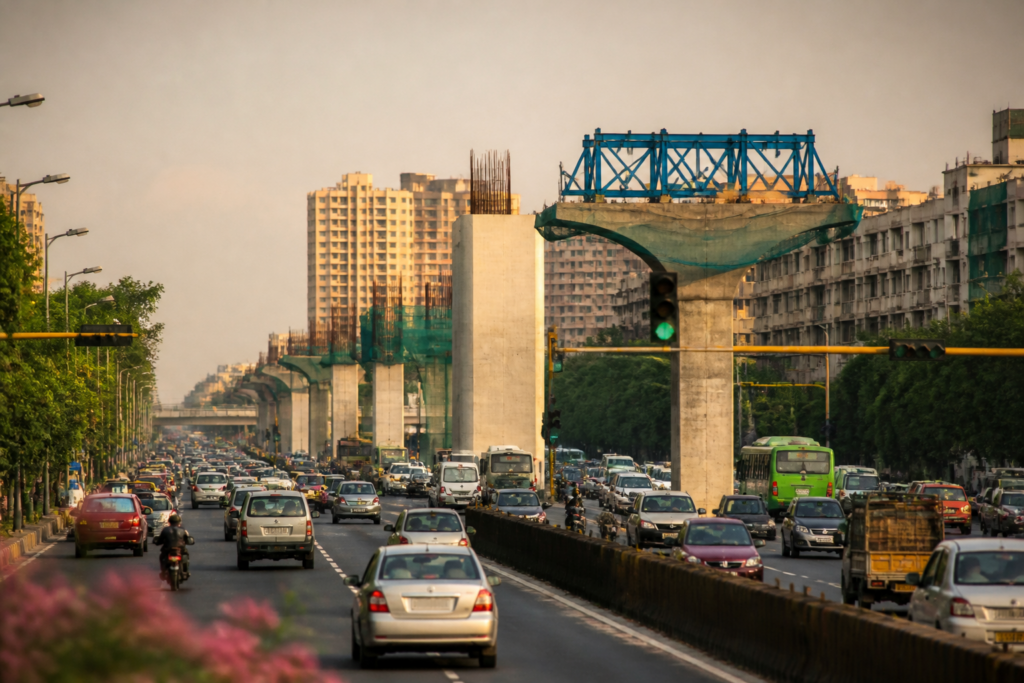
The Ashram-Badarpur corridor in Delhi is set for a major traffic overhaul, with the National Highways Authority of India planning four new flyovers to make the 7.977-kilometre stretch of Mathura Road signal-free. The Rs 378.87-crore project is expected to begin in January 2027 and take about two years to complete, according to a report by Jagran – New Delhi.
The proposed corridor runs from Ashram Chowk to the Badarpur Border, a key route between Delhi and Faridabad that experiences congestion at several traffic signals and junctions. NHAI’s plan is aimed at allowing through-traffic to move above the main carriageway while retaining arrangements for local vehicles below.
Under the reported technical plan, vehicles travelling between Delhi and Faridabad would use four elevated flyovers, avoiding the signalised intersections along the route. Local traffic would continue to use the road-level network, supported by U-turn underpasses and left-in and left-out arrangements. Existing facilities near Jasola and Apollo Hospital would also be used to help vehicles change direction without blocking the main carriageway.
The plan includes closing unauthorised cuts and median openings on the corridor. These openings currently allow local turning movements but can interrupt the flow of traffic on the main road. The proposed separation between through-traffic and local traffic is intended to reduce conflicts at the major junctions between Ashram and Badarpur.
The project will also include measures intended to manage traffic during construction. According to the report, NHAI plans to deploy trained traffic marshals and robotic flagmen at busy intersections to assist with diversions and safety control. The reported use of robotic flagmen would be a first for Delhi during construction at heavily used junctions.
The project is expected to cover the entire 7.977-kilometre stretch rather than addressing only one bottleneck. That is significant for a corridor where congestion can move from one junction to another when an individual intersection is improved without changes to the wider road network. The plan’s two-level design is intended to keep longer-distance traffic moving while preserving access for vehicles making shorter local trips.
NHAI is expected to take around two years to complete the construction after work begins. The contractor selected for the project will also be responsible for maintaining the road for 10 years, according to the report. The maintenance obligation is part of the project’s operating framework and will extend beyond the construction period.
The Ashram-Badarpur route is an important link for daily movement between southern Delhi and Faridabad. Its traffic pattern combines longer-distance commuters with local access to residential areas, hospitals, commercial locations and connecting roads. The proposed flyovers, underpasses and restrictions on median openings are therefore designed around different types of movement on the same corridor.
The plan remains a proposed infrastructure project, with construction reported to be scheduled from January 2027. Further details on individual flyover locations, traffic diversions and the construction timetable will determine how the corridor is managed during implementation.


