

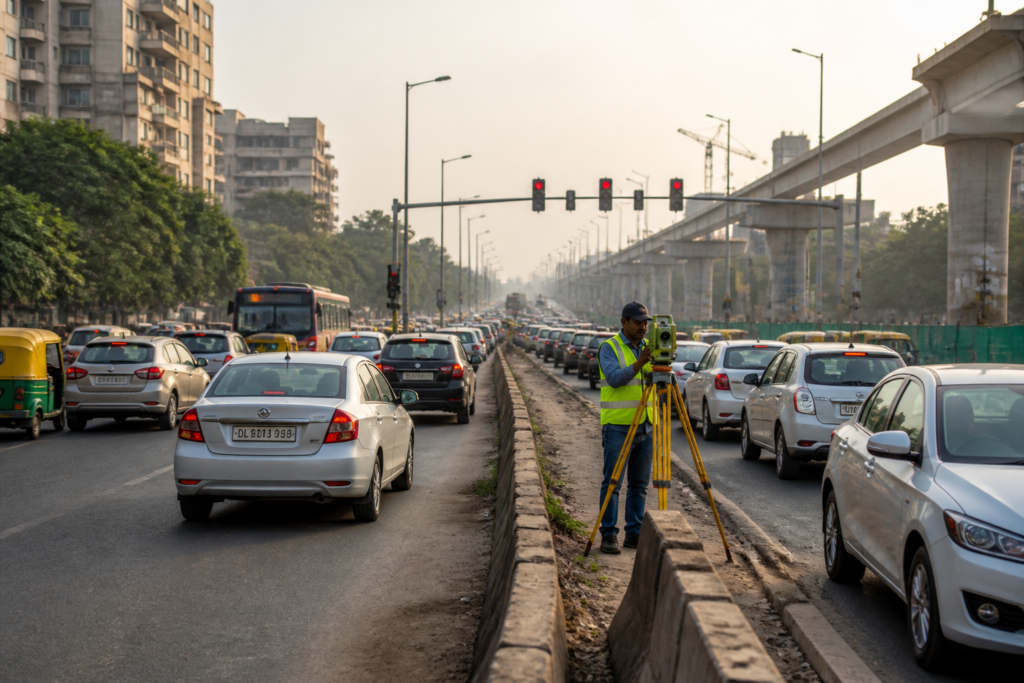
The National Highways Authority of India (NHAI) has prepared a ₹378.87-crore plan to make the 7.977-km Ashram-Badarpur stretch of Mathura Road in Delhi signal-free, with construction of four new flyovers expected to begin in January 2027.
The project covers the corridor between Ashram Chowk and the Badarpur border, a major route linking Delhi with Faridabad. According to a report by Jagran, NHAI expects the construction to take about two years. The company awarded the road-building contract will also be responsible for maintaining the corridor for 10 years after completion.
The proposed flyovers, described in the report as elevated structures or viaducts, are intended to carry through-traffic over the main signalised intersections. Vehicles travelling between Delhi and Faridabad, in both directions, will be able to bypass the red-light junctions instead of moving through the local traffic network at ground level.
NHAI’s plan separates long-distance movement from local traffic. Local vehicles will use U-turn underpasses, while illegal cuts and openings in the central median will be closed. Existing arrangements near Jasola and Apollo Hospital, including a U-turn underpass and left-in, left-out movements, will also be used to allow local vehicles to turn without blocking the main carriageway.
The proposal is aimed at addressing recurring congestion and bottlenecks along the Ashram-Badarpur route. The corridor carries traffic between southern Delhi and Faridabad, and the report said large numbers of motorists currently face delays at its signalised intersections. The plan does not state that the entire road will be elevated; instead, it combines flyovers for through-traffic with underpasses and controlled surface-level movements for local access.
NHAI also plans to use traffic-management measures during construction. The report said trained traffic marshals and robotic flagmen will be deployed at busy intersections to assist with diversions and safety control. The use of robotic flagmen has been described as a first for Delhi during construction at such junctions.
The project’s implementation timeline remains tied to the proposed January 2027 start. Once work begins, maintaining traffic movement through the corridor will be a key operational requirement because the construction will take place on an active route connecting Delhi and Faridabad. The report did not provide details of the contractor, the planned traffic-diversion map or the individual locations and lengths of all four flyovers.
NHAI’s stated next step is to begin construction in January 2027, with completion targeted within two years. The authority’s plan also requires the selected road-building company to undertake maintenance of the completed corridor for the following decade.


