

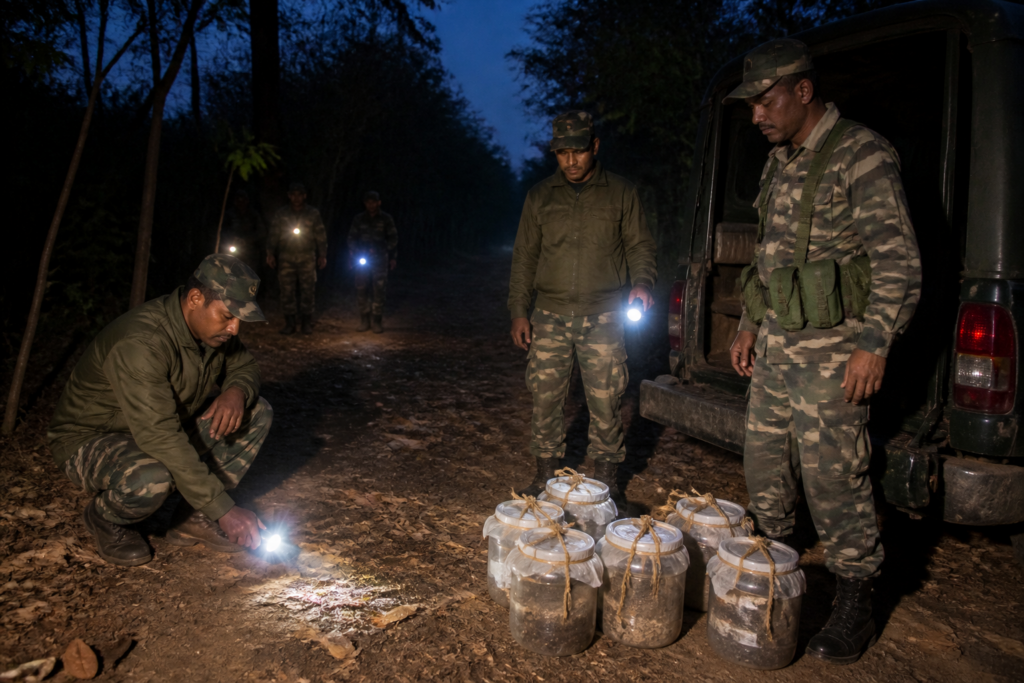
Four people were arrested after a wild boar was allegedly killed with an explosive-laced bait bomb inside Biripal reserved forest in Odisha’s Angul district, while forest officials seized six more bait bombs and a motorcycle during a night patrol on Tuesday.
The operation was conducted by the Rengali forester and his team in Gandamala beat under the Rengali section of Kaniha range, according to forest officials. The team recovered the dead male wild boar and the explosives from the forest area before bringing the seized items to the Kaniha range office for legal action.
The arrested people were identified as Ripun Kumar Matiari of Parachhat village, Jogeswar Penthoi of Ditikrushnapur, Malia Penthoi of Parachhat and Khetra Kisan of Purunapani. Officials also seized the motorcycle allegedly used by the group.
Divisional forest officer Angul Nitish Kumar said the investigation would examine the origin of the explosives and the method used to place them. “The bombs were seized and probe is on to find out how and where those had been made. Also, the scene was recreated to understand how the four poachers planted the bomb to lure the boar,” Kumar said, according to the report.
Bait bombs are crude explosive devices concealed inside edible material and placed as traps for wild animals. The devices detonate when bitten, causing severe injuries or death. Forest officials said the seizure of the six bombs helped prevent additional wildlife casualties in the reserve forest.
The incident also highlights the risk that bait bombs pose to animals other than the species being targeted. Since the explosives are hidden in food, they can be consumed by livestock or other wildlife moving through forest-edge areas. A similar incident was reported at Banki nearly two months ago on the fringes of Chandaka wildlife sanctuary, where a bull reportedly consumed a bait bomb intended for a wild boar.
The explosive detonated inside the bull’s mouth and caused catastrophic injuries. The animal later died despite intensive veterinary treatment, officials said. The Banki incident demonstrated how anti-poaching traps can create risks beyond forest wildlife and affect animals in settlements and agricultural areas near protected landscapes.
In the Angul case, the forest department’s investigation is expected to focus on the source and manufacture of the explosives, as well as the network and procedures involved in placing them. Reconstructing the scene is also intended to help officials establish how the accused allegedly used food to attract the wild boar.
Forest officials said intensified patrolling and strict enforcement would continue across forest areas in Angul division to curb poaching and protect wildlife. The seized explosives and other items remain with the Kaniha range office as the legal process proceeds.


