

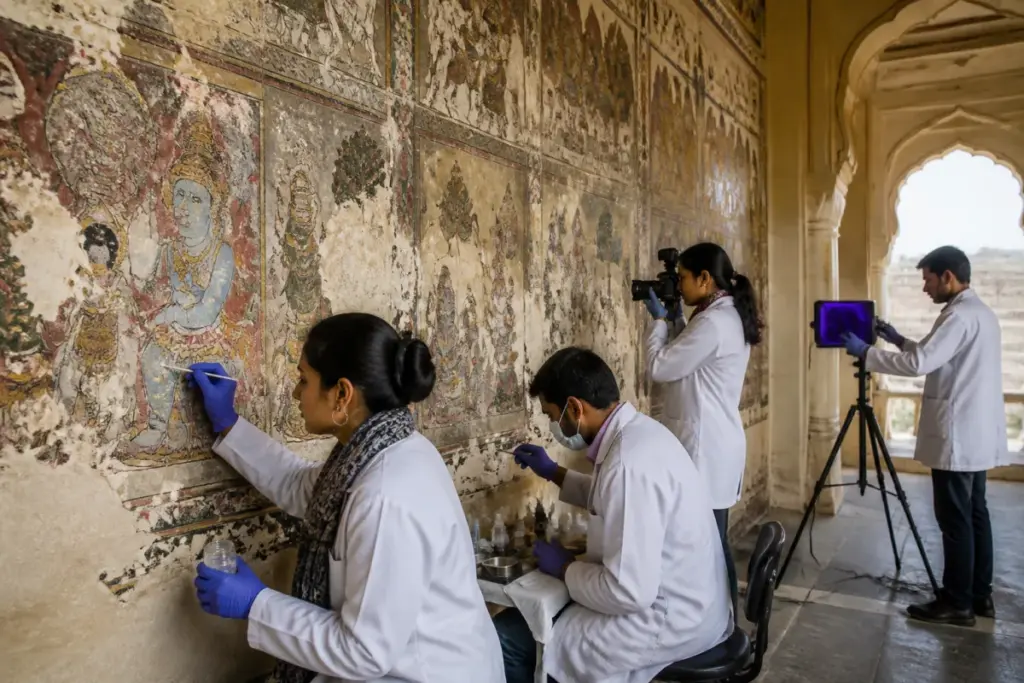
Amer Fort murals in Jaipur are undergoing a Rs 2.32 crore scientific conservation project after restoration work carried out in 2008 and 2017 allegedly damaged parts of the centuries-old artwork. The 2.5-year exercise began in June and is being conducted by a seven-member team from the Indira Gandhi National Centre for the Arts (IGNCA), in coordination with the state archaeology department and the Amer Development and Management Authority (ADMA).
The conservation team is using ultraviolet and infrared imaging, multispectral examination, X-ray fluorescence (XRF) analysis and chemical tests to identify original pigments and binding materials. The findings will guide the removal of unsuitable layers applied during earlier repairs and help conservators select cleaning methods that do not harm the original paint surface.
According to the project team, these techniques are being used for the first time for mural conservation at palaces under the state archaeology department. An ADMA engineer said materials used during the 2017 restoration did not meet the required standards and had contributed to the deterioration of the paintings.
“The material and colours used during earlier conservation work are now harming the surface of the walls,” said Kirtipal Singh Parmar, the project manager. He said the team was also examining the causes of the damage rather than treating the paintings in isolation.
Roof damage at the Bhojanshala and water seepage through its ceiling have contributed to the decline of the murals, Parmar said. Moisture has caused some surfaces to yellow, while plaster and paint layers are peeling off in several areas. The team member said the extent of damage varies and is linked to weather exposure, seepage and earlier retouching. Chemicals are being used only in very small concentrations to reduce the risk of damaging the original paint layer.
The murals depict religious and mythological themes associated with Ayodhya, Kashi, Mathura and Vrindavan. They were executed using the traditional Araish technique on wet plaster and reflect the artistic patronage of the Kachwaha rulers, including Sawai Jai Singh II. The Bhojanshala also contains unfinished panels depicting the 24 avatars of Vishnu.
Multispectral imaging allows conservators to examine the paintings under normal, ultraviolet and infrared light. This has revealed extensive earlier retouching that is difficult to identify with the naked eye. XRF analysis is being used to establish the chemical composition of pigments and binding materials before further cleaning work is finalised.
The mural project is part of a larger Rs 50 crore conservation plan for Amer Fort. Its first phase covers four locations: Singh Pol, Ganesh Pol, Man Singh Palace and the Bhojanshala. The restoration will continue through the planned 2.5-year project period under coordination between IGNCA, the state archaeology department and ADMA.


