

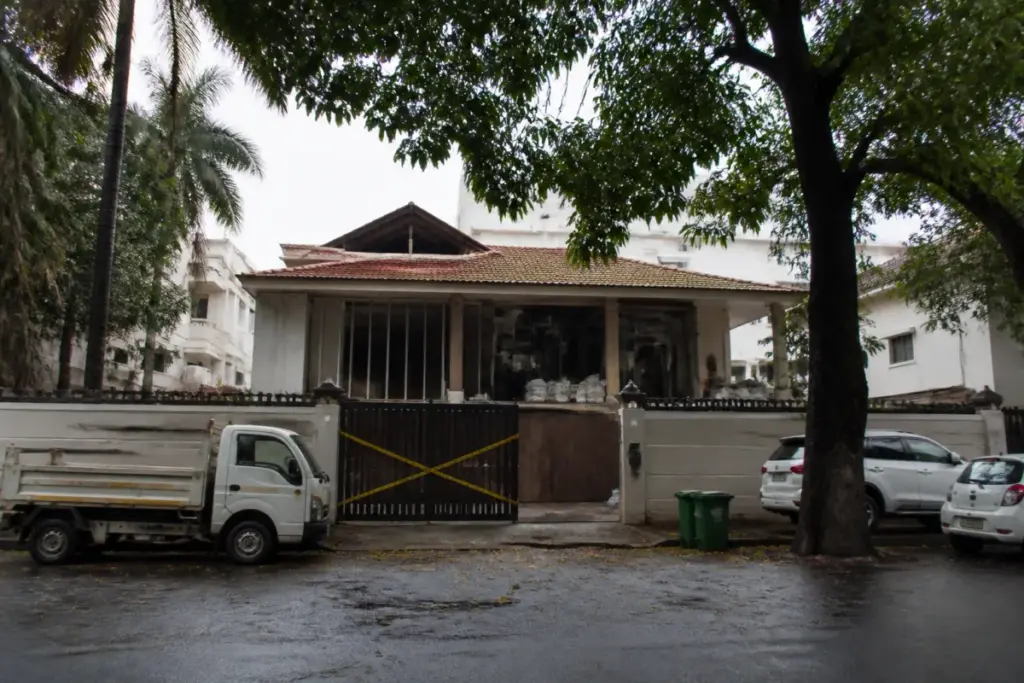
The Ajay Devgn bungalow in Mumbai’s Juhu area has become the subject of municipal action after the Brihanmumbai Municipal Corporation classified ongoing alterations as unauthorised, according to a report by Navbharat Times – Mumbai. The report says BMC officials removed or demolished parts of the work, but its account later states that the October order did not clearly establish whether the civic body had carried out the removal. That central point requires confirmation from BMC records or an official statement.
The property is located in Kapole Cooperative Housing Society in the JVPD area, on N S Road No. 11. The report identifies the property as being associated with actor Ajay Devgn and his mother, Veena Devgn, and puts the bungalow’s area at 7,802 square feet. The municipal action concerns alterations allegedly carried out without the required approval from the competent authority.
According to the report, the work included internal changes, partition walls, alterations to windows and other structural modifications. The report also refers to the use of Siporex blocks in the construction. BMC’s K/West ward office issued a stop-work notice on 10 September under Section 354A of the Mumbai Municipal Corporation Act.
The notice reportedly directed the owner or occupant to stop the work immediately and submit the necessary permissions within 24 hours. It warned that if the directions were not followed, the unauthorised structure and construction material could be removed at the owner’s risk and expense. Police assistance was also sought to monitor the site and remove workers if necessary.
The report says the owner’s side submitted a response dated 15 September. In an order issued on 6 October, BMC’s K/West ward office reportedly held that the response did not include documents proving that the construction was authorised. It said that no copy of permission issued by a competent authority had been attached to the reply. On that basis, the civic body rejected the response and treated the construction as unauthorised.
The municipal process described in the report reflects the administrative importance of building permissions in Mumbai, where changes to a private home can still require approval when they affect structural elements, internal layouts, openings or additions. A stop-work notice is intended to halt construction while the owner establishes that the work complies with the applicable development and building regulations.
The report’s account, however, does not establish the precise stage reached after the 6 October order. Its opening states that BMC demolished parts of the bungalow’s unauthorised construction and that officials reached the property with staff. Later, the same report says the order did not clarify whether the civic body had taken steps to remove the work. These statements cannot be treated as a confirmed account of demolition without further documentation.
The distinction matters because a finding that construction is unauthorised, a direction to stop work and the physical removal of a structure are separate stages of municipal enforcement. The supplied report confirms that BMC issued a stop-work notice and rejected the response for lack of supporting permission documents. It does not provide an official demolition report, inspection record, photographs, panchnama, ward statement or other primary document confirming the extent and timing of any removal.
The case also illustrates how enforcement depends on documentation rather than ownership status. The report attributes BMC’s action to the absence of copies of approvals from a competent authority, rather than to the identity of the property’s occupants. It does not state whether the owners challenged the order, whether any appeal or court proceeding was filed, or whether the alleged alterations affected the building’s structural safety, floor area or development rights.
Further confirmation is therefore needed on four points: whether BMC physically demolished any portion of the work; what specific structures were removed; whether the owners submitted additional permissions after the October order; and whether any legal challenge or subsequent municipal action followed. These details would determine whether the matter remained at the notice-and-order stage or progressed to enforcement at the site.
On the evidence supplied, BMC’s notice and rejection of the owner’s response are attributable facts reported by Navbharat Times – Mumbai. The claim that parts of the bungalow were demolished remains subject to verification. The next authoritative record would be a statement or document from BMC’s K/West ward office, supported where applicable by an inspection or demolition record.


