

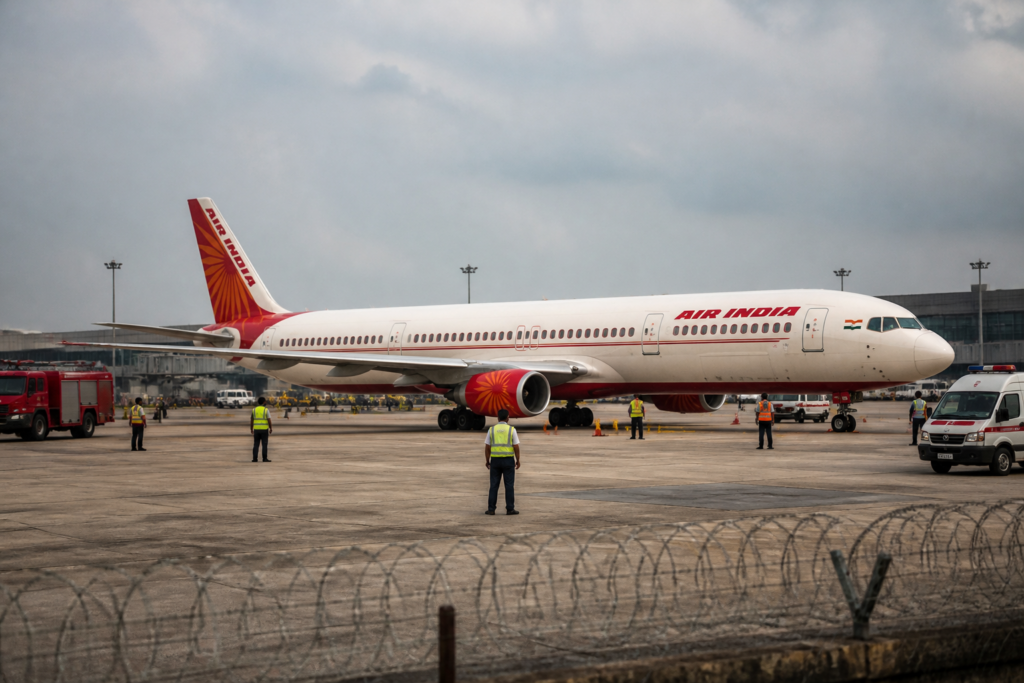
An Air India flight travelling from Frankfurt to Delhi made an emergency landing at Jaipur airport after it transmitted a Squawk 7500 distress signal during the journey, according to a report by Bartaman Patrika. The signal triggered an emergency response involving air traffic control and multiple central agencies.
The flight, identified as AI 2030, had departed Frankfurt for Delhi at around 9.45pm local time on October 13. It was scheduled to reach Delhi at 10.40am on October 14. During the flight, Ahmedabad Air Traffic Control received the Squawk 7500 code, after which the aircraft was diverted for an emergency landing at Jaipur airport.
Squawk 7500 is an internationally recognised transponder code used to alert air traffic controllers to a suspected hijacking or unlawful interference with an aircraft. The signal is transmitted through the aircraft’s transponder and is intended to allow controllers to coordinate an emergency response without requiring an immediate verbal announcement from the cockpit.
The report said the alert led to concern over the possibility of a security threat on board, including speculation about a bomb. After the aircraft landed, passengers were safely brought off the plane and the aircraft was moved to an isolation bay for examination. The supplied report does not provide details of any device being found, injuries, damage or disruption caused at Jaipur airport.
The incident has prompted an investigation by air traffic control and multiple central agencies. The authorities are expected to establish whether the Squawk 7500 signal was transmitted intentionally, triggered by a technical or operational error, or connected to an actual security incident. No final explanation for the alert was provided in the report.
The event places attention on the layered safety systems used in commercial aviation. A transponder alert can rapidly activate coordination between pilots, air traffic controllers, airport operators, security teams and investigative agencies. The aircraft’s diversion to Jaipur and its movement to an isolation bay were part of the response described in the report, although the source did not specify the individual decisions taken by each agency.
The report also referred to a September 30 incident involving a FlyDubai flight bound for Tel Aviv, where it said one pilot attempted to hijack the aircraft and the other pilot intervened. That earlier event was cited as context for renewed questions about passenger and cockpit security. The two incidents are not otherwise linked in the supplied report.
The investigation into Air India flight AI 2030 remains ongoing. Further official findings will be required to establish the reason for the distress signal and whether any security breach occurred.


