

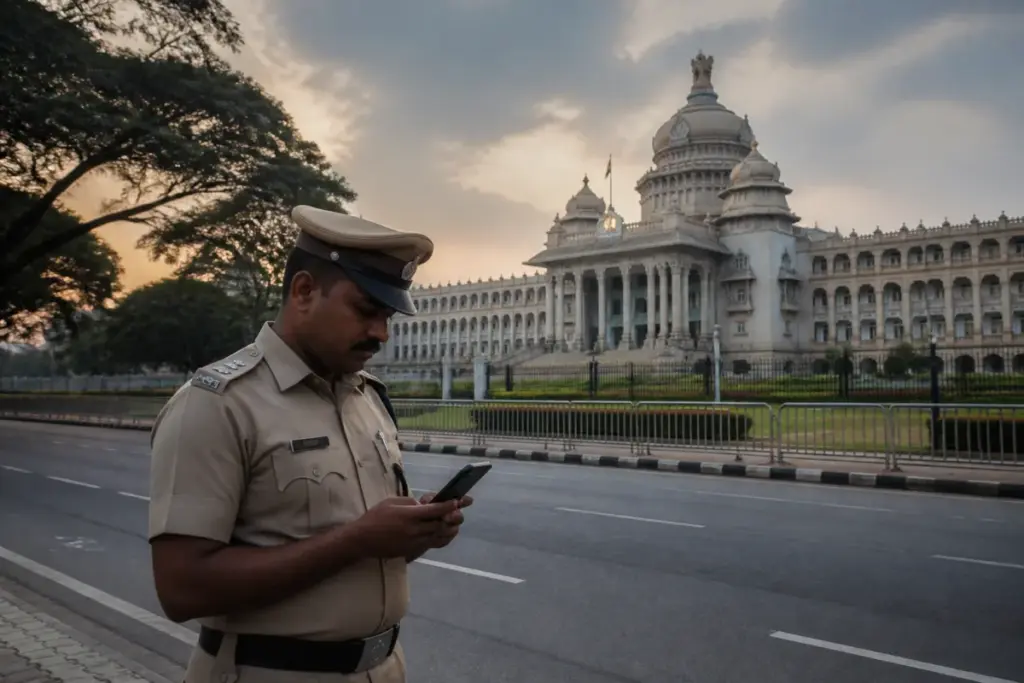
The FIR over an AI-generated video showing a bomb blast at Bengaluru’s Vidhana Soudha is not a report of an actual explosion. It is a police case arising from a synthetic visual that portrayed one of Karnataka’s most recognisable public buildings being destroyed. That distinction is central to understanding the incident: the immediate action described in the FIR concerns the creation and circulation of the video, not a confirmed physical attack on the legislature.
According to The Hindu’s report, the Vidhana Soudha police registered the case after a police team monitoring social media found the Instagram post on October 20. The post was uploaded by the account ‘jnx__king__h_g’ with the caption ‘Vidhanasabha Uda Diya Bam se’. The FIR identifies the person behind the account as unidentified. It states that the video was allegedly created using artificial intelligence, edited to depict an explosion and uploaded on Instagram.
The complaint was filed suo motu by the inspector of the Vidhana Soudha police station. The police registered a case under relevant provisions of the Bharatiya Nyaya Sanhita, 2023, although the report does not specify the sections. The available account therefore establishes that a police case has been registered and that the post was detected through social-media monitoring. It does not establish who created the video, why it was made, how widely it circulated or whether anyone acted on it as a genuine recording.
That gap between what an image appears to show and what actually happened is the institutional problem at the centre of the case. A digitally generated video of a blast at a government building can be treated in several different ways by the public: as a threat, a joke, political expression, misinformation or an attempt to cause alarm. The FIR shows the police treating the post as sufficiently serious to warrant a suo motu complaint. It does not, by itself, reveal the final legal characterisation of the act or the outcome of the investigation.
Vidhana Soudha gives the incident a particular civic weight. The building is the seat of Karnataka’s legislature and a prominent symbol of state authority in Bengaluru. A fabricated video involving it is therefore not simply a piece of manipulated entertainment detached from the city’s public institutions. It places a synthetic image inside the information environment surrounding a functioning government building, where residents, officials and security agencies may have to distinguish between an actual incident and a manufactured one.
The reported sequence also highlights the changing role of police monitoring. The post was not described as being brought to the police by a named complainant or eyewitness. Instead, the report says a police team monitoring social media detected it, after which the station inspector initiated the complaint. This suggests an enforcement process that begins with online observation, moves to preservation and examination of digital material, and then proceeds through a formal FIR. The supplied report does not state what technical methods were used to determine that the video was AI-generated, whether the platform supplied account information or whether the post was removed.
Those unanswered questions matter because synthetic media complicates the evidentiary chain. A conventional photograph or video can also be edited, but an AI-generated scene may be designed from the outset to imitate a real event without recording one. In this case, the police complaint reportedly says the uploader created the video using AI and edited it to depict an explosion. The available material does not explain whether investigators relied on the appearance of the video, information from Instagram, forensic examination or another source. Without that information, it is not possible to assess how the police established the description in the FIR.
The incident also demonstrates why the location of manipulated content can be as important as its technical form. The video did not depict an anonymous structure. It portrayed Vidhana Soudha, a government landmark that residents recognise and associate with Karnataka’s legislative process. The caption, written in a mix of transliterated language and English, explicitly referred to blowing up the legislative building with a bomb. The report does not establish that the uploader issued a direct threat, possessed explosives or had access to the building. It does establish that the post used the imagery of an attack on a public institution.
For city governance, this creates a difficult distinction between physical security and information security. The reported police response concerns content circulating online, but the subject of that content is a physical civic asset. An image of damage can prompt questions about whether there has been an actual emergency, whether access controls need to change and whether public agencies must issue a clarification. The supplied report does not say that Vidhana Soudha’s security arrangements were altered or that the legislature, government or building authorities issued a separate statement.
The FIR’s suo motu nature is another important administrative detail. It indicates that the police station did not wait for an identified individual or institution to file a complaint before opening the case. In practical terms, that allows the law-enforcement agency to begin investigating a post that it considers significant based on its own monitoring. It also places responsibility on investigators to establish the account holder’s identity, verify the content’s origin and determine whether the alleged conduct falls within the provisions invoked. None of those later steps is reported as complete.
The case comes against the background of a broader public need to establish what is real during incidents involving urban institutions. Yet the specific evidence supplied here is limited. There are no figures on how many people viewed or shared the video, no account of public panic, no record of an actual security breach and no statement from the Instagram user. There is also no information about an arrest, a notice to the platform, a forensic report or a court proceeding. These absences should not be filled with assumptions about the scale or intent of the incident.
That limitation is particularly important in reporting AI-related cases. Describing a video as AI-generated does not automatically establish that it was intended to deceive every viewer, nor does the existence of an FIR establish guilt. The reported facts support a narrower conclusion: police found an Instagram post depicting a bomb blast at Vidhana Soudha, attributed it in the complaint to an unidentified user, and registered a case after monitoring social media. The investigation must establish the remaining facts.
The institutional question is therefore not only whether police can detect manipulated content. It is also whether the public system can explain, quickly and accurately, what has happened when a synthetic image targets a major civic site. In this case, the police action is visible through the FIR, while the public record supplied in the report does not yet show the subsequent communication process. Whether the post was removed, whether its reach was assessed and whether any official clarification was issued remain unresolved.
The Vidhana Soudha case should consequently be read as an early indicator of a governance challenge rather than as evidence of a physical attack. It confirms that Bengaluru police are monitoring social media closely enough to initiate a suo motu case over a fabricated blast video involving a state institution. It does not yet reveal the uploader’s identity, the post’s reach, the investigative findings or the legal outcome. Those are the next facts needed to understand whether the incident was an isolated act of manipulation or part of a wider pattern involving synthetic content and public infrastructure.


