

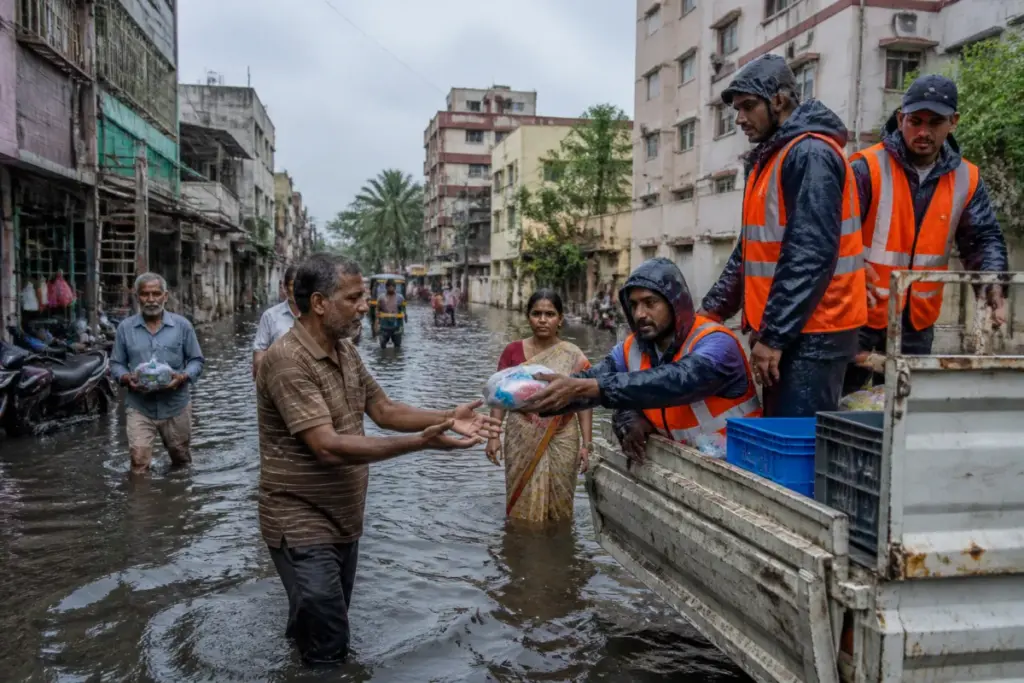
Ahmedabad waterlogging in July forced the municipal corporation to distribute 29,977 food packets and snacks at a cost of ₹31.31 lakh, according to details presented to the Ahmedabad Municipal Corporation’s health committee. The immediate expense was for emergency relief, but the larger significance lies in where the flooding occurred: areas in western and north-western Ahmedabad that were not traditionally seen as the city’s most vulnerable flood zones.
The account presented by AMC health committee chairman Deepakbhai Panchal describes a basic urban service failure that quickly became a food-security problem. Rainwater entered homes and shops in low-lying societies and chawls, leaving many residents unable to cook. The municipal response therefore moved beyond drainage and road clearance. The corporation had to arrange cooked food and snacks through cooks, hotels, restaurants and other local suppliers and deliver them to affected residents.
The episode shows how waterlogging is experienced at street level. A flooded road is often treated as a mobility problem, but when water enters homes, the disruption reaches kitchens, workplaces, small shops and household incomes. For residents without alternative cooking facilities, electricity, dry storage or the ability to leave the affected neighbourhood, even a short period of inundation can create an immediate need for municipal food assistance.
The July response was not linked to a single rain event. The health committee was told that the heaviest impact followed the rainfall of July 23, while further heavy rain on July 24, 25, 26 and 31 also required food packets to be supplied. The source report identifies 18 affected areas, including Gota, Sarkhej, Bopal, Thaltej and Jodhpur. Other locations listed include Ghatlodia, Bodakdev, Maktampura, Vejalpur, Stadium, Sabarmati, Asarwa, Shahibaug, Viratnagar, Nikol, Gomtipur, Vastral, Danilimda and Amraiwadi.
The concentration of relief in the north-west zone is particularly revealing. According to the details cited from the AMC, that zone accounted for 12,960 food packets, the highest among the areas mentioned. The distribution indicates that flood exposure is no longer confined to the parts of eastern Ahmedabad that were historically associated with heavy-rain impacts. The source report specifically notes that the pattern has worsened in western Ahmedabad as weather conditions have changed.
That shift matters because the western city has experienced substantial residential and commercial expansion. The report does not provide drainage-capacity figures, land-use maps or rainfall totals, so it cannot establish the precise cause of the flooding in each locality. It does, however, document the administrative consequence of water entering occupied neighbourhoods: the municipal system had to use public funds and emergency procurement channels to provide food when normal household activity became impossible.
The cost structure of the response offers a glimpse into how municipal relief is organised. Food packets supplied through the AMC food department were priced between ₹95 and ₹110, while snack packets cost between ₹19 and ₹59. The final bill of ₹31.31 lakh covered the distribution of food packets and snacks to affected residents. The report does not specify the exact split between meals and snacks, the number of beneficiaries, or the number of packets distributed on each date.
Those missing details are important for evaluating both the reach and efficiency of the response. A total packet count gives a measure of the scale of municipal intervention, but not necessarily the number of people served. One household may have received multiple packets, while a resident’s requirement may have changed across successive rain events. Similarly, the reported price range suggests that different suppliers or food items were used, but the source does not provide tender documents, vendor names, quality-control procedures or delivery records.
The institutional route through which the information emerged is also significant. The expenditure was included in an agenda placed before the AMC health committee, and the committee chairman explained the conditions that led to the distribution. This means the food-relief bill was not simply an operational expense hidden within a general monsoon response. It was brought before a municipal oversight forum, creating an opportunity to examine the decision, procurement, geographic distribution and outcomes.
In a functioning urban emergency system, food distribution is one layer of a larger response chain. Drainage and pumping determine how quickly water can be removed. Public health teams must assess contamination and disease risks. Ward-level staff must identify households requiring assistance. Transport and local suppliers must continue operating despite flooded roads. The AMC’s July expenditure shows that these systems were activated, but the supplied material does not establish how quickly each part of the chain responded or whether relief reached all affected households.
The Ahmedabad waterlogging episode also raises a planning question about the relationship between new urban development and inherited infrastructure. The affected areas named in the report span established neighbourhoods, expanding western suburbs and locations across different municipal zones. Without drainage surveys or project-level data, it would be unsafe to attribute the flooding to one factor. The evidence supports a narrower conclusion: the city’s emergency food requirement appeared across a wide geographic spread, with the north-west zone recording the largest reported distribution.
The westward movement of flood vulnerability has administrative implications. Municipal agencies must plan not only for historically known waterlogging points but also for areas where urban growth, altered surfaces and changing rainfall patterns may produce new exposure. The report itself describes a change from the earlier concentration of impacts in eastern Ahmedabad to a worsening problem in the west. It does not quantify that change over time, but the observation is relevant because emergency spending can become a recurring operating cost when underlying drainage and land-management problems remain unresolved.
The July figures therefore sit at the intersection of disaster relief and ordinary municipal administration. ₹31.31 lakh is a relatively visible expenditure because it was incurred for food that residents could directly receive. Other costs associated with waterlogging—pumping, road repairs, cleaning, health surveillance, damage to public assets and lost working time—are not included in the reported figure. Nor does the report state whether the affected residents received assistance for damaged homes, shops or household goods.
This distinction is essential when reading the expense. The food bill should not be treated as the total cost of the flood event. It is better understood as a measure of how far waterlogging disrupted everyday life. Once residents could no longer cook at home, the municipal corporation became responsible for a service normally provided by households and local markets. The public cost was generated not only by rain, but by the inability of neighbourhood systems to keep homes functioning during inundation.
The source also records the AMC’s stated explanation for the response: water had entered low-lying societies and chawls, making cooking impossible. That explanation places household vulnerability at the centre of the incident. The same rainfall can have different consequences depending on building elevation, ground-floor occupancy, drainage access, road levels, electricity availability and the ability of residents to move temporarily. The supplied report does not provide those household-level details, but its account of food distribution confirms that the impact extended beyond traffic disruption.
What remains unavailable in the reported information is as important as what is known. There are no cited rainfall measurements, flood-depth readings, drainage maps, pump-capacity figures, response-time records or independent assessments of the affected localities. The report also does not identify whether the AMC has changed its monsoon preparedness plans after the July events. These gaps prevent a full assessment of whether the emergency response was proportionate or whether the expenditure could have been reduced through earlier preventive action.
What the evidence does establish is a clear sequence: heavy rain in July caused water to enter homes and shops across multiple Ahmedabad areas; residents in affected locations were unable to cook; the AMC arranged food and snacks through local providers; 29,977 packets were distributed; and the reported cost reached ₹31.31 lakh. The largest reported distribution came from the north-west zone, where 12,960 food packets were supplied.
The bigger urban question is whether Ahmedabad’s monsoon system is being measured only by the clearing of roads or also by the restoration of household life. Food distribution provides a practical indicator of the severity of waterlogging because it records the point at which residents cannot rely on their homes for basic needs. Future municipal reviews will be important for establishing whether the July expenditure was an exceptional response or evidence of a recurring vulnerability in the city’s expanding western and north-western areas.


