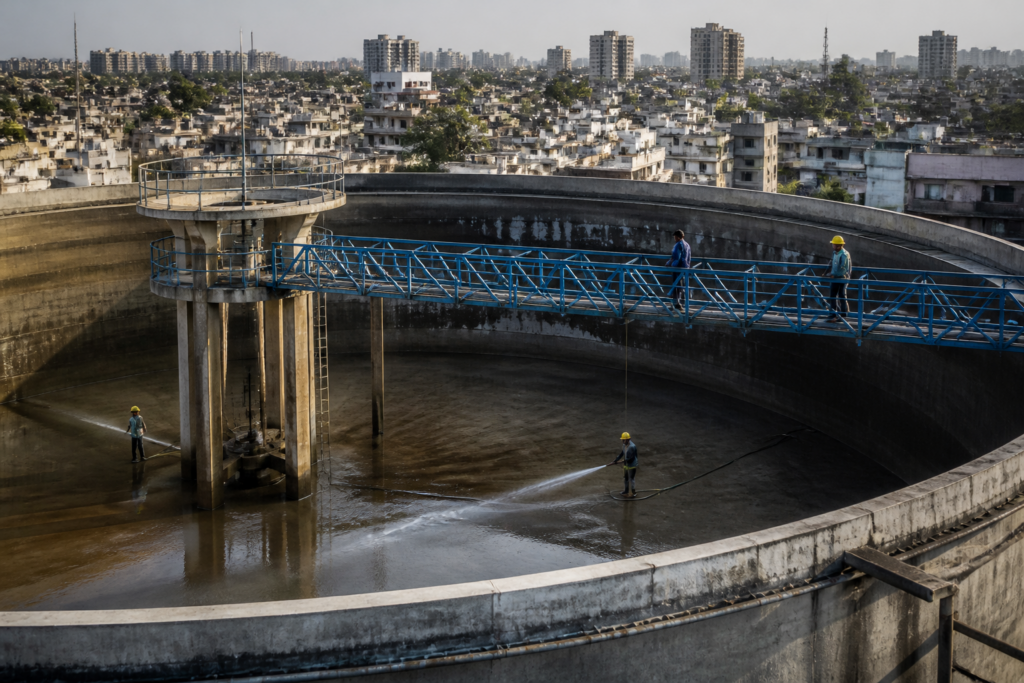
The Ahmedabad Municipal Corporation has ordered action against the agency responsible for cleaning municipal water tanks after 48 of the city’s 244 tanks were found not to have been cleaned within the prescribed six-month period. The Standing Committee chairman has also directed an inquiry into the role of officials responsible for supervising the work.
The tanks form part of Ahmedabad’s municipal water-supply system, which serves more than 8 million people, according to the report by Gujarat Samachar Digital. AMC records cited in the report show that 196 of the 244 tanks were cleaned within six months, while cleaning of the remaining 48 was delayed.
The action followed a report by Gujarat Samachar Digital highlighting that the cleaning schedule had not been completed on time. The Standing Committee chairman directed the civic administration to take action against the agency assigned to clean the tanks and to investigate whether responsible officials failed to monitor the work adequately.
The inquiry will examine why the cleaning of the 48 tanks was delayed, whether the contracted agency complied with its responsibilities and whether civic officials carried out timely supervision. The report states that responsibility will be fixed after the investigation and that further action will follow against those found accountable.
Regular cleaning of municipal water tanks is part of maintaining the safety and reliability of a city’s drinking-water system. The delayed schedule has therefore raised questions about the way AMC plans, monitors and records maintenance work across its water infrastructure. The immediate concern is not only the pending cleaning itself, but also whether the corporation has adequate oversight mechanisms to identify missed deadlines before they affect routine operations.
The source report does not specify which 48 tanks were delayed, how long the delay lasted in each case, or whether any water-quality problem was directly linked to the missed cleaning schedule. It also does not state when the pending cleaning will be completed. Those details are expected to be relevant to assessing the operational impact of the lapse.
The Standing Committee chairman’s directions place both the contractor and the municipal supervision system under review. The next steps will be the inquiry into the agency and officials, the determination of responsibility and the completion of cleaning at the 48 tanks that missed the six-month deadline.