

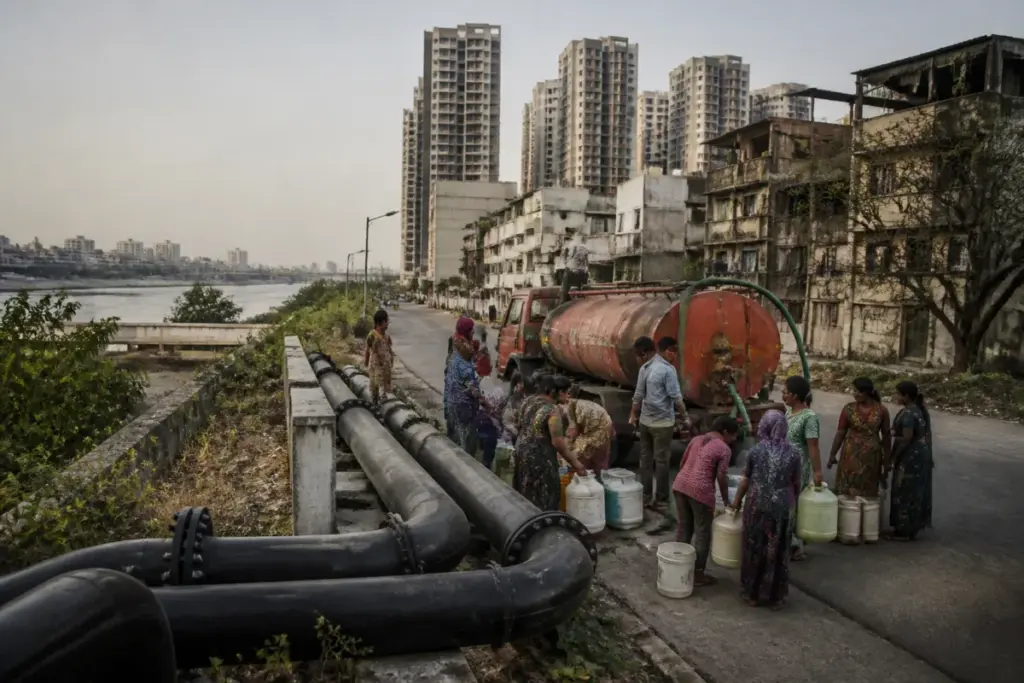
Ahmedabad’s reported daily water requirement of 1,763 million litres per day has brought renewed attention to the city’s dependence on the Sardar Sarovar system, declining groundwater levels and weaknesses in last-mile distribution. A report published by Sandesh says pressure shortages and uneven supply are affecting several parts of the city, while the Ahmedabad Municipal Corporation is preparing an emergency tanker arrangement for areas where piped water delivery is difficult. The central warning, however, still requires confirmation from the civic administration or an official water-supply document.
According to the Sandesh report, Ahmedabad’s expanding population, newly incorporated areas and growing number of high-rise buildings have pushed daily water demand to 1,763 MLD. The report links this rising requirement to increasing pressure on the AMC’s water-supply department, which must balance available supply with demand across a large and expanding urban area.
The report also says that groundwater levels in the city are continuing to fall. As a result, Ahmedabad’s water-supply system has become increasingly dependent on water from the Sardar Sarovar Dam and the Narmada project. The dependence matters because any variation in the supply received through the Sardar Sarovar canal, or any technical problem affecting the Narmada-based system, could have a direct effect on the city’s water-treatment plants, according to the report.
This creates a structural vulnerability for a city whose demand is spread across established neighbourhoods, newly added municipal areas and high-rise developments. A problem at the source or in the treatment and transmission network can become a distribution problem several kilometres away. The Sandesh report says reduced pressure in main pipelines has led to a rise in complaints that sufficient water is not reaching peripheral areas.
The areas mentioned in the report include localities around the Sabarmati Riverfront and parts of Ahmedabad’s northern, southern and eastern zones. It says daily supply timings are being reduced in some areas, although the report does not provide a zone-wise schedule, complaint data, water-quality readings or the number of affected households. It also does not state whether the reported changes are temporary, planned maintenance measures or the result of a broader supply shortfall.
The tanker question illustrates the difference between citywide water availability and reliable household access. Where piped supply cannot reach residents with adequate pressure, the civic body may have to use tankers as an emergency distribution mechanism. Sandesh reports that the AMC is working to establish tanker arrangements in areas facing difficulty with tap-water delivery. The report does not provide the number of tankers, proposed supply points, operating dates, tanker capacity or the administrative orders authorising the arrangement.
For residents, the immediate concern is not only the total volume entering the city but also how consistently water reaches individual neighbourhoods. Pressure loss in main lines can affect upper floors in high-rise buildings particularly sharply, while areas at the end of distribution networks may receive water for shorter periods or at lower pressure. The supplied report identifies these risks but does not include resident testimonies, ward-level data or an official assessment of the scale of the disruption.
The report attributes concern about future conditions to engineers and experts associated with water management, saying that inadequate advance planning for the Sardar Sarovar allocation and water levels could make the drinking-water problem more severe in the coming days. These experts are not named in the supplied material. Their assessment therefore cannot be independently evaluated from the report, and it should not be treated as a confirmed forecast.
The report identifies three immediate areas for civic action: preventing water wastage, cutting illegal connections and repairing leakages. These are important components of a distribution system because water lost before reaching consumers increases the volume that must be sourced, treated and pumped. However, the supplied material contains no official estimate of leakage, non-revenue water, illegal connections or recoverable supply, so the scale of these factors in Ahmedabad remains unestablished here.
The city’s dependence on a large external water source also raises questions about resilience. A system relying heavily on canal and dam-linked supply needs accurate demand estimates, dependable treatment capacity, functioning transmission lines and local distribution networks that can maintain pressure. The Sandesh report connects these parts of the system but does not provide current reservoir levels, the city’s allocated quota, treatment-plant output, pipeline capacity or the difference between installed capacity and actual daily supply.
That missing information is central to assessing whether Ahmedabad is facing an active water crisis, a localised pressure problem or a precautionary warning about future shortages. The figure of 1,763 MLD is presented as the city’s daily requirement, but the supplied report does not state the current daily supply, the size of any shortfall or whether the requirement includes all categories of use. Without those figures, the relationship between demand and supply cannot be independently established.
The report’s account is therefore best understood as a warning about the city’s water-system exposure rather than confirmation of a citywide emergency. It establishes that Ahmedabad’s reported demand is high, that groundwater depletion and dependence on the Sardar Sarovar system are concerns, and that tanker-based assistance is being considered for areas with inadequate piped delivery. It does not establish how many residents are affected or whether the AMC has formally declared a water shortage.
The next verification points are an official AMC statement, a ward-wise account of supply interruptions, current data on daily water demand and supply, details of the Sardar Sarovar allocation, and confirmation of any tanker deployment. Until those records or statements are available, the report’s warning should be treated as a significant but unconfirmed account of pressure within Ahmedabad’s water-supply system.


