

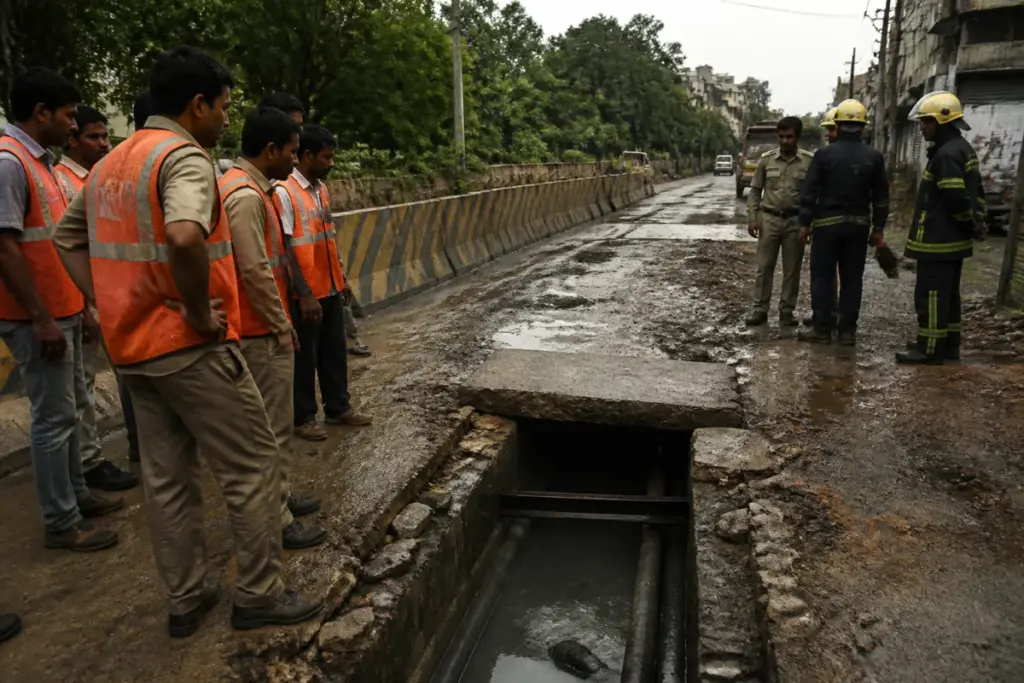
The Ahmedabad open drain girl case has moved from a rescue operation to a deeper test of civic accountability. Eleven days after a 10-year-old visually impaired girl reportedly fell into an uncovered drainage line in the Piplaj area, authorities had still not located her. Tissue fragments recovered from a river section had been sent to the Forensic Science Laboratory, but officials had not confirmed whether they belonged to the missing child or an animal.
The facts reported so far are stark. On 10 October, the girl was with her mother when she reportedly fell into an open drain while her mother was paying an auto-rickshaw driver. The fire department began searching the drainage line, but the operation had not produced a confirmed result by the time the report was published on 20 October. The report attributed the operational difficulties to a continuing flow of chemically contaminated water and heavy silt inside the line.
That combination matters because an open drain is not merely a maintenance problem. It is a point at which the city’s public infrastructure becomes a direct safety hazard. The incident raises questions about how drainage assets are designed, inspected, secured and monitored, particularly where they intersect with roads, pedestrian movement and informal or high-use neighbourhood spaces.
The case also shows why the performance of urban infrastructure cannot be measured only by the size of a municipal budget or by the presence of modern equipment. The report referred to Ahmedabad’s annual civic budget of more than Rs 18,000 crore and to the city’s “smart city” identity. Yet the immediate challenge was basic: preventing access to an open drainage line and, after the incident, maintaining an effective search route through a system filled with silt and chemically contaminated water.
Budget size and technology claims do not automatically translate into safer streets. They become meaningful only when they produce visible outcomes at the point where residents encounter the city. In this case, the relevant outcomes were whether the drain was covered, whether the opening was identified as dangerous, whether the drainage network could be searched without interruption, and whether the family received a clear and continuing account of the response.
The reported sequence also exposes the difference between emergency response and infrastructure prevention. Fire department teams were deployed after the girl disappeared, and a search operation continued for 11 days. However, a rescue response begins after a risk has already materialised. The more fundamental administrative question is why the drainage line was open in a location where a child could fall into it, and what inspection or maintenance system was expected to identify and correct that condition before the incident.
The available report does not establish who owned or maintained the particular drain, when it was last inspected, whether the opening had been reported previously, or whether any safety barrier had been installed. Those gaps are important. Drainage networks typically involve multiple operational responsibilities within a municipal system, but the supplied material does not identify the department or contractor responsible for this specific location. Without that information, accountability remains difficult to trace beyond the general reference to the civic administration and fire department.
The search itself reveals another institutional weakness: the condition of urban utility infrastructure can make rescue work harder than the original public-safety failure suggests. According to a fire department official cited in the report, chemically contaminated water continued to flow through the line and large quantities of mud had accumulated there. These conditions limited search and rescue efforts and prevented a quick determination of where the girl may have gone.
This is not only a question of equipment. It is also a question of access, mapping and operational control. When a person disappears inside a drainage system, responders need reliable information about the network’s direction, depth, connections, flow and discharge points. The report does not say whether such a complete map was available to the search teams, nor does it describe the specific equipment used. It does, however, show that the physical state of the drainage system became a central barrier to finding the missing child.
The discovery of tissue fragments in a river section added a second layer of uncertainty. The fragments were found on the 11th day of the search and sent for FSL examination. The source explicitly stated that there was no confirmation that they belonged to the girl. That distinction is essential. Until the laboratory examination establishes their identity, the fragments remain evidence requiring forensic analysis, not proof of the child’s fate.
This uncertainty also affects how the search should be understood. A missing-person investigation and an identification process are not the same thing. The search concerns the child’s location and the route through which she may have moved. The FSL examination concerns the identity of the recovered material. The report indicates that both processes remained active, but it does not provide a final police finding, a laboratory result or a confirmed conclusion.
A further concern arises from the reported decision to cover the drainage line with soil after the incident. The report said the line was filled and closed, and that this could gradually slow or end the search campaign even though the girl had not been found and the recovered fragments had not been identified. The reason for covering the line is not provided in the supplied material. Nor does the report establish whether the closure was temporary, whether another access route was created, or whether the search authorities approved the step.
That missing information is central to the governance question. Infrastructure repairs can reduce immediate danger, but a repair carried out before a search is complete may alter the evidence and restrict access. The appropriate sequence, responsibility and documentation are not established by the report. What is clear is that the closure created concern because the family still had no confirmed information about the girl.
The incident also highlights a recurring urban contradiction: cities may pursue large-scale modernisation while failing to secure small, exposed pieces of essential infrastructure. The reference to Ahmedabad’s preparation to host Commonwealth Games-related activity and its smart-city image places the case within a broader debate about how urban progress is represented. However, the available evidence does not show that those programmes caused the drainage failure, nor does it establish how their budgets or institutions relate to this specific drain. The defensible conclusion is narrower: a city’s modern identity does not remove the need for routine safety management in ordinary neighbourhoods.
For residents, the consequences are immediate and unequal. An uncovered drain can be especially dangerous for children, older people and persons with disabilities. The report identifies the missing child as visually impaired, but it does not establish whether her disability contributed to the fall or whether any accessibility or warning measures were present. That detail nevertheless underlines the importance of designing public infrastructure for actual conditions of movement rather than for an idealised user who can always see, anticipate or avoid hazards.
The available evidence leaves several questions unresolved. It does not identify the exact location and design of the opening, the agency responsible for it, the duration of the search on each day, the number and type of teams involved, or the results of any inspection after the incident. It also does not provide the FSL findings, a police statement, a municipal explanation or a confirmed account of the girl’s status. These are not minor details; they determine whether the episode is treated as an isolated failure or as evidence of a wider problem in drainage safety and emergency coordination.
What the case already confirms is that civic capacity is experienced at the street edge. A large budget, a smart-city designation and the deployment of emergency personnel cannot by themselves reassure residents when a child remains missing after falling into an open drain. The central urban question is whether drainage systems are being managed as public safety infrastructure, with regular inspections, secure covers, accessible records and coordinated emergency protocols, or merely as underground utility networks that receive attention after a crisis.
The next factual milestones are the FSL examination of the recovered tissue, the continuing search and any official clarification from the police, fire department or civic administration about the drainage line and its closure. Until those steps produce verified findings, the child’s whereabouts and the identity of the recovered fragments remain unresolved. The case should therefore be followed not only for its forensic outcome, but also for the documented account of how an open drain was allowed to become a life-threatening gap in Ahmedabad’s urban system.


