

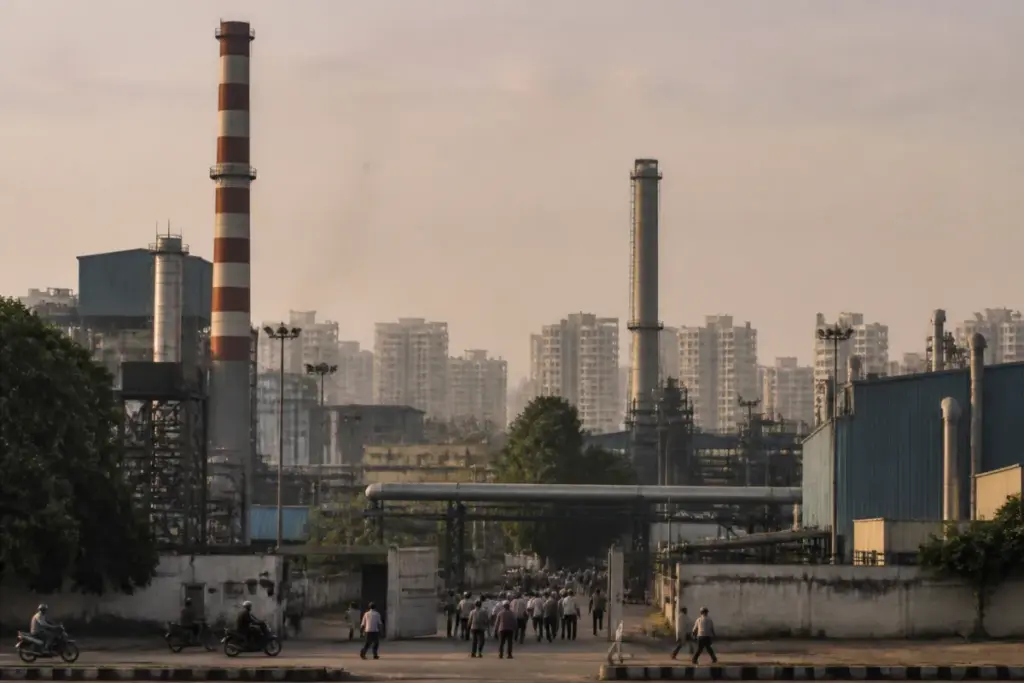
A reported proposal to relocate industrial units from Ahmedabad’s Naroda, Vatva and Odhav estates before the 2030 Commonwealth Games has triggered concern among small and medium manufacturers and workers, but the proposal has not been independently confirmed through an official notification or named government statement in the available material.
The report by Gujarat Samachar – Ahmedabad says the relocation is being discussed as a possible measure to improve Ahmedabad’s air quality before the Games. It identifies Kheda and other areas outside the city as possible destinations for the industrial units. The report does not establish whether a final decision has been taken, which authority is leading the exercise, how many units would be affected or what legal and financial framework would govern any relocation.
The three industrial estates are described as important centres for Gujarat’s chemical, textile and engineering sectors. According to the report, more than 3.27 lakh workers may be directly employed in the four industrial areas referred to in the article, while an additional one lakh people may depend on indirect employment. The report also says that workers’ families could take the total number of people affected by any relocation to about 20 lakh.
Those figures are attributed to the report and have not been supported in the supplied material by a government survey, Gujarat Industrial Development Corporation data, an employment census or a published assessment by an industrial association. The absence of such documentation is significant because employment estimates determine the scale of rehabilitation, housing, transport, schooling and social-security measures that would be needed if a relocation programme were ever approved.
For manufacturers, the reported proposal would involve more than moving machinery from one plot to another. A new site could require land acquisition or allotment, fresh infrastructure, factory construction, dismantling and reinstallation of equipment, regulatory approvals and a period during which production would stop. The report says that small units could be forced to shut down and that medium-sized businesses could face substantial financial pressure. It does not provide a unit-by-unit cost assessment or identify any government compensation package.
The report also links the possible relocation to the changing geography of Ahmedabad. Naroda, Odhav and Vatva were developed when they were farther from the city’s built-up areas, but urban expansion has brought residential and commercial development closer to the industrial estates. That pattern is common to growing cities: industrial land that was once peripheral becomes strategically valuable as roads, housing and services spread around it. The resulting conflict is not only about pollution. It also concerns land-use planning, employment access, infrastructure capacity and the cost of moving established economic activity away from workers’ homes.
A permanent relocation would therefore have consequences beyond factory ownership. The report says many workers could be required to move with their families to Kheda or another distant location. It raises concerns about disruption to children’s education, access to housing and healthcare, and the social networks that support migrant and industrial households. These effects are described as potential consequences; the supplied material does not contain a government resettlement plan or a social-impact assessment.
The report presents a temporary shutdown during the Games as an alternative to permanent relocation. It says industrial units could be asked to close for about two months, or possibly up to three months, with advance planning to build inventories and reduce disruption to domestic and export orders. It further reports that industry representatives are prepared to pay workers’ full wages during the temporary closure. No named association, company or official is identified in the available material as having formally made that offer, and the proposal’s feasibility has not been established.
The article also compares the suggested shutdown with restrictions on construction and demolition activity imposed for 42 days in Delhi to control pollution around schools. The supplied material does not provide the notification, dates, legal basis or measured air-quality impact of that example. It therefore cannot establish whether a similar approach would be legally available or environmentally effective in Ahmedabad.
Air pollution control would require a clear account of the sources being targeted. The report argues that construction activity contributes significantly to particulate pollution and questions why construction sites and developers would not face comparable restrictions during the Games period. This is a policy issue that cannot be resolved through the available report alone. Any credible plan would need source-wise emissions data, monitoring results, enforcement responsibilities and measurable pollution-reduction targets.
The possible relocation also raises questions about the role of the Gujarat Industrial Development Corporation, the Ahmedabad municipal administration, the state pollution-control authorities and the agencies responsible for the Commonwealth Games. The available material does not identify which institution has authority to order a closure, change industrial land use, approve relocation sites or compensate affected businesses and workers. Without that institutional map, it is not possible to determine whether the reported discussions represent a formal policy process or an early industry concern based on informal messages.
The report further carries an allegation that pollution control may be a pretext for clearing valuable industrial land for residential, commercial or mixed-use development. That allegation is not supported by a named source or documentary evidence in the supplied material. It should not be treated as an established motive. However, the concern points to a central urban-planning question: if industrial land is eventually converted, who decides the new land use, how are existing workers protected, and how are the public costs and private gains of redevelopment assessed?
For Ahmedabad, the issue is ultimately a question of how a manufacturing city manages growth. Industrial estates close to expanding neighbourhoods can create pollution and traffic conflicts, but they also provide jobs within reach of established communities. Moving them outward may reduce some local conflicts while increasing commuting distances, infrastructure demands and pressure on workers to relocate. Retaining them without stronger environmental controls can expose nearby residents and workers to continuing risks. The evidence supplied does not show which balance the authorities are considering.
Before any conclusion can be drawn, the reported proposal requires confirmation from the relevant government and industrial authorities. Key documents would include any relocation notice, air-quality assessment, list of affected estates and units, proposed destination plans, environmental permissions, compensation framework, worker-impact assessment and timeline. Until those records are made available, the relocation plan, the estimate of 20 lakh affected people and the allegation concerning redevelopment interests remain reported claims rather than established facts.


