

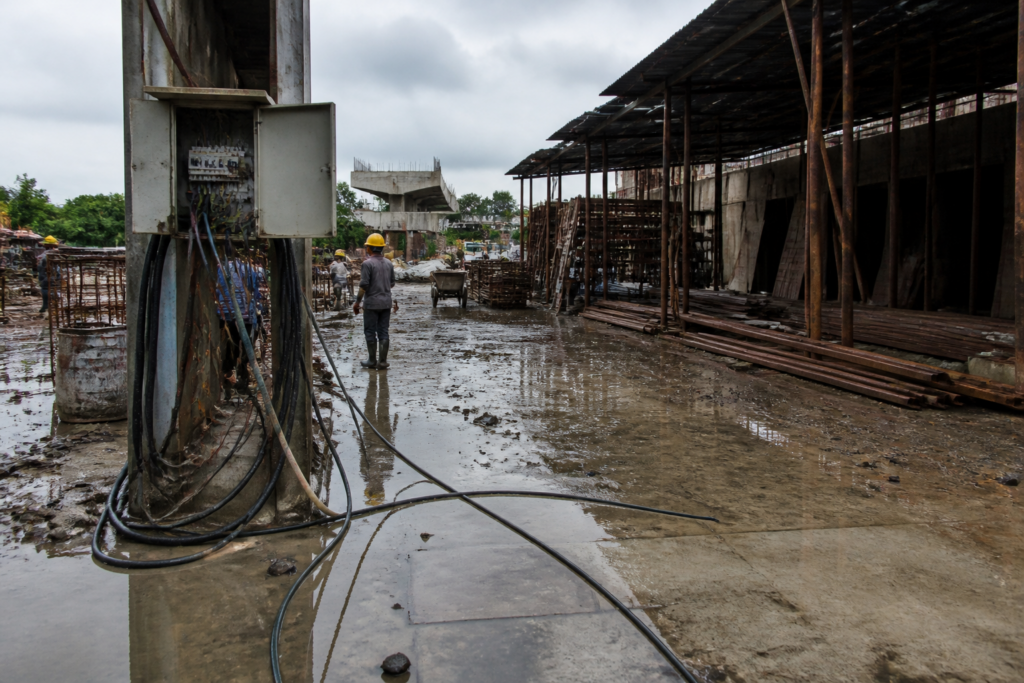
The death of a 16-year-old worker after he stepped on an exposed electrical wire at a construction site in Ahmedabad’s Jagatpur area has brought the risks of informal and inadequately supervised work into sharp focus. The case, reported by Divya Bhaskar – Ahmedabad, involves an open wire near an electrical switchboard, standing water and the absence of safety equipment at a site where the teenager was carrying iron supports.
According to the report, the teenager, identified as Sachin Garasia, had gone to the Blue Well construction site near Jagatpur Crossroads on 11 October with his elder brother Mism Garasia. The brothers, who lived in Ghatlodia, reportedly travelled from Kadiyanaka in Ghatlodia to undertake daily-wage work. Mism was assigned plastering work, while Sachin was asked to carry iron supports to different parts of the site.
The incident occurred while Sachin and another young worker were carrying an iron support. The report states that an electrical wire passing from a shop’s switchboard was exposed and that some water had accumulated nearby. Sachin’s foot came into contact with the wire, causing an electric shock and making him fall. He was taken to hospital for treatment, but died during treatment, according to the report.
Chandkheda police registered a complaint against the site’s main contractor, identified as Kanti Mistry, and supervisor Nanji Solanki. The complaint was filed by Mism Garasia. The allegations concern negligence and the use of workers without safety equipment. The supplied report does not state whether the police have made arrests, whether the construction site has been sealed, or whether a separate inspection has been ordered by any labour or civic authority.
That missing information is important because construction-site safety is not limited to helmets or protective clothing. The reported sequence points to a combination of hazards: an exposed electrical connection, water near the wire, workers handling metal equipment and inadequate control over who was permitted to undertake the task. Each condition can become more dangerous when it occurs alongside the others.
The electrical risk was apparently visible at the worksite. The report describes a wire lying open near a switchboard and water on the ground. It does not establish how long the wire had remained exposed, who was responsible for the electrical connection, whether power should have been isolated before work began, or whether the contractor or supervisor had carried out a site inspection. Those details would be central to determining how the incident happened and where responsibility lay.
The presence of a 16-year-old worker adds another layer to the case. The report identifies Sachin as a minor and says that he was working alongside his brother at the construction site. It does not provide information about the contractor’s recruitment process, whether the worker’s age was known, whether any identity or employment records were maintained, or whether the family had been engaged directly or through another intermediary.
These unanswered questions matter because construction work is often organised through several layers of responsibility. A main contractor may supervise the site, while smaller subcontractors or labour intermediaries may bring workers to the project. The supplied report names the contractor and supervisor but does not explain the project’s ownership, the developer involved, the electrical agency, or the chain through which the brothers obtained work. Without those details, the public record remains incomplete.
The case also illustrates how a construction site functions as a temporary workplace within a rapidly expanding city. Jagatpur, located in Ahmedabad’s northern urban area, has seen construction activity alongside the growth of residential and commercial development. At such sites, the work environment changes daily: masonry, plastering, material handling, electrical installation and finishing activities may overlap. This makes coordination and supervision essential, particularly where workers move heavy metal objects around live electrical connections.
The report says Sachin was carrying an iron support, described in the translated account as an iron ‘horse’, when he came into contact with the wire. Metal objects can increase the danger of an electrical fault because they may provide a conductive path or bring workers closer to exposed connections. The available account does not establish the technical cause of the electrocution, and that determination would require an official investigation. But the reported proximity of exposed wiring, water and metal handling identifies a clear safety breakdown that authorities will need to examine.
The complaint against the contractor and supervisor places site-level supervision at the centre of the case. A supervisor is typically the person present to allocate tasks and monitor daily work, while the contractor is responsible for organising labour and construction operations. The report does not establish the precise legal responsibility of either individual, and the police case should not be treated as a final finding of guilt. The allegations must be tested through investigation and due process.
At the same time, the incident demonstrates why responsibility cannot end with the person closest to the worker. A complete inquiry would need to examine the project’s contracting structure, electrical arrangements, safety procedures and worker records. It would also need to establish whether the worksite had been inspected earlier, whether hazards had been reported, and whether the site had a designated system for isolating electricity during construction activity. None of these facts is available in the supplied report.
The age of the deceased worker also raises questions about how urban construction absorbs labour. The report says the brothers went for daily-wage work and that Sachin was given a manual material-handling task. It does not say whether he was hired for that particular day, whether he had previously worked at the site, or whether other minors were present. These are not peripheral details. They determine whether the incident was an isolated failure or a sign of a wider weakness in labour screening and site control.
A construction project is usually judged publicly by its progress, scale and completion. The daily safety systems that make that progress possible are less visible. They include keeping electrical installations secure, preventing water accumulation around power sources, separating work zones, providing protective equipment, training workers and ensuring that supervisors know which tasks are being performed. When those systems fail, the consequences are borne by workers who may have the least power to question unsafe instructions or refuse a task.
The report does not provide data on construction-site accidents in Ahmedabad, nor does it identify the number of workers employed at the Blue Well site. It therefore cannot support a claim that such incidents are increasing or that the site represents a citywide pattern. What it does establish is a specific fatal incident in which the reported hazard was connected to ordinary site operations and in which a minor was performing manual work.
That distinction is important for responsible reporting. The police complaint records an allegation of negligence; it does not by itself prove the final cause of death or establish criminal liability. The hospital treatment and death are reported facts, while the precise failures that led to the electrocution remain matters for investigation. Any assessment of the contractor’s or supervisor’s liability must follow the findings of the authorities and the court process.
The next stage should therefore clarify the institutional response. The supplied report does not say whether Chandkheda police have inspected the site, recorded statements from other workers, examined the electrical installation or sought technical evidence. It also does not mention any response from the contractor, supervisor, project owner or civic and labour authorities. These responses would help determine whether the case is being treated only as a criminal complaint or also as a workplace-safety failure requiring administrative action.
For the city, the central question is not simply how Sachin Garasia died, but how a live electrical hazard remained in a work area where workers were carrying metal materials. The answer will depend on evidence that has not yet been made public: who installed or controlled the wire, who inspected the area, who assigned the task, whether safety equipment was available and why a 16-year-old was working at the site.
The facts currently available confirm a fatal electrocution at a Jagatpur construction site, the reported presence of an exposed wire and water, and a police complaint against the contractor and supervisor. They do not yet establish the full chain of responsibility or whether the incident reflects broader conditions across Ahmedabad’s construction sector. The police investigation, any technical inspection and the authorities’ response to the minor’s employment will determine what the case ultimately reveals about safety governance at the city’s building sites.


