

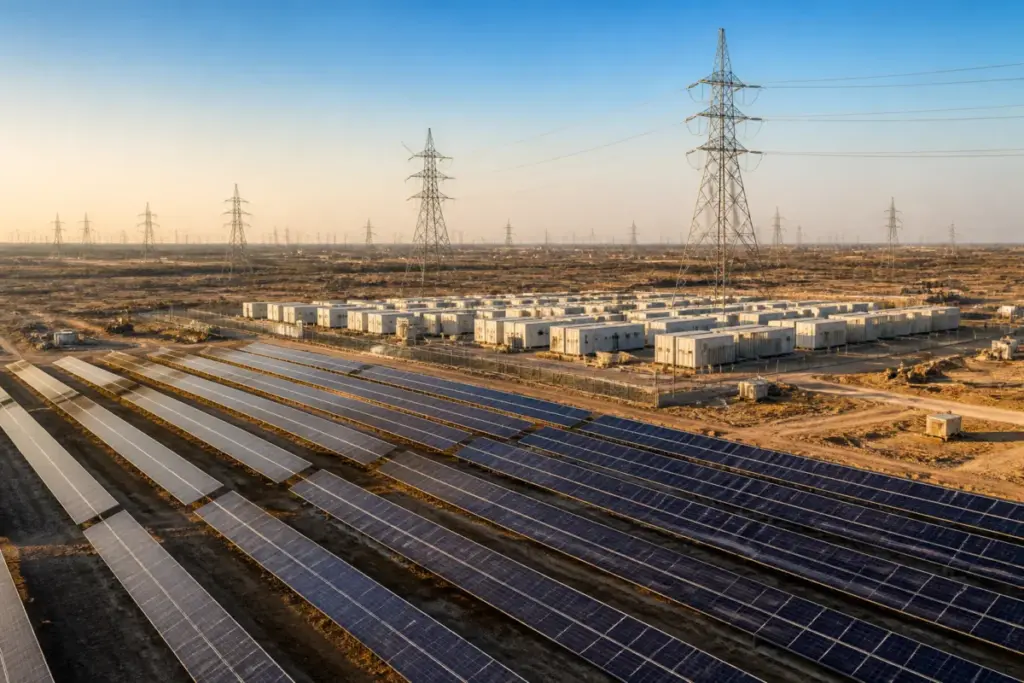
Adani Green Energy’s latest financial results expose a central tension in India’s renewable infrastructure push: the company is expanding generation capacity and battery storage at speed, but the financial returns visible in its standalone accounts have weakened sharply. In the second quarter of FY27, standalone profit after tax fell 93% year-on-year to Rs 33 crore even as revenue from operations almost doubled to Rs 7,890 crore.
The numbers matter beyond one company’s balance sheet because Adani Green is developing a 30GW renewable energy plant at Khavda in Gujarat, added 4,083MW of renewable capacity in the first half of FY27 and is targeting 50GW of operational renewable capacity by 2030. Its operational renewable capacity had reached 20.8GW, while its cumulative operational battery energy storage capacity stood at 6,632MWh after a 3,081MWh addition at Khavda in the second quarter.
The results, released by the company in an unaudited stock exchange filing, show that expansion is continuing even while profitability is under pressure. Standalone total expenses more than doubled to Rs 8,159 crore in the July-September quarter, compared with Rs 3,867 crore in the corresponding period a year earlier. As a result, profit before tax was limited to Rs 22 crore, against Rs 331 crore in the year-ago quarter.
For the first half of FY27, the divergence became more pronounced. Standalone revenue from operations rose to Rs 14,096 crore from Rs 8,736 crore, but total expenses increased to Rs 14,717 crore from Rs 8,110 crore. The company consequently reported a loss before tax of Rs 64 crore, compared with a profit before tax of Rs 367 crore in the first half of the previous year. Standalone profit after tax for the six-month period was a loss of Rs 18 crore, against a profit of Rs 509 crore a year earlier.
These figures describe the cost of building infrastructure at scale, but they do not by themselves establish the precise cause of every expense increase. The supplied results do show the financial weight of the current expansion programme. Adani Green invested Rs 17,160 crore in capital expenditure during the first half, 38% higher than a year earlier. Its net debt-to-run-rate EBITDA ratio stood at 5.6 times.
The infrastructure being created is nevertheless producing stronger operating indicators. Energy sales increased 32% year-on-year to 25,747 million units in the first half of FY27. Revenue from power supply rose 36% to Rs 8,299 crore, while earnings before interest, taxes, depreciation and amortisation from power supply increased 41% to Rs 7,957 crore.
The second-quarter power-supply numbers were stronger still. Revenue from power supply grew 45% to Rs 4,019 crore, and EBITDA rose 51% to Rs 3,835 crore. This contrast between power-supply performance and standalone profit is important. It suggests that the operating performance of the renewable portfolio and the financial outcome after broader expenses, capital spending and financing-related pressures cannot be read as the same measure.
For India’s cities and industries, the distinction is significant. Renewable generation is not only a question of how many megawatts are installed. Large projects also require transmission links, storage systems, land, capital and institutional capacity to convert generation potential into dependable electricity. The addition of 3,081MWh of battery storage at Khavda indicates that the project is being developed with storage as part of its infrastructure build-out rather than as a separate afterthought.
The Khavda project therefore represents more than a power-generation site. Its planned 30GW scale places it at the centre of the company’s capacity strategy, while the storage additions point to the operational challenge of managing renewable electricity. The supplied financial results do not provide details on the project’s transmission arrangements, land footprint, local employment, tariff structure or the schedule for each construction phase. Those gaps limit what can be concluded about its wider regional effects.
What the results do establish is the scale and speed of the build-out. Operational renewable capacity grew 24% to 20.8GW during the period covered. During the first half alone, the company added 4,083MW of capacity and spent Rs 17,160 crore on capital expenditure. The stated 50GW target for 2030 would require the company to continue adding capacity after reaching the current operational base, although the supplied material does not set out an annual commissioning schedule.
That target also places financial structure alongside physical expansion. A net debt-to-run-rate EBITDA ratio of 5.6 times indicates that the company is undertaking this expansion with a substantial debt burden relative to its operating earnings measure. The figure does not, on its own, establish whether the level is sustainable or unsustainable. It does, however, show why the relationship between new capacity, operating cash generation, capital expenditure and financing costs will remain central to the infrastructure story.
The results also reveal an institutional distinction that is often lost in headline profit numbers. The company’s standalone accounts and its renewable energy operating indicators present different pictures. Standalone accounts show a 93% fall in quarterly profit and a first-half loss, while power-supply revenue and EBITDA rose strongly. Without additional financial details beyond those supplied, the results cannot explain the full relationship between the standalone entity, its operating assets and the costs associated with expansion.
For urban India, the implications are linked to the reliability and scale of the electricity system. Renewable capacity can support cleaner power supply, but the transition also depends on whether projects are connected, dispatched and supported by storage and other system infrastructure. The Khavda storage addition is therefore a relevant operational development, while the capital expenditure and debt figures show the financial resources being committed to the transition.
This is also why the company’s results should not be read simply as either a success story or a failure story. The operating data points to rapid growth in energy sales, capacity and power-supply earnings. The standalone financial data points to rising costs that have overwhelmed the profit reported after expenses. Both are part of the same infrastructure cycle: assets are being added and operated, but the financial outcome is shaped by the cost of getting to the next stage of scale.
The evidence currently confirms three things. Adani Green’s renewable platform expanded substantially in the first half of FY27; Khavda has become a major site for both generation and battery storage; and the company’s standalone profitability weakened sharply despite higher revenue. It does not, from the supplied filing summary alone, establish the detailed causes of the expense increase, the commercial returns from each project or whether the 2030 capacity target will be met.
The next relevant milestones are the continued development of the 30GW Khavda plant, further additions to renewable and storage capacity, and the company’s ability to translate that physical expansion into stronger financial performance. Those indicators will determine how India’s renewable infrastructure growth is reflected not only in installed capacity, but also in the financial resilience of the institutions building it.


