

By DR. NIRANJAN HIRANANDANI
Founder & Chairman, Hiranandani Communities
As global awareness of climate responsibility heightens, India’s real estate sector stands at a pivotal crossroad. As one of the largest contributors to carbon emissions, the industry also holds immense potential to lead transformative change. With 2025 fast approaching, the question looms large: Can India achieve carbon neutrality in its built environment, or is this target merely an aspirational ideal?
Carbon neutrality is more than a reduction in emissions—it signifies achieving equilibrium between carbon emissions and their offset or sequestration. For the energy-intensive real estate domain, this requires a fundamental reimagining of design, construction, and eventual demolition processes.
From Policy Pledges to Practical Implementation
India has committed to ambitious climate goals, from the Paris Agreement to the Panchamrit targets tabled at COP26. Integral to these plans is the decarbonization of the construction and building sector. Yet, translating such national commitments into on-ground action requires a collective paradigm shift involving developers, urban planners, financiers, and consumers.
Sustainability, for organizations such as Hiranandani Communities, goes beyond being a trend—it is a corporate responsibility. Initiatives such as green-certified townships, energy-efficient building frameworks, mass afforestation efforts, and next-generation waste management demonstrate a measurable commitment to cutting carbon footprints. However, scaling these practices nationally is essential to advance the country’s carbon-neutral aspirations.
 Technology’s Role in Pioneering Progress
Technological advancements are opening new avenues for sustainable real estate. Low-carbon concrete, prefabricated building components, renewable energy systems, and modernized construction techniques have proven effective in reducing embodied and operational
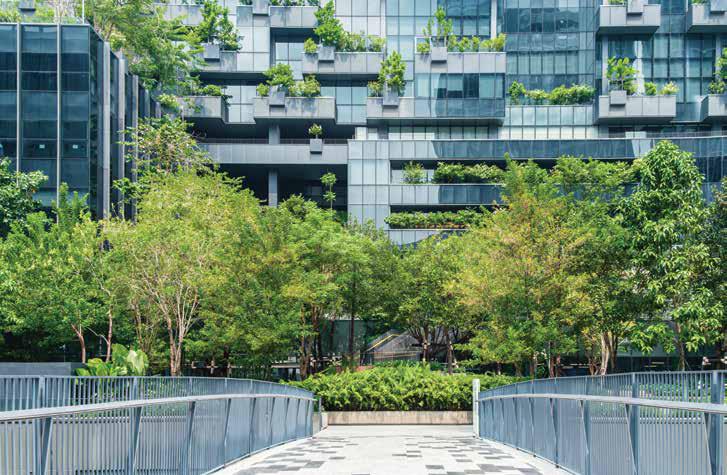
carbon footprints.
Additionally, the integration of tools like Artificial Intelligence (AI), the Internet of Things (IoT), and Building Information Modeling (BIM) has revolutionized energy optimization in buildings. Smart structures—once considered futuristic—are now critical to achieving real-time efficiency, especially in energy consumption. Yet, democratising access to such innovations, particularly in affordable housing, is imperative for widespread adoption and impact.
Perceptions, Costs, and the Reality Check
Despite the optimism, significant barriers persist. High upfront costs, fragmented regulations across states, inconsistent green financing options, and limited consumer awareness hinder progress. Compounding these challenges is the perception that sustainable real estate is a luxury rather than a necessity.
This misconception needs dispelling. Long-term analysis reveals that sustainability is cost-effective, even if initial investments seem higher. Bridging this perceptive gap requires large-scale education initiatives targeting both developers and consumers. Industry stakeholders must understand that the upfront expense yields downstream advantages—reduced operational costs, enhanced property values, and improved resilience to environmental risks.
Additionally, the introduction of fiscal incentives—such as benefits for green-certified projects and tax advantages for homebuyers—can serve as key motivators for broader participation. Sustained efforts to educate all involved parties on such incentives and benefits will play a pivotal role in closing the gap between perception and reality.
Collaboration: The Cornerstone of Carbon Neutrality
Carbon neutrality is a challenge that a real estate sector can’t address in isolation. A unified approach, involving the government, private enterprises, civil society, and academia, is crucial. Streamlined approvals for sustainable designs, expanded ESG frameworks in financing, and incentive-driven policies for green development can significantly advance the agenda.
Equally vital is investing in a “green-collar” workforce to support sustainable construction practices. Cutting-edge technologies and bold visions will only succeed if matched by a workforce trained to implement them effectively.
 Beyond 2025
Can India achieve carbon-neutral real estate by 2025? For select trailblazing organizations and projects, the answer is yes. However, achieving this goal uniformly across the nation may require more time. The seeds of transformation have been planted, and with continued collaboration, innovation, and persistence, the aspiration for carbon neutrality can evolve into a nationally scalable standard.
The real estate sector must recognize that its actions today will define the environmental legacy of tomorrow. The fundamental question is not whether India can afford to embrace green practices, but rather, whether it can afford to delay adopting them.