

West Bengal chief minister Suvendu Adhikari visited families of people killed in the Chorebagan pandal stampede on Wednesday, handing over compensation cheques of ₹25 lakh and promising government jobs and further assistance to eligible relatives.
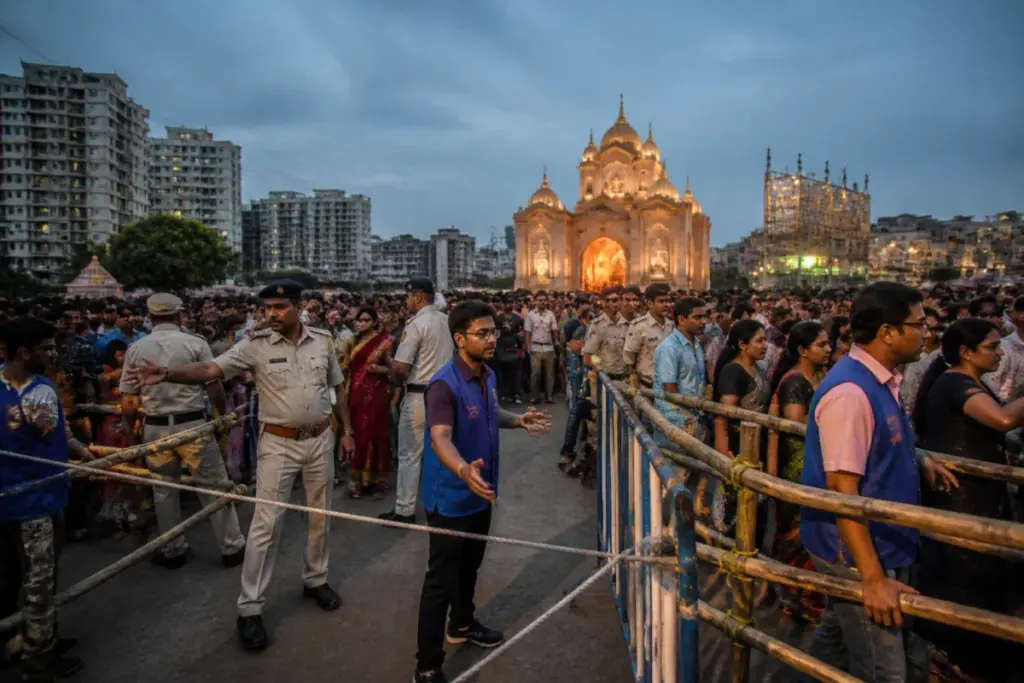
Nineteen pandal visitors died and 25 others were injured when the stampede occurred at Chorebagan on Saturday, Saptami. The incident has raised questions about how large religious and cultural gatherings are planned, staffed and managed across Kolkata’s wider urban region.
Adhikari visited the homes of several bereaved families in North 24-Parganas, including Tania Biswas’s and Barnali Halder’s families. He also stopped at Gouranganagar in New Town and met Prithwish Ghosh, a young survivor who lost both his parents in the stampede.
The chief minister described the visits as a responsibility rather than a formality and said the government would provide all possible assistance. The state government had announced that each bereaved family would receive ₹25 lakh in compensation. During one visit, Adhikari was also heard assuring a family of an additional ₹2 lakh to be transferred to a bank account. The report said this amount appeared to be separate from the announced compensation.
Adhikari asked family members to provide details of eligible relatives who could be considered for government employment. He also offered to act as Prithwish’s local guardian and assured him of continued support.
The compensation and employment assurances address the immediate financial consequences of the tragedy, but the incident has also brought crowd-control arrangements at seasonal public events under scrutiny. Adhikari maintained that the stampede was primarily the result of human error rather than structural failure. He pointed to possible lapses involving crowd-control ropes and the management of visitors inside the premises.
The chief minister also defended the police against criticism, citing shortages in the state force. He said Bengal had around 105 police personnel per one lakh residents and questioned how the existing force could meet the demands placed on it without adequate recruitment.
According to Adhikari, reliance on civic volunteers and temporary home guards during Puja could not by itself resolve the wider personnel shortage. Regular police recruitment was necessary, he said, although filling vacancies would take time. The government was working to address the shortfall, he added.
The account places the tragedy at the intersection of event-level crowd control and the capacity of the institutions responsible for public safety. For residents attending high-footfall pandals, the immediate questions include how entry and exit routes are controlled, who monitors visitor movement and whether sufficient trained personnel are deployed at peak times.
The state government’s next steps, including assistance to bereaved families, consideration of eligible relatives for government employment and action on police recruitment, will determine how its response develops after the stampede.


