

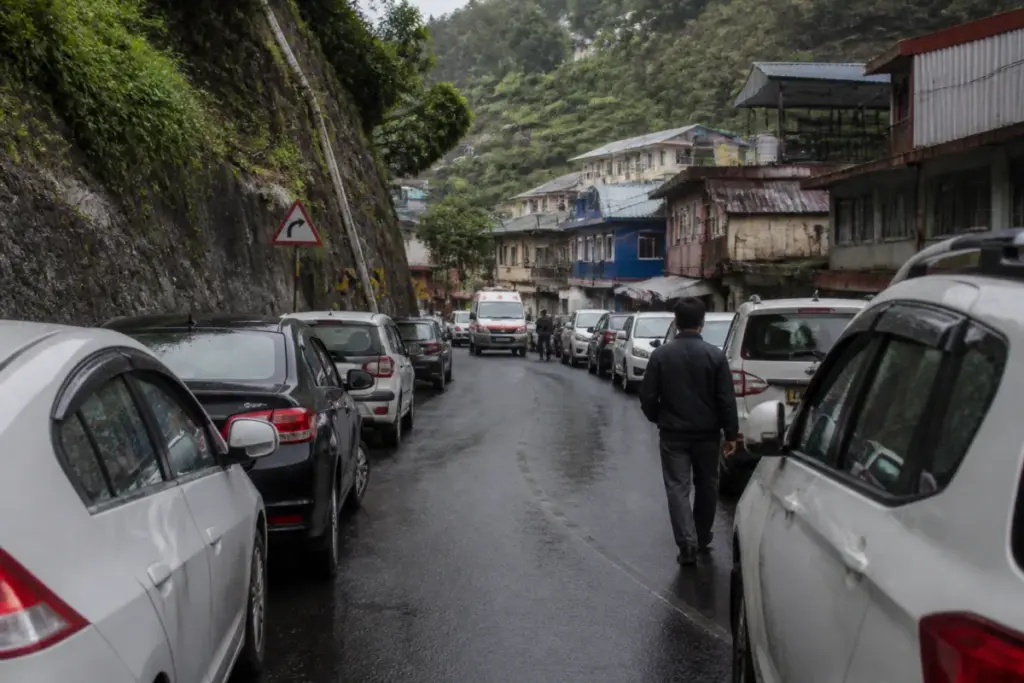
A reported ambulance delay in Wellington, near Coonoor, has brought the Nilgiris’ narrow-road parking problem into sharp focus. According to social activist Usha Frankel, a woman reportedly died while waiting in an ambulance that could not move through the Boys Company area because vehicles parked on both sides of the road obstructed its passage. The account, included in a letter to Tamil Nadu Chief Minister C. Joseph Vijay, has renewed demands for a district-wide plan to keep emergency routes clear.
The incident is not presented in the supplied report as the result of a formal government inquiry or an independently published medical or police finding. It is an account cited by Frankel in her appeal to the Chief Minister. That distinction matters, but it does not reduce the seriousness of the urban question it raises: when roads are narrow, parking is unmanaged and emergency access depends on finding vehicle owners, the street itself becomes a point of institutional failure.
Coonoor, Wellington and the wider Nilgiris have a road network shaped by hill terrain. In such locations, the usable carriageway is constrained by slopes, bends, built-up edges and limited opportunities to widen streets. The report specifically refers to narrow ghat roads in Wellington and Coonoor, as well as the national highway passing through Coonoor. On roads with little spare width, parking is not simply a question of convenience or traffic discipline. A vehicle left along one edge can reduce the operating space available to ambulances, fire tenders and rescue vehicles, particularly when another vehicle is parked opposite it.
Frankel’s appeal identifies this as a public-safety issue affecting more than routine congestion. She said an ambulance lost precious time while efforts were made to locate the owners of obstructing vehicles at their homes and ask them to move. The reported sequence exposes a critical weakness in emergency mobility: access was treated as an individual parking problem to be solved after an ambulance encountered an obstruction, rather than as a route-management responsibility that should be addressed before an emergency occurs.
Her request to the state government is therefore broader than action at one location. She has urged restrictions on parking on one or both sides of narrow roads wherever necessary, along with measures to ensure that ambulances, fire engines and rescue vehicles can pass at all times. She has also asked the Nilgiris district administration, police department, traffic police and local bodies to conduct an immediate survey of narrow and vulnerable roads across the district and prepare a time-bound action plan.
That demand points to the fragmented nature of street management in a hill district. Different agencies may have responsibility for different road classes and functions. The report refers to the district administration, police, traffic police and local bodies as institutions that would need to act. Any effective response would therefore require more than occasional enforcement. It would need a shared identification of vulnerable stretches, clear parking restrictions, visible communication to residents and visitors, and a mechanism for keeping emergency corridors usable throughout the day.
The source material does not establish how many roads in the Nilgiris face this problem, how frequently ambulances or fire services are delayed, or whether a formal survey of emergency access has previously been completed. It also does not provide details of the road widths, traffic volumes, available parking capacity or enforcement arrangements in Coonoor and Wellington. Those gaps prevent the reported incident from being treated as a statistical measure of the district’s entire traffic system. They also show why the proposed survey is important: without a mapped understanding of the locations and conditions that create the greatest risk, restrictions may remain reactive and uneven.
The reference to the Ooty national highway is significant because it places the parking problem on a route with a function beyond local access. A highway passing through a dense hill settlement can carry through traffic, local trips, commercial movement and emergency journeys at the same time. When roadside parking occupies part of the available space, the conflict is not only between parked vehicles and moving cars. It is between several urban functions competing for a constrained corridor. An emergency vehicle has no practical substitute for a blocked road in the moment when access is needed.
The Nilgiris case also illustrates why narrow-road parking cannot be separated from the availability of alternatives. A restriction without a workable enforcement and parking arrangement can shift vehicles to nearby streets, create new obstructions or be applied inconsistently. The supplied report does not state whether dedicated parking areas, one-way systems, loading arrangements or resident permits currently operate in the affected locations. These are not details that can be assumed. They are precisely the operational questions a district-level assessment would have to answer before a durable plan is implemented.
The institutional responsibility is similarly clear but distributed. Frankel has asked the Chief Minister to intervene, while naming the district administration, police, traffic police and local bodies as agencies that should implement the response. The appeal does not record a government decision, a new notification, a traffic order or an implementation deadline. At this stage, the development is a demand for intervention rather than confirmation of a new policy. The next step would be to establish whether the state or district authorities order the proposed survey and what agency is assigned responsibility for each identified road.
There is also an important difference between traffic management during ordinary conditions and emergency access planning. Routine enforcement may focus on congestion, illegal parking or vehicle movement. Emergency access requires a higher threshold: roads must remain passable even when traffic is heavy, visibility is poor or a vehicle needs to approach a location quickly. Frankel’s letter explicitly groups ambulances, fire tenders and rescue vehicles together, indicating that the issue concerns several types of time-sensitive public service rather than healthcare access alone.
The reported death, as described in the activist’s letter, has given the parking problem its most serious human consequence. Because the source does not include an official investigation, the precise causal chain remains to be established by the relevant authorities. What is already evident from the account is that a delay in moving an ambulance can turn a familiar street-management failure into a matter of life and death. In hill settlements, where alternative routes may be limited and road space is physically difficult to expand, prevention becomes especially important.
The larger urban question is whether the Nilgiris treats emergency movement as a design requirement or as an enforcement problem addressed only after a crisis. A road can appear functional for everyday travel while remaining dangerously unreliable for ambulances and fire vehicles. Measuring that difference requires authorities to examine not only traffic flow but also the minimum clear width available at different times, the location of parked vehicles, access to vulnerable neighbourhoods and the response routes used by emergency services.
The supplied report confirms a serious appeal for immediate intervention following a reported ambulance obstruction in Wellington. It does not confirm a government response or establish the scale of the problem across the district. The developments that now require monitoring are whether authorities conduct the requested survey, identify roads where parking must be restricted, assign enforcement responsibility and publish a time-bound plan to protect emergency access in Coonoor, Wellington and other congested parts of the Nilgiris.


