

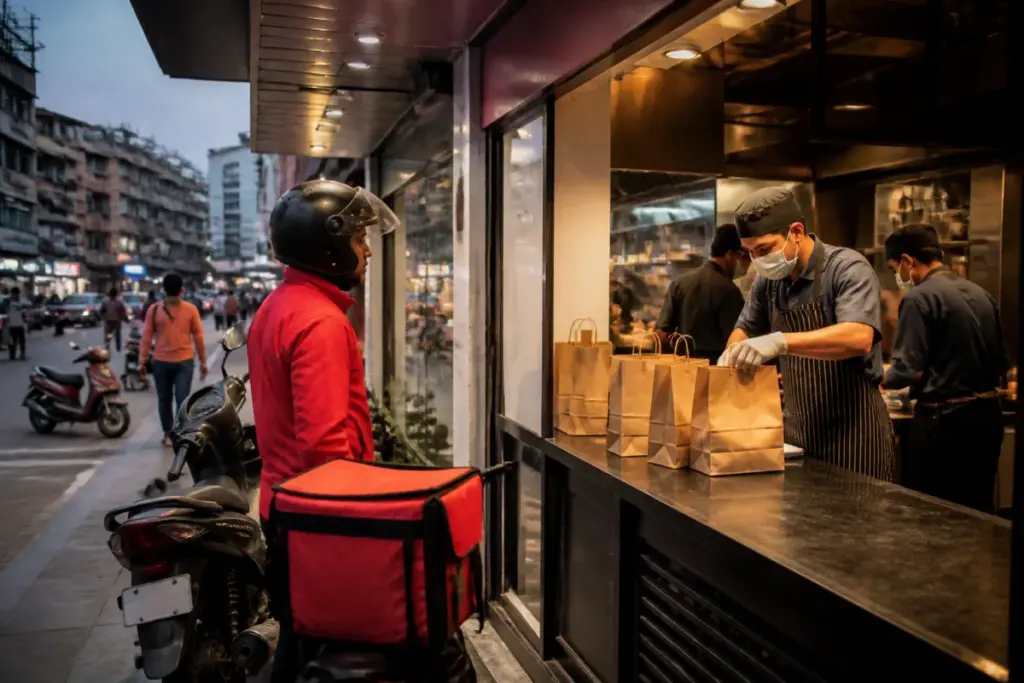
Shiprocket’s move into direct food ordering is less about adding another restaurant app than about changing who controls the customer relationship after a meal is discovered online. Through its fastrr platform, the company is working with Delhi-NCR restaurant chains Punjabi Angithi and Bikkgane Biryani to help them generate repeat orders, use customer data and arrange deliveries without relying entirely on food aggregators.
That proposition addresses a central problem in India’s urban food economy: restaurants may depend on aggregators to reach new diners, but the cost of acquiring and serving those customers can sharply reduce the value of each order. Shiprocket’s model attempts to separate discovery from repeat business. Aggregators can remain the entry point, while restaurants use their own digital channels for subsequent purchases.
The timing reflects the pressure on restaurant margins. Food-aggregator commissions, taxes, discounts and promotional expenses can together consume up to 40 per cent of an order’s value, according to the report. A December 2025 NCAER study conducted with Swiggy investor Prosus found that average aggregator commissions rose from 9.6 per cent in 2019 to 24.6 per cent in 2023. At the 2023 average, a restaurant would pay ₹24.6 lakh on every ₹1 crore of commissionable orders in commissions alone, before accounting for other expenses.
These numbers explain why direct ordering has become a strategic question rather than merely a technology upgrade. A restaurant’s digital presence is no longer limited to menus and online visibility. It also includes the ability to identify returning customers, communicate with them, offer targeted incentives and measure whether marketing spending produces another order. The platform that controls those functions has influence over the restaurant’s recurring revenue.
Shiprocket’s fastrr platform is designed to provide those capabilities. Under the partnerships with Vegorama Group, which operates Punjabi Angithi and Bikkgane Biryani, fastrr Identity and fastrr Signals will help identify potential and returning customers. Targeted advertising, WhatsApp reminders, personalised offers and abandoned-order recovery are intended to improve repeat purchases.
The significance of this approach lies in its focus on the second and third order. A restaurant may accept the cost of an aggregator commission when acquiring a new customer, particularly when the platform provides discovery and demand. But paying the same kind of recurring commission every time that customer orders can become more difficult to justify. Direct ordering gives the restaurant an opportunity to replace part of that recurring cost with spending on marketing, payments and delivery that it can manage more directly.
This does not make aggregators irrelevant. Their continuing value is customer acquisition: they provide a large marketplace where diners can discover unfamiliar restaurants, compare options and place an initial order. The direct-ordering model therefore depends on a transition that is difficult to execute. Restaurants must persuade customers who were acquired through a marketplace to return through a separate channel, remember the brand and complete another transaction without the aggregator’s interface.
That transition turns customer data into a core commercial asset. Shiprocket CEO Gaurav Mangla said the company believes brands should be able to build relationships directly rather than have them mediated entirely by third-party platforms. In operational terms, that means restaurants can use information about previous orders and customer behaviour to design communications and offers. The approach also raises a practical question for restaurants: whether they have the systems, staff and marketing discipline to convert that data into repeat demand.
The delivery component is equally important. Direct ordering can reduce dependence on an aggregator’s delivery network only if restaurants can offer a reliable alternative. Shiprocket Quick plans to arrange doorstep deliveries through third-party riders, including Ola, Porter, Borzo and Shadowfax Local. The service provides live tracking, advertised rates starting at ₹10 per km, uniform pricing across partners and no surge fees, according to the report.
This is an example of the broader unbundling of urban commerce. The customer interface, marketing layer, ordering system, payment process and last-mile delivery network do not necessarily have to be controlled by one company. Shiprocket is positioning itself as an infrastructure provider across several of those layers, allowing restaurant brands to retain their own digital channels while outsourcing logistics.
For restaurants operating across dense urban markets, this arrangement could reduce the need to maintain a dedicated delivery fleet. The benefit is not only financial. Fleet ownership requires recruitment, scheduling, supervision and capacity management, especially during meal-time peaks. An outsourced network can provide access to delivery capacity from individual outlets, although the supplied material does not establish how the model will perform during high-demand periods or in lower-density areas.
The partnership also extends beyond prepared food. The agreements cover packaging, influencer marketing and packaged foods sold through brand websites and quick-commerce platforms. Shiprocket plans to expand fastrr to quick-service restaurants, cloud kitchens, bakeries and packaged foods, while adding loyalty programmes and peak-hour delivery allocation. This indicates an attempt to build a broader commerce layer around food brands rather than limit the platform to restaurant ordering.
Shiprocket is entering a field that already includes DotPe and uEngage, which offer restaurant ordering apps and marketing tools. EatClub and Rebel Foods’ EatSure operate direct-ordering platforms for their own restaurant brands, while the Open Network for Digital Commerce, or ONDC, provides another alternative. The competitive landscape therefore includes both specialist technology providers and restaurant groups building controlled channels for themselves.
The immediate challenge is that both Punjabi Angithi and Bikkgane Biryani already use apps built by uEngage. Shiprocket is not starting with an entirely unserved customer base; it is seeking to strengthen existing channels with marketing and delivery capabilities. That makes the proposition less about replacing every existing system and more about integrating or improving the functions that determine whether a direct channel becomes commercially useful.
The urban policy dimension is indirect but important. Digital food commerce is now connected to employment, delivery work, small-business viability, consumer data and the use of city streets for last-mile logistics. Every direct order still requires packaging, payment processing, rider movement and delivery access to homes and offices. A change in the ordering platform can therefore affect several parts of the urban economy even when the customer sees only a different checkout link.
The available evidence does not establish whether direct ordering will reduce the total cost of serving customers in every case. Lower platform commissions may be offset by spending on customer acquisition, software, payment processing, packaging, delivery and discounts. The model’s economics will depend on repeat-order rates, delivery distances, order density and the ability of individual brands to manage customer communications without creating excessive promotional costs.
What the development does establish is a clear shift in bargaining priorities. Restaurants are seeking more control over the relationship with diners, while technology companies are competing to provide the tools that make such control operationally possible. The key commercial opportunity is converting customers first acquired through aggregators into direct repeat buyers. The key uncertainty is whether enough customers will make that shift for the savings to outweigh the cost of running separate channels.
Shiprocket’s expansion will therefore be measured less by the number of restaurants it signs than by whether those restaurants can retain more value from recurring orders. Its next stated areas of expansion are quick-service restaurants, cloud kitchens, bakeries and packaged foods, along with loyalty programmes and peak-hour delivery allocation. Those developments will show whether direct ordering can move from a cost-control experiment for selected chains to a broader operating model for urban food businesses.


