

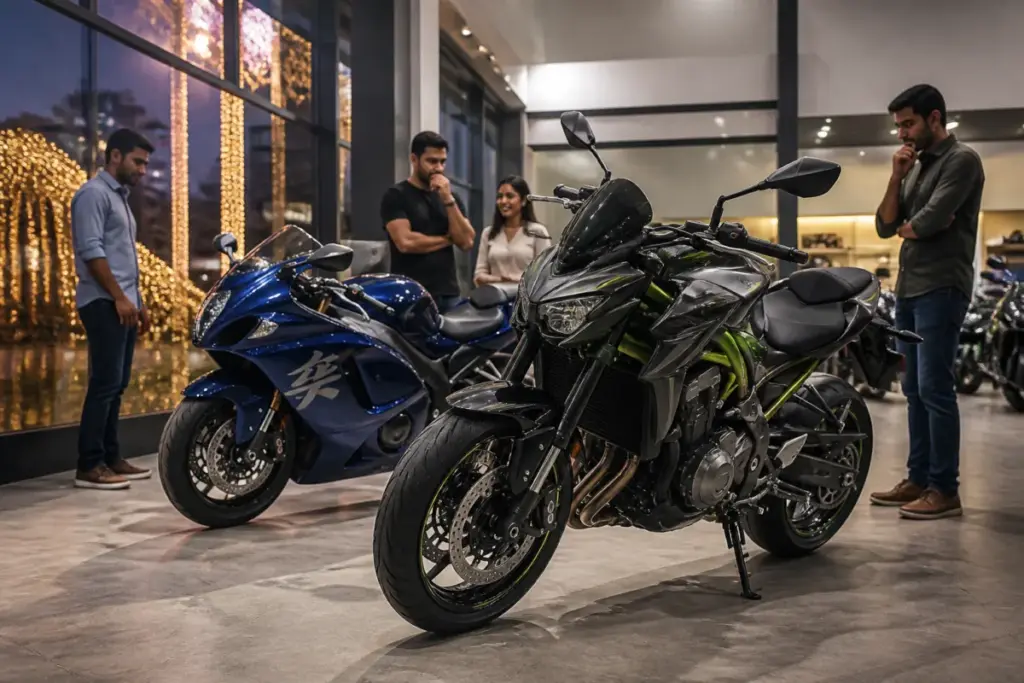
India’s premium motorcycle market has entered a more difficult phase of expansion. Sales in the tracked 1,000–1,600cc category rose 22 per cent to 1,105 units in FY26 from 905 units a year earlier, but manufacturers are now testing how much pricing power remains after motorcycles above 350cc moved to a 40 per cent GST rate. Kawasaki has held the price of its 2027 Z1100 at ₹12.79 lakh, while Suzuki has raised the standard Hayabusa to ₹18.99 lakh and introduced a ₹19.90-lakh Special Edition. The contrast is not simply a contest between two superbikes. It reflects the larger pressure on a niche market where purchase prices, taxes and ownership costs can quickly narrow the pool of buyers.
The market’s recent growth is also concentrated. Suzuki’s Hayabusa accounted for 543 units in the tracked category, nearly half of total sales. Kawasaki followed with 281 units, up sharply from 61 units in the previous year. Triumph’s sales declined to 159 units from 208, while Harley-Davidson remained broadly stable at 120 units. These figures suggest that the category is growing, but not evenly across manufacturers or products. A rise in aggregate sales can therefore conceal substantial differences in brand momentum, price sensitivity and product appeal.
The taxation change provides the immediate backdrop. Since September 22, 2025, motorcycles above 350cc have attracted 40 per cent GST, compared with an earlier effective rate of 31 per cent. The increase pushed the Hayabusa’s price up by about ₹1.16 lakh. Its wholesale dispatches subsequently fell 32 per cent, from 324 units in the first half of FY26 to 219 units in the second half. The figures do not establish that taxation alone caused the decline, but they show how a tax change can have a visible effect in a segment where the absolute price increase is significant.
For a premium motorcycle buyer, the tax is only one part of the final calculation. The Kawasaki Z1100’s on-road price in Delhi is about ₹14.56 lakh after registration and insurance, compared with its ₹12.79-lakh ex-showroom price. Maintenance, tyres and spare parts add further costs over the ownership period. At this level, a change of even a few percentage points in taxation is not an abstract policy adjustment; it becomes a sizeable addition to the amount required before the motorcycle reaches the road.
That makes Kawasaki’s decision to retain the Z1100’s ex-showroom price significant as a pricing strategy, even if it does not by itself indicate how the wider market will perform. The motorcycle is positioned below Honda’s CB1000 Hornet SP, priced at ₹13.29 lakh. The 2027 Z1100 is mechanically unchanged from the model introduced in November 2025, and deliveries are scheduled to begin on October 19. Holding the price allows Kawasaki to preserve a clear comparison with rival performance roadsters while absorbing or managing the effects of the changed tax environment.
The company has also used tactical pricing in other parts of its portfolio. Earlier offers included discounts of up to ₹1.5 lakh on the Ninja ZX-10R and Ninja 1100SX. Such incentives indicate that premium positioning does not eliminate the need for active demand management. Even in a luxury segment, manufacturers may have to balance headline prices with limited-period benefits, particularly when buyers are comparing imported or locally assembled motorcycles with increasingly capable middleweight alternatives.
Suzuki is taking a different route. The standard Hayabusa now receives new dual-tone colours, a lighter lithium-ion battery and revised electronics, while the Special Edition adds exclusive styling, exhaust detailing and a factory-fitted single-seat cowl. The Special Edition costs ₹91,000 more than the standard model. Deepak Mutreja, Vice-President, Sales and Marketing, Suzuki Motorcycle India, said the company aimed to offer customers “an even more exclusive and premium ownership experience”.
This is a premiumisation strategy in a market where volume alone is unlikely to justify every product decision. Flagship motorcycles can strengthen a manufacturer’s brand, bring enthusiasts into showrooms and support communities built around riding, touring and performance. Their value to a company is therefore not limited to the number of units sold. They can also function as brand symbols that influence customers considering less expensive models from the same manufacturer.
The distinction between market size and market influence is important. The 1,000–1,600cc figures cover only part of the broader premium motorcycle segment. Industry sources cited in the report say the ₹10-lakh-plus market also includes adventure motorcycles, sport-tourers and performance roadsters from BMW Motorrad, Ducati and other manufacturers. The reported 1,105-unit category cannot therefore be treated as a complete measure of all premium motorcycle demand in India. It is a tracked subset that provides a useful, but limited, view of the market.
The data nevertheless shows why manufacturers remain interested. A 22 per cent annual increase is meaningful in a category with limited volumes, particularly when one brand has expanded from 61 units to 281. But the same data also shows the vulnerability of a small market. A change in the sales performance of a single high-volume model can materially alter the overall picture. The Hayabusa’s 543 units, for example, account for almost half of the tracked category, making the performance of that model central to the segment’s reported growth.
The tax structure is only one part of the policy landscape. Budget 2025 reduced the basic customs duty on fully built motorcycles up to 1,600cc from 50 per cent to 40 per cent. That change may benefit manufacturers dependent on imported models, although its impact will vary according to sourcing arrangements, pricing decisions and the extent to which any duty reduction is passed on to customers. Suzuki’s Hayabusa, by contrast, is assembled locally at Gurugram, giving its cost structure a different character from that of a fully imported motorcycle.
Local assembly does not remove exposure to the premium pricing challenge. Components, technology, logistics, after-sales support and brand positioning all contribute to the final cost of a high-performance motorcycle. Nor does a lower customs duty automatically translate into lower retail prices. The market response depends on how manufacturers distribute savings across prices, margins, promotions and product investment. The available information establishes the policy change and the different manufacturing arrangements, but not the precise financial effect for each company.
The ownership model is changing as well. Industry sources say organised riding events, track days, touring programmes and after-sales support are becoming more important in retaining premium customers and encouraging repeat purchases. This suggests that the premium motorcycle market is increasingly built around an ownership ecosystem rather than a single transaction. A manufacturer selling a motorcycle at more than ₹10 lakh must support the customer’s experience after delivery, including service access, parts availability and opportunities for community participation.
That ecosystem also helps explain the continued importance of flagship motorcycles despite their limited volumes. A premium motorcycle is both a vehicle and a lifestyle product. Buyers are paying for performance, design, exclusivity and access to a brand community, while manufacturers are seeking visibility, loyalty and a pathway to future purchases. But the same positioning creates a ceiling: as prices rise, the products become less accessible, and the market must rely more heavily on high-income enthusiasts and repeat customers.
Middleweight motorcycles add another layer of competition. Their growing popularity offers buyers alternatives with lower purchase and ownership costs than litre-class machines. This does not mean that middleweight models directly replace superbikes for every customer, but they can reduce the pressure to move into the most expensive part of the market. For a buyer comparing performance, touring ability and everyday usability, the difference in total ownership cost may matter as much as engine capacity or badge value.
The festive season is consequently a test of pricing power rather than only a sales opportunity. Kawasaki’s price hold, Suzuki’s higher-priced special edition and the use of discounts on selected Kawasaki models represent different responses to the same problem: how to protect premium positioning while keeping demand alive after a tax increase. The outcome will be visible not only in unit sales but also in the balance between standard models, special editions, promotions and customer engagement programmes.
The evidence confirms that India’s premium motorcycle market is growing, but it does not yet show that the growth is broad-based or insulated from taxation and ownership costs. The tracked category expanded strongly in FY26, while the largest model recorded a decline in wholesale dispatches after its price rose. The wider market remains only partly captured by the available data. Future assessments will need to watch whether the festive period sustains demand, whether manufacturers rely more on incentives and whether premium buyers continue to pay for exclusivity as the total cost of ownership rises.


