

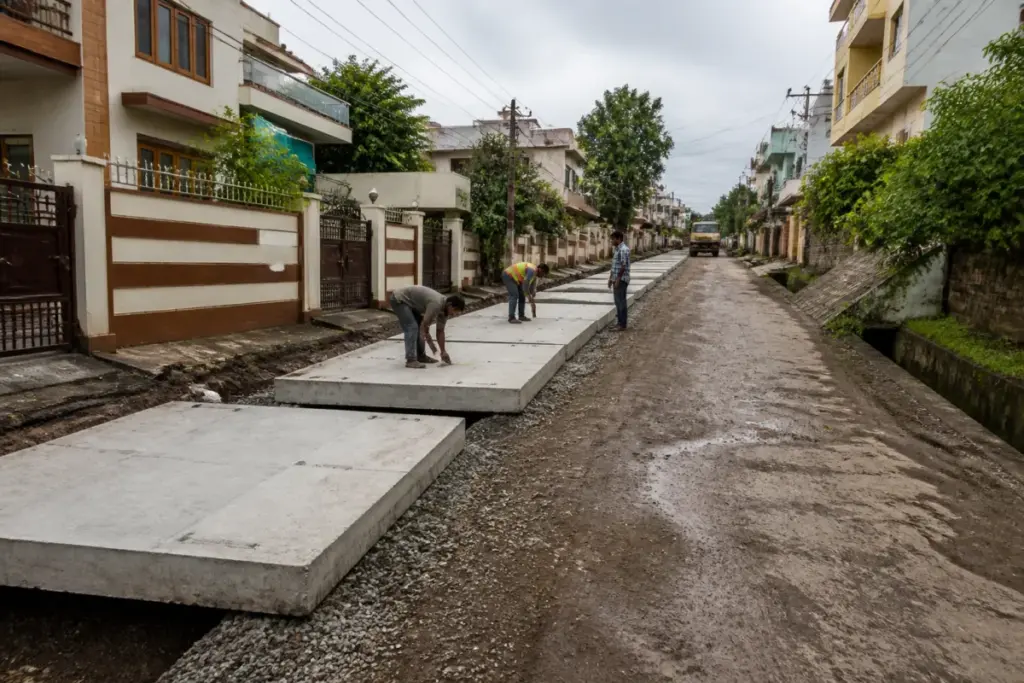
Nagpur’s Public Works Department (PWD) is planning a Rs3 crore experimental precast road in Mhalgi Nagar that will use around 490 concrete blocks to build a two-lane stretch while matching the surrounding ground level and reducing the risk of waterlogging near homes.
The proposed road will be 330 metres long and 7.5 metres wide. According to the PWD estimate, each precast block will measure 2.5 metres by 3.7 metres and have a thickness of 0.2 metres. The department is executing the project, which remains at the planning stage and will begin only after the necessary formalities are completed.
PWD officials told the Times of India that the trial is intended to address a recurring problem associated with cement roads: their elevation can end up higher than adjoining roads, plots and houses. That difference can obstruct access for residents and increase the possibility of rainwater flowing into properties.
Instead of casting the concrete at the site and waiting for it to cure, the proposed system will use blocks manufactured in advance and assembled at the location. The construction method is expected to reduce the time required for road work and limit disruption to traffic and access to nearby properties, although the department will assess those outcomes through the trial.
Road elevation is a practical issue in built-up neighbourhoods because a carriageway does not function independently of the plots, entrances and adjoining streets around it. When a new surface is raised without adequately matching existing levels, residents can face difficulties entering properties and managing runoff during rainfall. The PWD’s stated design objective for the Mhalgi Nagar project is to avoid that mismatch by aligning the road with surrounding ground levels.
The project will also allow the department to examine whether precast construction can provide greater control over the finished road profile than conventional cement-road work. The blocks would be prepared before being transported and placed, rather than being poured and cured sequentially on the road itself.
The proposed stretch is described as an experimental project on a busy urban road. Its performance will determine whether the method can offer a practical alternative to conventional cement roads in similar settings. The department has not yet moved the project into construction and is expected to initiate work after completing the required formalities.


