

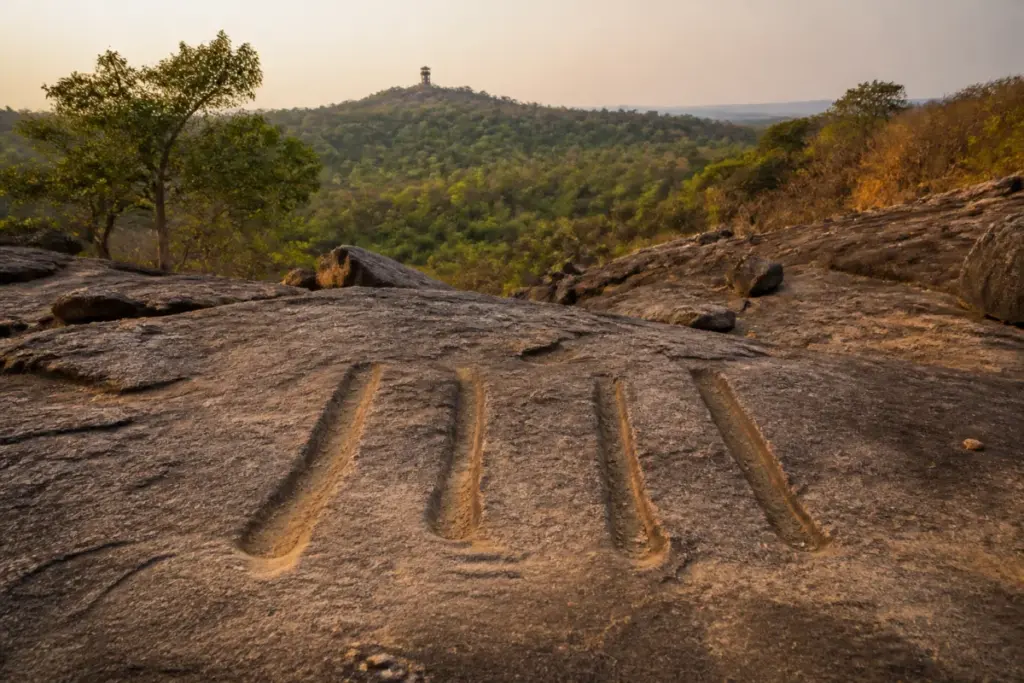
Four deep rock grooves of possible prehistoric significance have been identified near the Banda Juvvi Watch Tower in Mrugavani National Park at Chilkur, near Hyderabad, prompting a call for a systematic archaeological survey of the forested site and nearby rock-art locations.
The grooves were identified during a safari visit by historian Dr Satyanarayana Dyavanapalli. The site was brought to his attention by B. Anand Kumar, Administrative Officer with the Forest Department in Rangareddy district. Dr Dyavanapalli said the discovery raises the possibility of prehistoric human activity in the landscape surrounding Hyderabad.
The four grooves are located on a plateau-like rock surface overlooking surrounding valleys. Each groove is approximately one foot long and between two and four inches deep, according to the report. The area also has nearby water sources and valleys, features that Dr Dyavanapalli said may have supported hunting and gathering activities.
The grooves have not been conclusively identified as prehistoric tools or work surfaces. However, Dr Dyavanapalli said their length and depth raise the possibility that they were repeatedly used for grinding or sharpening stone implements, including axes and other tools. Establishing their age, purpose and archaeological significance would require scientific examination and documentation.
The reported discovery is located near an existing rock-art site containing ochre paintings. Dr Dyavanapalli said the grooves, the distinctive landscape and the nearby paintings together warrant detailed study. He urged the Telangana Department of Archaeology and Museums to conduct a systematic survey of the Banda Juvvi Watch Tower area and the adjoining rock-art site.
The proposed investigation would require coordination between the Archaeology Department and the Forest Department. Because the locations fall within Mrugavani National Park, any survey and documentation would also need to be carried out in a manner that protects the forest landscape and prevents damage to the rock surfaces.
Mrugavani National Park is a forested public landscape on Hyderabad’s outskirts, making the reported site significant not only for archaeology but also for the management of natural and cultural assets within an accessible urban region. The discovery indicates the need to establish whether the grooves and paintings form part of a connected archaeological landscape or represent separate features.
Dr Dyavanapalli said discoveries of this nature deserve careful scientific investigation. The next step requested by the historian is a formal survey by the Archaeology and Museums Department in collaboration with the Forest Department, followed by detailed study and documentation of the grooves, rock art and surrounding terrain.


