

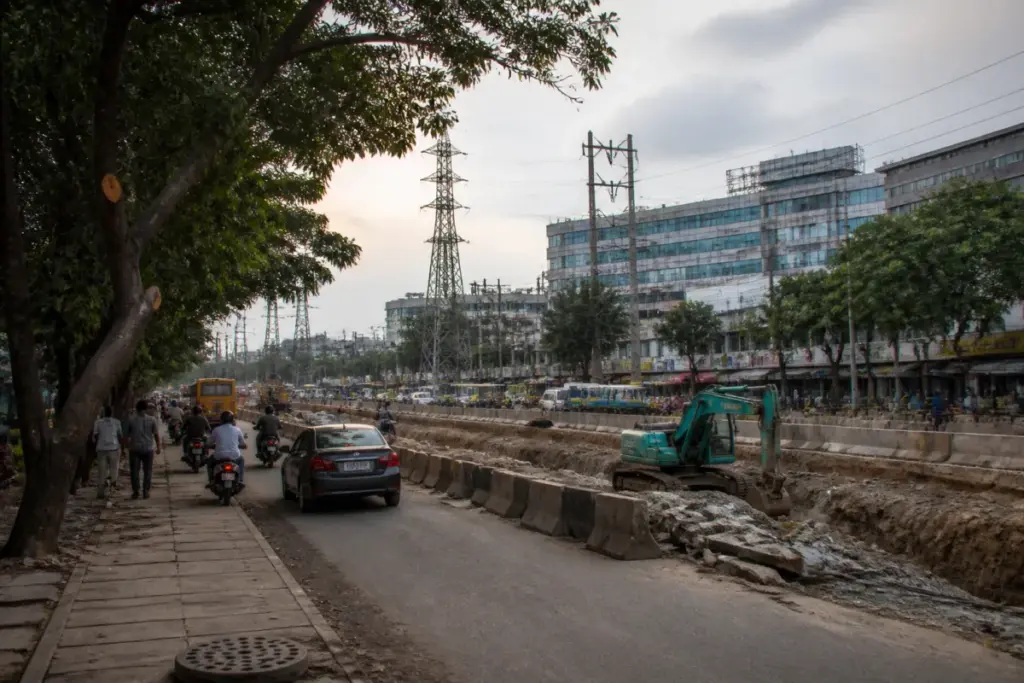
The Allwyn-Miyapur flyover is being advanced as a response to severe congestion in one of Hyderabad’s expanding urban corridors, but the project is also bringing a less visible infrastructure cost into focus: the likely removal of more than 350 mature trees. The proposed six-lane bidirectional flyover is intended to handle traffic growth up to 2045, while residents and environmentalists fear that its construction will remove a decade-old canopy and intensify heat along the corridor.
The project sits at the intersection of three pressures that increasingly shape Hyderabad’s built environment. The first is immediate mobility demand, reflected in the large volumes recorded at Allwyn and Miyapur junctions. The second is the expansion of the IT-linked urban corridor, which is increasing pressure on roads and junctions. The third is the limited space available for new infrastructure in an already developed environment, where road widening and grade separation can directly affect trees, utility lines, shops and pedestrian access.
According to the report by Telangana Today, the Cyberabad Municipal Corporation has begun advancing the project along the high-traffic Allwyn-Miyapur X Road corridor. Authorities say the flyover is required to ease daily congestion affecting more than 500,000 vehicles and to accommodate future growth. The project is expected to be completed by June 2028.
The scale of the traffic problem is reflected in recent vehicular surveys cited in the report. Peak-hour traffic reached 14,528 Passenger Car Units per hour at Allwyn Junction and 13,459 PCU per hour at Miyapur Junction. Passenger Car Units are used to express mixed traffic in a common measure, allowing cars, buses and other vehicles to be assessed together for road-capacity planning. These figures indicate that the two junctions are already operating under substantial pressure, even before the corridor’s projected growth is taken into account.
The proposed response is a multi-level grade separator with six lanes and bidirectional movement. Officials maintain that the project is designed to serve traffic projections through 2045. Their stated concern is that, without additional grade-separated capacity, the junctions could face severe gridlock within a decade. The project’s justification therefore rests not only on current delays but also on the expectation that demand will continue to rise across the expanding corridor.
That long-term planning horizon is central to the project’s logic. Building infrastructure for projected traffic is intended to prevent repeated reconstruction and congestion as development intensifies. However, the same long horizon raises a question about what the city is counting as infrastructure capacity. The road system is being planned in terms of vehicle movement, while the trees along the corridor represent another form of urban capacity: shade, environmental comfort and continuity in the public realm. The supplied report does not quantify those ecological services, but residents’ concerns show that the canopy is experienced as part of the corridor’s everyday infrastructure.
The likely removal of more than 350 mature trees has become the most contested element of the project. Residents have warned that the loss of the decade-old canopy could transform the route into a barren heat island. Environmentalists have described the issue as an example of the ecological cost of rapid urbanisation. These concerns are not separate from the transport project. They arise because the flyover is being constructed within an established urban corridor, where space for foundations, ramps, approaches and utility relocation overlaps with the existing tree line.
The project’s administrative process also shows how such conflicts are handled. CMC sources said that tree enumeration was conducted with the Forest Department and the Tree Protection Committee. Documents submitted in August included a signed relocation plan, an agency undertaking letter and a soil suitability certificate. However, final clearance was still pending at the time of the report. This distinction is important: tree enumeration and the submission of relocation documents indicate that the impact has been formally identified, but they do not amount to final clearance.
Relocation is consequently a key part of the project’s environmental response. The report refers to a signed relocation plan and a soil suitability certificate, suggesting that authorities are examining whether affected trees can be moved rather than simply removed. The supplied material does not establish how many trees would be relocated, where they would be planted, what survival rate is expected or whether all the affected mature trees are technically suitable for transplantation. Those details will determine whether relocation functions as an effective mitigation measure or only as an administrative condition.
The timing of construction has added to public concern. Excavation work has begun between trees along the route, prompting criticism from residents and local shopkeepers. The work has also disrupted commuter access. This creates a second layer of impact beyond the final tree count. Construction activity can alter how people reach shops, move along the corridor and access adjoining properties before the flyover is completed. For businesses operating at street level, the construction period is therefore part of the project’s immediate urban cost.
The project is also being implemented alongside major utility work. Authorities have initiated the relocation of water and sewerage lines and TGSPDCL electric poles in order to maintain the construction schedule. This indicates that the flyover is not a single road structure being inserted into an empty corridor. It is a coordinated intervention involving transport infrastructure, underground services and electricity distribution. Each relocation adds to the project’s institutional complexity and creates additional opportunities for disruption if the work is not sequenced carefully.
Utility shifting also helps explain why projects in built-up corridors can produce effects well beyond the footprint of the completed structure. Water and sewerage lines serve existing development, while electric poles support daily activity along the route. Moving them is necessary for construction, but it can require temporary access changes and coordination among several agencies. The report does not provide details of the relocation schedule or the agencies’ operational arrangements, so the extent of those disruptions remains unclear.
The institutional structure around the trees is similarly significant. The CMC is advancing the flyover, while the Forest Department and Tree Protection Committee are involved in the enumeration and clearance process. Other work relates to TGSPDCL electricity infrastructure and civic water and sewerage services. The project therefore requires decisions across multiple administrative systems rather than a single approval from the road-building authority. The pending final clearance shows that mobility urgency has not eliminated the environmental approval stage.
This is the policy landscape in which Hyderabad’s infrastructure expansion is taking place: traffic demand is measured in PCUs and vehicle volumes, project success is linked to a completion target, and environmental safeguards are processed through enumeration, relocation plans and suitability documents. These mechanisms create a formal framework for balancing competing needs. But the available report does not yet show the final conditions attached to the clearance, the approved tree-by-tree treatment or the monitoring arrangements that will follow construction.
The data available in the report presents a clear imbalance between what is measured and what is at risk. Traffic has been quantified at 14,528 PCU per hour at Allwyn Junction and 13,459 PCU per hour at Miyapur Junction. Vehicle demand is also described in relation to more than 500,000 vehicles using the congested system. The tree impact is expressed as more than 350 mature trees, but there is no equivalent assessment of canopy area, shade loss or the environmental performance of the relocation plan. That does not invalidate the traffic case, but it means the public debate is being conducted with more detailed evidence on mobility demand than on ecological loss.
The project’s 2045 design horizon adds another dimension. A flyover intended to serve traffic projections for nearly two decades will shape the corridor’s physical form for a long period. Its approaches, ramps and access arrangements will influence how people experience the road, where shops connect to the street and how much room remains for trees and pedestrian movement. The report establishes the intended traffic function, but it does not provide details of the final design, its pedestrian facilities or how the canopy will be treated along the completed corridor.
The larger urban question is not whether congestion should be addressed. The reported traffic volumes make the mobility problem clear. The question is how a city evaluates the full cost of solving it when road capacity is expanded inside an established neighbourhood. A project can improve vehicle movement while weakening shade, street comfort and local access during and after construction. Conversely, protecting every existing tree without addressing severe congestion could leave residents and businesses facing a different but equally real failure of urban infrastructure.
The Allwyn-Miyapur project has therefore become a test of whether Hyderabad’s growth systems can account for mobility and environmental performance together. The immediate facts are established: construction-related excavation has started, utility relocation is under way, more than 350 trees are at risk, final clearance remains pending and completion is targeted for June 2028. What remains to be clarified is the final clearance decision, the treatment of each affected tree, the enforceability of the relocation plan and the measures that will protect commuter and shop access during construction. Those details will determine whether the project’s environmental safeguards match the scale of its transport ambition.


