

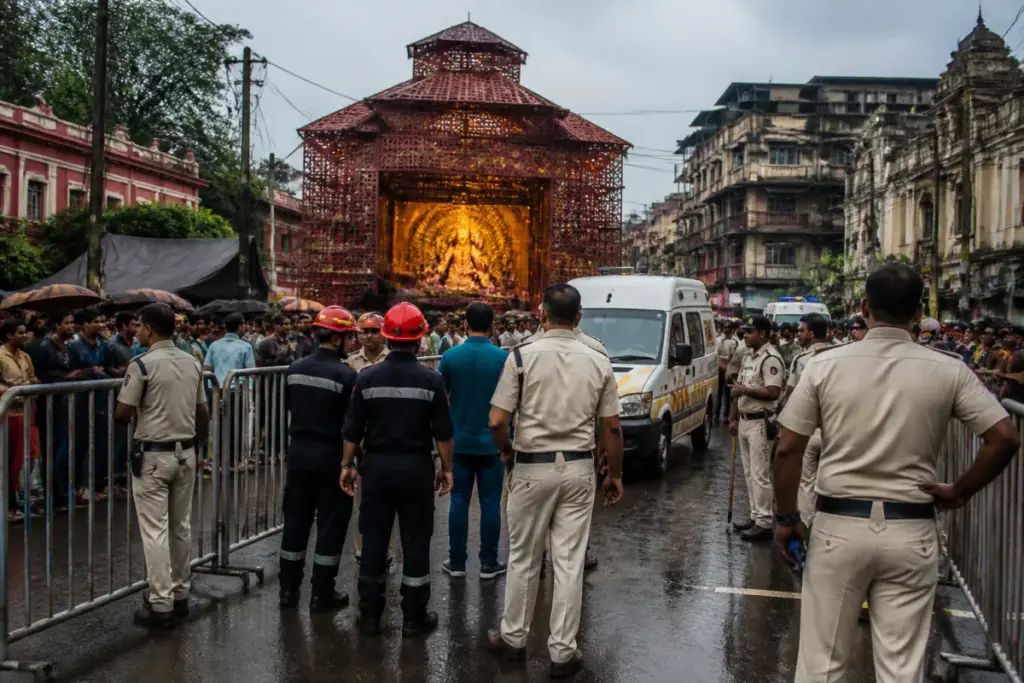
The Chorbagan festival-death incident has prompted visits to bereaved families, compensation payments and assurances of a full inquiry, according to a report by Sangbad Pratidin – Kolkata. The report attributes these actions and statements to Suvendu Adhikari, described in the report as the chief minister, but the identity and official designation require confirmation from an authoritative government or administrative source.
The incident reportedly took place on Saptami evening, when people had gone to see festival idols at Chorbagan. Among those reported dead was Priya Samaddar, a resident of New Barrackpur in North 24 Parganas. The report says a state representative visited her family home on Wednesday, spoke with relatives and offered condolences. It also says the family received financial compensation from the state government.
The same report identifies a couple from Baranagar, Dilip Ghosh and Dipali Ghosh, among the dead. It says the couple’s son met the visiting representative and received condolences. The report describes the family as grieving and states that compensation was handed over to the families of the deceased.
The reported visits are significant because they connect the immediate aftermath of a crowd-related death to the responsibilities of the state administration. Festival gatherings can bring together large numbers of visitors in confined public spaces, making crowd movement, access routes, emergency response and on-site supervision central to public safety. The supplied report, however, does not provide the number of people present, the precise location of the incident, the sequence of events, the number of deaths and injuries beyond the families named, or the operational arrangements at the venue.
The report quotes the person it identifies as the chief minister as saying that the Chorbagan incident was “unforgivable” and resulted from a “two-minute mistake”. It does not explain what the phrase refers to, which agency or individual was responsible for the alleged lapse, or whether the statement was based on a preliminary official assessment. Those details are important for distinguishing an established finding from an early political or administrative characterisation.
The report also says that a fact-finding team will collect information and that a complete investigation will be conducted. It refers to comments by the chief justice of the High Court that the state government could, if it wished, establish an inquiry commission led by a retired judge rather than a serving judge. The supplied material does not include the court proceeding, the chief justice’s full statement, the terms of reference for any commission, or confirmation that an inquiry has formally been constituted.
The institutional questions raised by the incident extend beyond compensation. A credible investigation would need to establish how the crowd entered and moved through the site, whether the venue had a documented capacity, how police and organisers coordinated, whether emergency exits and medical support were available, and how authorities responded once the incident began. None of these points is established in the supplied report, and they should not be treated as findings until an official inquiry or other documentary record confirms them.
The report further includes a political comment about conditions over the past 45 years and police recruitment under the Trinamool Congress administration. That assertion is not supported by figures or an official document in the supplied material. It therefore remains a political claim rather than verified evidence about police capacity or crowd-management preparedness.
For now, the confirmed editorially usable information is limited to the report’s account of visits to two bereaved families, the reported compensation, the promised fact-finding exercise and the possibility of a commission led by a retired judge. The identities of the official actors, the full death toll, the cause of the incident and the investigation’s formal status require confirmation from government, police, court or inquiry records before the account can be treated as fully verified.


