

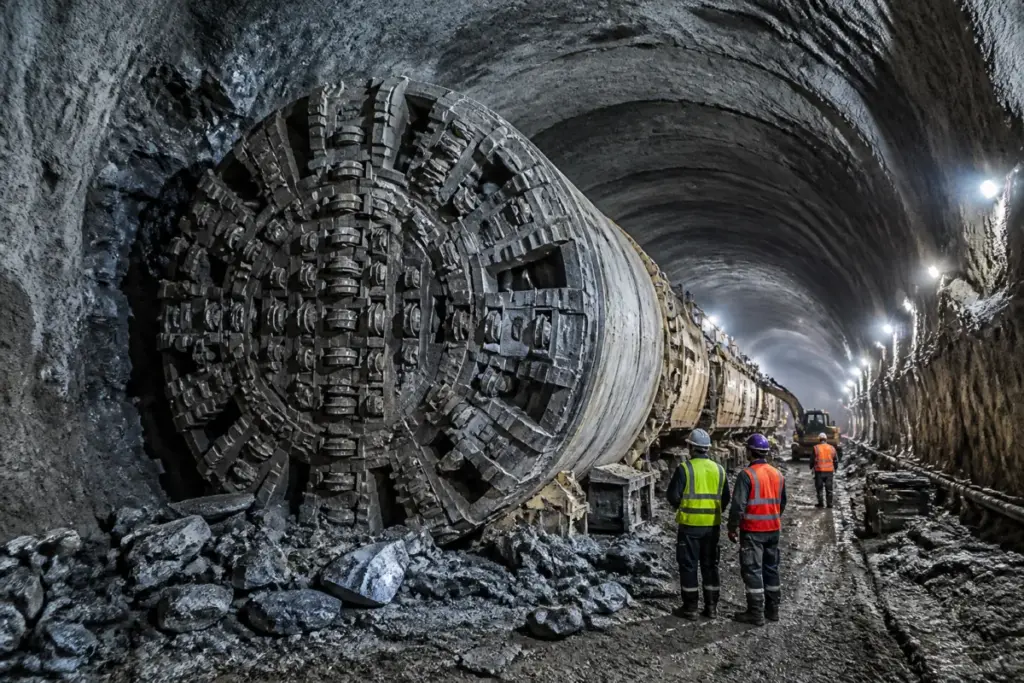
Mumbai’s Goregaon-Mulund Road tunnel project is progressing through hard Deccan basalt at an average pace of 5.5 metres a day, with excavation falling below three metres on some days as engineers adjust operations for safety. The Brihanmumbai Municipal Corporation has said the first tunnel boring machine, named Tulsi, has excavated 183 metres nearly two months after boring began.
The 6.65-km twin-tunnel system will pass beneath Film City and the forested hills of Sanjay Gandhi National Park before emerging at Khondipada in Mulund. The tunnels are a central part of the 12.2-km Goregaon-Mulund Road corridor, which is intended to provide a direct east-west road connection between Mumbai’s western and eastern suburbs.
The BMC expects the corridor to reduce the journey between Goregaon and Mulund to less than 20 minutes. The same trip can currently take between 60 and 90 minutes, depending on traffic. The tunnel component is estimated to cost around Rs 6,600 crore, while the wider GMLR project is estimated at approximately Rs 14,000 crore.
Of the total tunnel length, around 5.3 km will be excavated using tunnel boring machines. The remaining sections will be constructed through other methods. The first machine, manufactured in Japan, began operations on August 17. A second TBM is expected to start excavation later this month, with both machines planned to bore parallel tunnels carrying traffic in opposite directions.
Civic officials said the excavation is challenging because of the geology beneath the alignment. Much of the route passes through Deccan Trap basalt, a dense volcanic rock formed by the cooling of ancient lava flows. Its hardness and abrasive properties vary depending on its mineral composition, texture and degree of weathering, requiring engineers to monitor the cutting process closely.
“Beneath the surface, the Deccan Trap basalt varies in quality. The rock is hard, with thick, sharp edges. Owing to these formations, the TBM cutting efficiency is monitored carefully to ensure that stability and progress are not hindered. If the blades are not controlled then there are chances that they may get damaged during the operation,” an official told The Indian Express.
The tunnel’s depth will vary from around 20 metres to 160 metres. Officials said the deeper alignment was planned to reduce the impact on the forest, including tree roots and the water table, as the route passes beneath an ecologically sensitive landscape near Tulsi and Vihar lakes. The changing depth and non-linear alignment require the excavation path to be assessed continuously.
“Another factor that adds up to the challenge is the tunnel is going to have a variable depth, which means the digging is not being done by following a straight line. Therefore, every inch forward is being assessed even though the average rate of progress is above 5 metres, on some days, we could dig less than 3 metres because we need to slow down the process for safety reasons, again picking up the pace the next day,” the official said.
The BMC has planned a 21-month excavation period. It is targeting completion of the first tunnel by March 2028 and the second by June 2028. The civic body previously used a Chinese-made TBM, Mavala, for the 2.07-km Coastal Road tunnel connecting Marine Drive and Priyadarshini Park. TBMs have also been used for water-supply tunnels in Mumbai.
Officials said two machines were being deployed for GMLR because its tunnel section is substantially longer than the Coastal Road stretch. The next scheduled milestone is the start of excavation by the second TBM later this month.


