

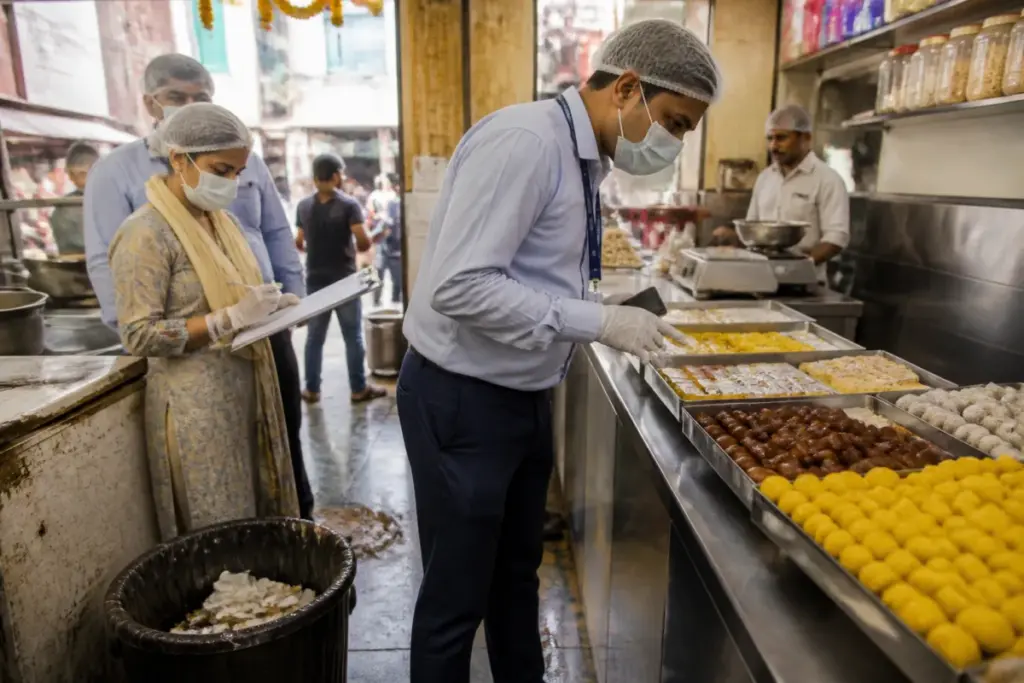
Delhi sweet shop raids have exposed more than unhygienic kitchens. The inspections reported by Jagran – New Delhi point to a larger governance problem: the food safety system is finding violations, but the available figures raise questions about what happens after samples are collected and notices are issued.
The Food Safety Department’s inspections on Tuesday reportedly found insects in storage areas, open waste bins, dirty equipment, inadequate personal hygiene and unsafe storage practices at several sweet shops in the capital. At some establishments, workers were handling food without gloves and proper sanitation. Documents relating to water and food product testing were also unavailable at certain premises.
These findings matter because sweets are not an occasional product in Delhi’s food economy. They are prepared, stored, displayed and sold through a large network of shops, especially during festival periods when demand rises sharply. The inspection findings therefore place the focus not only on individual establishments, but also on how the city monitors routine compliance across a dispersed and high-volume food retail system.
The reported inspection at Evergreen Sweet House in Okhla Phase II illustrates the problem at shop level. The storage area allegedly had a large number of insects, while employees were handling food without gloves and adequate cleanliness. The department collected samples of boondi dana and khoya from the premises. The report said that water and food material testing records were not available at the site.
Similar shortcomings were reportedly found at Kalighata Sweets, Bhikharam Chandmal, Aman Mithaiwala, Grover Sweet Corner, Methi Foods and Singla Sweets. The reported deficiencies included poor sanitation, weak pest-control arrangements and inadequate storage. At several locations, food safety licences were not displayed. Documents concerning packaging and employee training were also incomplete.
The significance of these observations lies in their repetition. The issue described in the report is not limited to one contaminated item or one isolated shop. It covers multiple stages of food handling: storage, equipment hygiene, worker practices, documentation, packaging and pest control. Each stage represents a point at which unsafe food can enter the consumer supply chain.
## What the Delhi sweet shop raids reveal
The inspection data cited in the report shows that Delhi’s food safety authorities examined 9,169 food samples between 2022-23 and 2024-25. Of these, 535 were found not to meet prescribed standards. The annual figures were 255 non-compliant samples out of 3,133 in 2022-23, 150 out of 3,412 in 2023-24 and 130 out of 2,624 in 2024-25.
The numbers show that non-compliance was recorded in each of the three years. The proportion declined across the period cited in the report, from about 8.1 per cent in 2022-23 to about 4.4 per cent in 2023-24 and about 5 per cent in 2024-25. That decline may indicate fewer failures among the samples tested, but the figures alone do not establish whether compliance improved across all food businesses or whether the mix and location of inspections changed.
The more serious institutional gap appears in the action that followed. The report states that only 38 cases resulted in convictions during the period and that just two licences were cancelled. These figures cannot be directly compared with the number of failed samples as a one-to-one measure of enforcement because a sample failure may lead to a process involving notices, laboratory procedures, hearings and adjudication. However, they clearly show that the number of recorded non-compliant samples was far higher than the number of convictions and licence cancellations reported.
That difference is the central public-interest issue. Inspection is visible and immediate: officers visit a shop, document conditions and collect samples. Final enforcement is slower and less visible. Unless the department regularly publishes the status of cases, the public cannot easily know whether violations led to penalties, corrective orders, prosecution, closure or no further action.
The report specifically raises this concern, noting that inspection drives are publicised while the final outcomes of cases are not presented with the same visibility. For consumers, this creates an information gap. They may know that raids took place, but not whether a shop found violating safety requirements was later penalised or whether it resumed operations after making changes.
## From inspection to accountability
Food safety enforcement in an urban setting depends on more than the number of raids conducted. It also depends on the chain that connects inspection to evidence, adjudication and compliance. The reported deficiencies in licences, testing records, packaging documents and staff training suggest that this chain involves both physical conditions and administrative records.
The absence of a displayed licence does not by itself establish that an establishment is unlicensed. Similarly, the absence of a report at the premises does not prove that testing never occurred. But such gaps make it harder for consumers and inspectors to establish whether a business is meeting its obligations. They also weaken the transparency of a system in which compliance depends on documentation as well as day-to-day hygiene.
The reported seizure of samples from Evergreen Sweet House is therefore important, but it is only an intermediate step. The public interest does not end with the collection of boondi dana and khoya. The relevant questions are whether the samples passed laboratory testing, what action followed if they failed, whether the shop was required to correct its practices, and whether those corrections were checked later. The supplied report does not provide those case-level outcomes.
The same limitation applies to the wider list of establishments named in the inspection report. The findings describe conditions observed during the raids, but they do not establish the final legal status of each case. Any account of enforcement must distinguish between an inspection finding, a failed sample, a prosecution, a conviction and a licence cancellation. Treating these as interchangeable would overstate what the available data proves.
## The seasonal pressure on Delhi’s food system
The inspections were reported in the context of festival purchases, when consumers buy larger quantities of sweets and demand moves quickly through retail outlets. This seasonal concentration increases the importance of storage conditions, production hygiene and product traceability. It also makes the timing of inspections significant, since authorities may be attempting to identify unsafe practices before or during a period of heightened consumption.
The report also cites the destruction of more than 4,100 kilograms of alleged adulterated or counterfeit khoya, paneer and chhena in September. At the Mori Gate khoya market, 22 of 30 khoya samples were reportedly found unsafe, while 19 of 59 ghee samples were unsafe and four were described as substandard. These figures point to risks not only inside retail sweet shops, but also within the upstream market from which ingredients are sourced.
The sample results from Mori Gate require careful reading. They concern the samples tested, not necessarily every product sold in the market. Even so, the reported concentration of unsafe or substandard findings indicates why ingredient markets are central to food safety enforcement. A retail inspection can identify poor storage and handling, but it may not by itself resolve whether the problem originated at the shop, during transport or earlier in the supply chain.
This distinction has direct implications for urban administration. Food safety risks move through networks of producers, wholesalers, markets, transporters and retailers. Enforcement that focuses only on the final shop may detect visible failures without fully identifying the source of unsafe ingredients. Conversely, action at wholesale markets may not correct poor hygiene at the point of sale. The available report documents both types of locations but does not establish how the department links cases across them.
## What the data confirms—and what it does not
The available evidence confirms four points. First, recent inspections found serious hygiene, storage and documentation deficiencies at multiple Delhi sweet shops. Second, food samples tested in the city were found non-compliant in each of the three financial years cited. Third, the report records a much smaller number of convictions and licence cancellations than non-compliant samples. Fourth, unsafe or substandard findings were also reported in khoya and ghee samples from Mori Gate.
The evidence does not establish the exact reasons for the difference between sample failures and convictions. It does not provide the number of prosecutions initiated, the time taken by individual cases, the penalties imposed, the number of shops that complied after inspection or the number of repeat offenders. It also does not show whether the two licence cancellations were connected to the 535 non-compliant samples cited for the three-year period.
Those missing details are not minor administrative information. They determine whether inspection operates as a deterrent or merely as a periodic detection exercise. A city can increase the number of inspections and still leave consumers uncertain if the outcomes remain difficult to track. Conversely, a lower number of convictions may reflect procedural requirements rather than inaction, but that explanation would need to be demonstrated through publicly available case data.
The reported decision by the department to collect samples and document deficiencies represents the first stage of enforcement. The next stages—laboratory results, notices, hearings, penalties, corrective measures and follow-up inspections—are what determine whether the intervention changes conditions. Without those outcomes, the public sees the exposure of risk but not the resolution of risk.
Delhi’s sweet shop raids have consequently become a test of administrative transparency as much as food hygiene. The immediate findings show where the system is failing at shop level. The three-year figures show that non-compliance continues to be detected. The conviction and licence-cancellation figures raise a further question about enforcement capacity and disclosure. The department’s case-wise follow-up, the results of the newly collected samples and the final action against the inspected establishments will determine whether this inspection drive produces lasting compliance or remains another publicly visible raid without a publicly visible conclusion.


